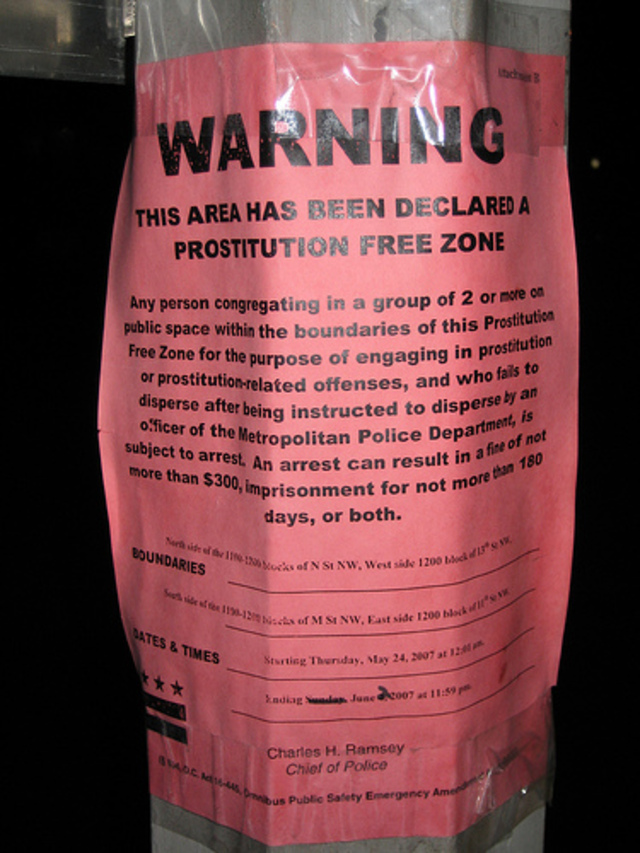
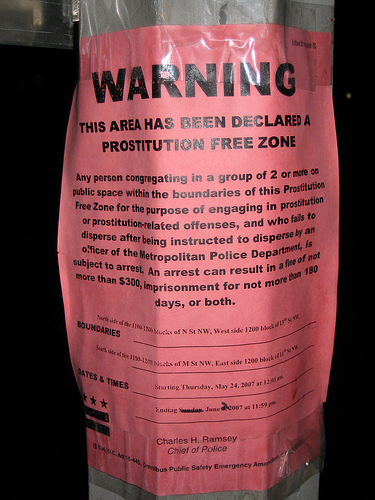
 Photo by rmb.
Representatives from the Office of Attorney General and the Metropolitan Police Department both voiced support today for a bill that would repeal “prostitution free zones,” which advocates say open transgender women of color to harassment and do more harm than good.
“Let there be no doubt that the administration supports strongly the policy goal of combatting and reducing prostitution and the related risks in the District in every legal and practical way possible,” said Andrew Fois, Deputy Attorney General for the Public Safety Division Office of the Attorney General for the District of Columbia. “We also commend the Council for reexamining the legality and effectiveness of tools to address these important public safety problems. We have substantial concerns about the constitutional soundness of the prostitution free zones law as well as doubts about its practical utility. MPD supports repeal and has not established a prostitution free zone since OAG expressed its constitutional issues in January of 2012.”
One of the reasons OAG supports the repeal, Fois said, is the high standard of proof required to show intent to engage in prostitution. The other deals with how prostitution has changed with technology.
“A second reason to support repeal of prostitution free zones, and MPD was consulted and is here for its operational expertise on these points, is the changing nature of prostitution and its enforcement. With the emergence of the Internet, prostitution has to some extent moved off the streets and into on-line services. Though still a problem, average annual calls for service for prostitution are down from the period when the Act was before the Council,” he said.
According to MPD, an arrest has never been made under the law and a “prostitution free zone” has not been declared in over a year. While it does not exercise this power, the city currently has the ability to declare these zones for 20 days, meaning “it is unlawful for a group of two or more persons to congregate in a public space or property in that area for the purpose of engaging in prostitution or prostitution-related offenses.”
The reasoning for repeal from Cyndee Clay, executive director of HIPS — a D.C. organization that “promotes the health, rights, and dignity of individuals and communities impacted by sexual exchange” — focused on the unintended negative effects the zones have on sex workers. Instead, Clay said the city needs to take a “comprehensive” and “compassionate” approach. This could include decriminalizing sex work.
“Offer people hope, respect, and options, not fear of arrest,” Clay said. “It’s a process not an event.”
Activist Ruby Corado of Casa Ruby testified as to how the zones disproportionally and negatively hurt transgender women of color: “They are supposed to be addressing a problemm but instead they’ve created a nightmare for transgender women of color.”
A task force that examined MPD’s handling of hate crimes found, “The mistreatment of transgender individuals — and particularly transgender women of color — by police officers is among the most frequently cited and egregious examples of bias and misconduct.” The bill was introduced by At-Large Councilmember David Grosso, in part, because of the report’s findings.