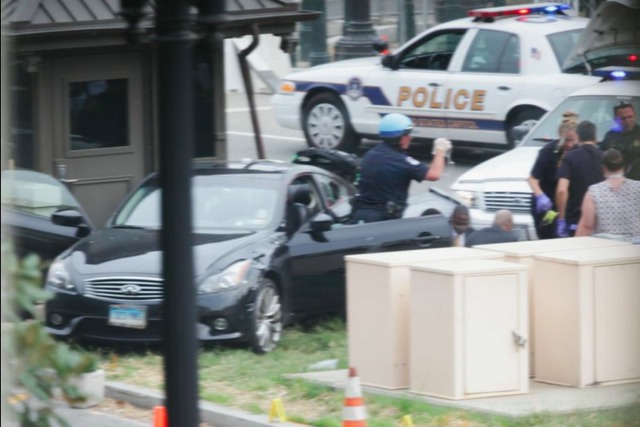
 Getty Images.
No charges will be filed against officers from the Secret Service and Capitol Police in the shooting death of Miriam Carey, the woman who led law enforcement on a chase around Capitol Hill after driving into a White House checkpoint last year.
The decision comes after a “comprehensive review” by the U.S. Attorney’s Office for the District of Columbia and the Metropolitan Police Department, according to a release, “which included interviews of more than 60 witnesses and careful review of all crime scene evidence, ballistics reports, scene and traffic video footage, photographs, the autopsy report, and other evidence.” Investigators concluded there was insufficient proof that officers used excessive force “or possessed the requisite criminal intent at the time of the events.”
Carey was shot in her vehicle near the Capitol in October 2013. Her young child was in the backseat. Her family has argued that she took a wrong turn into the White House and that police should have ended their pursuit of Carey for safety reasons.
“Now that the criminal inquiry has concluded, the Carey Family will continue with its fight for Miriam’s and her minor child EF’S rights,” the family’s attorney Eric Sanders said in a release. “The United States Attorney’s legal position has not changed the Carey Family’s legal position. Again, after an exhaustive review of all publicly available data, the Carey Family has concluded the shooting of Miriam Iris Carey was ‘NOT JUSTIFIED.’ The closing of the criminal inquiry will now open the opportunity to obtain further data from various government agencies to support the Carey Family’s legal position.”
Here’s the release from the U.S. Attorney’s office outlining the events of that day.
The U.S. Attorney’s Office for the District of Columbia and the Metropolitan Police Department conducted a comprehensive review of the incident, which included interviews of more than 60 witnesses and careful review of all crime scene evidence, ballistics reports, scene and traffic video footage, photographs, the autopsy report, and other evidence. After a thorough review of all the evidence, the U.S. Attorney’s Office concluded that the evidence was insufficient to prove beyond a reasonable doubt that the officers who were involved in the shooting used excessive force or possessed the requisite criminal intent at the time of the events.
The investigation covered a chain of events that took place on Thursday, Oct. 3, 2013, between 2:13 p.m. and 2:20 p.m., a time span of just seven minutes. During that period, Ms. Carey confronted officers at three locations – one at the White House and two near the Capitol.
At 2:13 p.m., Ms. Carey, 34, of Stamford, Conn., drove into a well-marked, restricted White House checkpoint at 15th and E Streets NW, without authorization and without stopping. After seeing Ms. Carey refuse to stop at the direction of two uniformed Secret Service officers, an off-duty U.S. Secret Service officer placed a metal bike rack in her path to block Ms. Carey’s exit. Ms. Carey then struck the bike rack, and the off-duty Secret Service officer who was standing behind it, knocking both the bike rack and the officer onto the ground. The incident at the White House checkpoint lasted about 30 seconds.
Ms. Carey then drove down Pennsylvania Avenue at speeds estimated at 40-80 mph, while weaving through traffic, and ignoring red lights.
Four minutes after leaving the White House checkpoint, Ms. Carey arrived at Garfield Circle, one of two traffic circles in front of the U.S. Capitol. She drove into the circle going against the flow of traffic, almost hitting another vehicle head-on. Ms. Carey then turned her vehicle towards the permanently-affixed black barriers that block vehicular traffic on the pedestrian walkway that leads to the steps of the U.S. Capitol. The pursuing law enforcement officers blocked Ms. Carey’s exit from the left, right and rear of her vehicle, attempted to open her locked doors, and issued multiple commands for her to exit the vehicle. Ms. Carey then put her vehicle in reverse and rammed the marked cruiser that was positioned behind her vehicle.
After ramming the cruiser, Ms. Carey drove forward onto the sidewalk, forcing officers to run out of Ms. Carey’s path to avoid being struck by her vehicle. It was at this point, as Ms. Carey drove on the sidewalk between the wall that borders the U.S. Capitol lawn and the tree boxes on the sidewalk, that two U.S. Secret Service police officers and a U.S. Capitol Police officer fired eight rounds at Ms. Carey. Investigators do not believe that Ms. Carey was hit by any of these rounds. Ms. Carey then drove back around Garfield Circle, against the flow of traffic, and headed towards Constitution Avenue. The incident at Garfield Circle lasted approximately 35 seconds.
The U.S. Capitol, the U.S. Supreme Court, and other buildings within the Capitol square were put on lockdown in response to the “shots fired” report. With continued reckless and evasive driving, Ms. Carey traveled along the north side of the Capitol and headed towards the Senate and House office buildings. A U.S. Capitol Police officer who was responding to the scene in his cruiser slammed into one of the barriers that had just been raised in response to the lockdown order, causing what sounded like an explosion that was later reported by witnesses. The cruiser was totaled and the officer had to be airlifted to the hospital for treatment of his injuries.
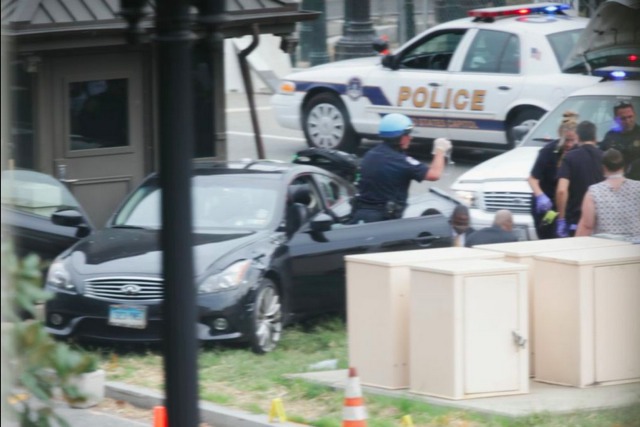
Approximately one minute after the shooting at Garfield Circle, Ms. Carey arrived at the manned U.S. Capitol Police Truck Interdiction Point at 2nd Street and Maryland Avenue NE. With raised barriers blocking her path, Ms. Carey made a sharp left, drove up a curb, over the center median, and struck an unmarked Supreme Court police officer’s vehicle that had stopped in front of the Hart office building. After ignoring multiple commands given by officers who were running towards her vehicle with guns drawn, Ms. Carey revved her engine and then reversed her vehicle and drove directly at a U.S. Capitol Police officer who was approaching Ms. Carey’s vehicle from behind. As the U.S. Capitol Police officer ran towards the median to avoid being struck by Ms. Carey’s vehicle, he and another officer from the U.S. Secret Service (who also had fired shots at the Garfield Circle location) started firing. The two officers fired nine rounds each. Twenty seconds after Ms. Carey had arrived at the 2nd and Maryland location, her vehicle crashed into the kiosk and came to rest. Ms. Carey was unconscious at this time, and did not get out of the vehicle. No additional rounds were fired by officers after the crash.
After the shooting and after Ms. Carey’s vehicle crashed into the kiosk and came to rest, the officers on the scene discovered that there was a young child in the vehicle. They carried the child from the car. The child, who was not seriously injured, was taken to a hospital.
Medical personnel arrived on the scene and attempted to revive Ms. Carey. She was transported to a hospital, where she was pronounced dead. Ms. Carey sustained five gunshot wounds to her neck and torso area, one of which was fatal. She was not under the influence of illegal drugs or alcohol, and no weapon was recovered from inside her vehicle.