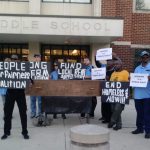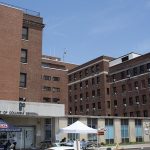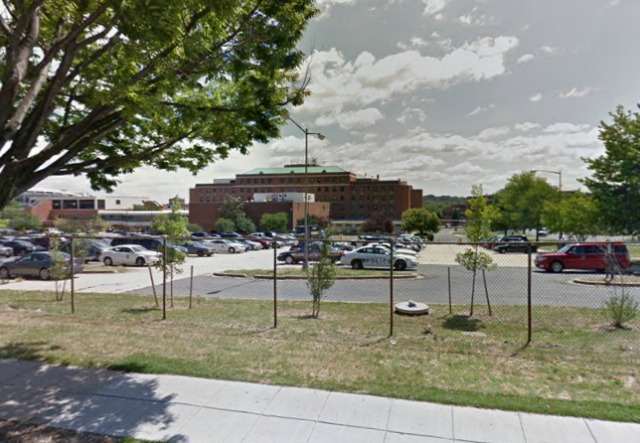
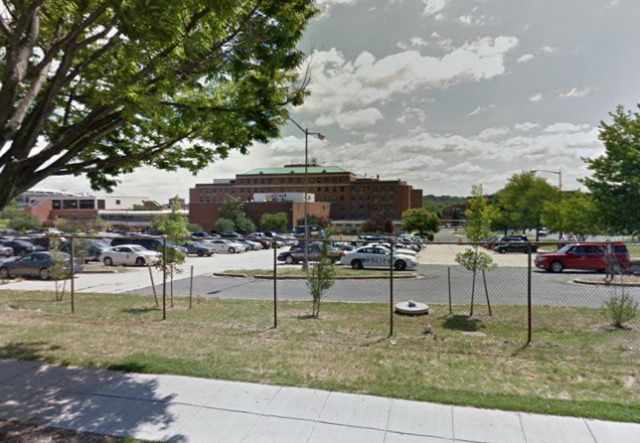
 The D.C. General Hospital building, which is now used as a homeless shelter. Photo via Google Street View.
The D.C. General family homeless shelter will likely stay open through next year, city officials testified yesterday, as an effort to find housing for 500 families in 100 days fell short of its goal.
The Council’s human services committee held a hearing yesterday on the city’s 500 Families, 100 Days program, which did not meet its goal. Indeed, there was even disagreement between Department of Human Services officials and Councilmembers yesterday about what the goal of the effort was — to identify units or actually place people in them.
“We worked aggressively to get the word out,” Deborah Carroll, interim director of DHS, said of the 500 Families, 100 Days program. This included focus groups, a launch event, and ads in the Washington Business Journal. As of July 9, 532 units were identified for the program. However, only 459 passed the initial screening stage. At the end of the 500 days, 198 families had been housed and 261 units were ready to be matched with families.
Carroll said an average of 40 to 45 families exit shelter per month. With recent modifications, that number has increased to between 50 and 60. But according to the D.C. Fiscal Policy Institute, it needs to be 100. “We’re confident these numbers will continue to increase,” she said.
Councilmember Jim Graham, who chairs the human services committee, said he didn’t “want to diminish” the program’s successes, but he was hoping the shelter would be close to empty at the end of the 500 days. Graham has called many times for the closing of D.C. General, but based on the testimony yesterday that does not seem likely until 2016.
While Carroll said “we’ve learned a lot over the past few months,” she couldn’t provide an “assurance” that by next winter D.C. General wouldn’t look like it did this year: Full. “We will fill vacant rooms at beginning of hypothermia season,” Carroll said.
Carroll said the Council has to do something to reduce the number of families seeking shelter during hypothermia season, when D.C. is required to provide it. This could mean a return to provisional placement, meaning families are not guaranteed shelter unless they can prove they have no other options.
This summer, DHS has not placed any homeless families in shelter, as there isn’t space and there’s no mandate. “We’re just very successful at diverting them during this period of time,” Carroll said.
“If you want to call that a successful effort at diversion, you can do so,” Graham said. “But I think it’s just simply that they’re not being admitted.” Graham said he’s aware of two families who are “dying” to be placed in D.C. General.
Carroll said DHS’s goal is to empty the hotels and be 50 families below capacity at D.C. General by the end of September. Hypothermia season begins in November, and the next fiscal year’s budget does not provide funding for hotels for homeless families. For fiscal year 2014, the city was able to find other funds to pay for shelter overages. That overage is not being anticipated for next fiscal year.
“We are working on a plan with the [Interagency Council on Homelessness] and the Department of General Services to replace D.C. General,” Carroll said. “Under the best of circumstances, it will not happen before the end of this year. Our goal is 18 months.” The process includes identifying the number of units needed and finding a location.
Indeed, once a family enters shelter, figuring out how to get them out becomes more complicated. Carroll said immediate affordable housing, good housing stock that can quickly be matched to families and job assistance is needed.
“And yes, it’s very hard. It’s hard for us, and it’s hard for our families.”