
 Via IFC Films.
The biggest film of the summer isn’t adapted from a comic book, nor does it contain any explosions—Michael Bay’s name isn’t even anywhere in the credits. Instead, it’s a quiet, meditative indie film that took 12 years to make.
Richard Linklater’s Boyhood isn’t just an impressive piece of American independent summer, it’s a monumental achievement in filmmaking. Shot over the course of twelve years, the tells the story of Mason Jr. as he grows from a precocious six-year-old into a unique 18-year-old as he begins his freshman year of college. But the character of Mason Jr. isn’t played by multiple actors of varying ages—instead, Linklater filmed parts of movie for a few weeks every year, so that, as we watch the story of Mason Jr. and his family (which includes his divorced parents—Ethan Hawke and Patricia Arquette, along with sister Lorelei Linklater), we’re watching the actors age and develop as the characters do.
On the surface, Boyhood is the story of Mason Jr., but it’s not really a story, it’s more of a series of vignettes cobbled together to depict how certain experiences shape our lives over the course of time. Recently, DCist sat down with Linklater to discuss how he turned this 12-year experiment into Boyhood.
This interview has been slightly edited for length and clarity.
DCist: How did your filmmaking process—or you as a filmmaker—change during the 12 years of making this film?
Richard Linklater: Believe it or not, I didn’t want to evolve at all. At least not for this story. It was like: here is the tone, here is the story, here’s what it should feel like. I did a bunch of other films during the interim [of making this film], and if I grew it all, it was during those films.
DCist: Not even during the editing process did you grow at all?
RL: I mean, I kept working on it. Am I better in the editing room in year 12 than I was in year one? Am I a better storyteller? I hope, but still, that didn’t step outside the film itself. It was just one thing. Even though, in a way, it was 12 things. Every time we shot, the tonal consistency was obviously a big concern. I didn’t really answer your question, did I?
DCist: No, no, you did. I meant did you…
RL: Would I do anything differently? Am I happy with how it came out?
DCist: No, not really that. I meant looking back on the footage during editing, did any revelations about your filmmaking process come to you?
RL: Ah, yeah, between making this movie and then kind of having to articulate what it is. I think I had to go to a new level, probably. I don’t know how that will reflect anything else, but it certainly gave me some confidence.
It was a big leap. It was a kind of a theoretical thing that I felt strongly about, but you never know. I could always be wrong. But it feels confirmed at the end when it goes according to plan.
DCist: I can imagine setting out to make a film over the course of 12 years, that you probably encountered problems you hadn’t planned for. What were some of the biggest hurdles in making this film?
RL: I didn’t really look at them as problems. I just knew, to do this, you’re kinda stepping into a world where you’ve accepted an unknown, random future as a collaborator. So I chose not to look at it as “what could go wrong?” but that it’s going to be an ever-shifting thing. I knew what I was trying to do. I knew the tone. I think that’s the director’s job in storytelling: tone and knowing the feel of what you’re going for.
Most of us are control freaks, but I couldn’t know everything. But I looked forward to that, I looked forward to having those ideas as we went. I’m pretty process-oriented, so I chose to think of it all as a positive experience. I was excited to watch the kids grow up and going where they went and discovering things. It was an exploration, for sure. It almost didn’t feel like a film, but some kind of a cinematic life process. I was trying to tell a very specific story about this family and about life. It was really just an accumulation of intimate moments, I guess.
DCist: One would argue that it’s a direct reflection of life, as you’re sort of telling experiences, rather than a story.
RL: Yeah, moments of, what I hope the audience perceives as, reality. I mean, it’s not [reality]. It’s not a documentary, it’s not improvised. It’s a huge construct, but I wanted to convey the story and feelings via this artifice that I wanted to feel real.
Cinema is such a powerful medium, such a powerful recorder of that reality—and the way people perceive. I tried not to break that connection by having a bunch of false notes and things you maybe didn’t believe or seemed too trumped up—which they work in other movies—let’s face it. But, for this, I thought the way [audiences] would identify is by caring about the family. It’s hard to describe that, it’s something about the power of cinema.
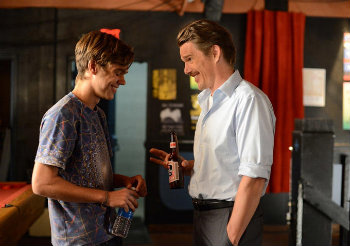 Via IFC Films.
DCist: A lot of people have called this an achievement in cinema. When you first conceived this film were you cognizant that you were doing something that really hadn’t been done before?
RL: It definitely felt like we were heading out into uncharted territory, but as a navigator, I really felt I knew where we were going. I really did, I thought it would work.
And I didn’t know for sure it hadn’t been done. I’m a cinephile and I’d never seen something like this. but I kind of thought that, by this point, if someone had said “oh yeah, Argentina 1958 to 1969 or something, you haven’t seen that movie?” and i’d lie and say “of course I’ve seen that!” But that hasn’t happened yet.
I think the closest I’ve come is, I was in London and someone told me that apparently [Stanley] Kubrick was circling this idea in two different projects: In Napoleon, he was going to film Al Pacino over many years as Napoleon, and on A.I., something about a kid growing up, he needed him to age. But, he never did it because I think, to do this, you’re giving up the control that most filmmakers are used to.
DCist: Which is?
RL: Just control over anything. We’re control freaks by nature. Your collaborator on this for 12 years is a random, unknown future, which can be a little unnerving. You can look at that fearfully, like “what if someone dies?” or “what if someone quits?” But is that a way to go through life?
I’m as much a control freak as everybody else, but I’ve always had this kind of playful relation to whatever’s happening that I can kind of incorporate it [into my work]. So I thought if Ellar ends up a 300-pound football player, it wouldn’t alter the tone, but [the film] would be kind of about that. I was set in the tone and what I was trying to communicate, but I wasn’t so absolutely set on a kind of detail like that I can’t totally control.
So, you give up that, but then it’s exciting. It’s a really creative collaborator—the unknown future—but you just have to be attuned to it.
DCist: In this film, and in many of your others, location plays such an integral role to the tone.
RL: Geography is a big structural device in our minds.
DCist: How does a setting or location affect your screenwriting process?
RL: Depends on the project. I had films early on that had kind of a vague everywhere feel. In Dazed & Confused, there’s no town, but it feels like it could be everywhere. Everywhere, USA. But at some point you have to pick license plates for the cars, so I said “alright, let’s do Texas.”
But over the years I’ve gotten more specific. I like the specificity of saying “this is Texas.” Geography—for what I was going for [with Boyhood]—was very important to have that communication with the audience feel very real. I wanted it to, at least, feel real to the characters. They’re in a real place, they’re in a real culture, they’re in a real geography.
I think that’s really important. And that goes for the cues for the modern world—all the things that kind of tap into the culture of the moments. Well, a little bit. It’s not really about that, but there it is in the backdrop to a life, so I wanted to get all that right. All that’s important.
DCist: Speaking of culture, you’ve always had a knack for carving out pop culture nuances in the foreground of your films. How much did pop culture inform your decisions through the filming process?
RL: It’s funny because I’ve already run into a bunch of 19-year-olds who’ve seen the movie—not that 19-year-old men are flocking to see indie films en masse—but the ones who have at certain screenings are just kind of flabbergasted. They’re like “that’s my life!”
DCist: So was that all sort of premeditated? Like “I’m going to do this film about this boy’s life, but it’s also going to be the story of culture in the early aughts?
RL: No, I never said it would be the story, I just said it would take place during this time. You have to pitch it on a practical level, and I said “at the end of the day, I think we’ll have an older audience”—whatever the graying art-film audience is. But I think for a young person, it’ll be interesting. You forget how nostalgic an 18-22 year-old can be, because they’re still kinda confronting an adulthood that’s still coming into focus.
Even though it’s only 12 years in the past, it’s a lifetime for you. If you’re 20 years old and you’re thinking back to nine, that’s more than halfway through your life. And to an adult, that’s 11 years. That’s nothing. It’s all relative. I always was aware of how those signifiers work on a young psyche, because I remember it. I remember it so well.
So I thought that that would be a fun possibility if you could portray it accurate enough. And it doesn’t take much—a snippet of a song, a video game, maybe one you didn’t play, but one your friend played. Something close to home that’ll make you say “oh! I remember that!”. We have no choice but to look for connection in our perception of the world. That’s what the human psyche is always doing. We’re pattern-seeking. When you see something familiar to you, it registers in a way that’s trying to make sense of the world. A little of that can go a long way, I think.
DCist: The great thing about this film is how it’s a kind of snapshot of pop culture in the past twelve years, but it never ever feels nostalgic, especially at a time where nostalgia is so fetishized in websites like Buzzfeed constantly publishing articles like “X Reasons Why The ‘90s Were Awesome.”
RL: Heh, we’re already there, huh? I’ve lived that from the ‘50s on. I was in the ‘70s when the ‘50s became cool. We had a ‘50s day at high school, and the ‘50s were before any of us were born; we were nostalgic for is an era that didn’t exist in our lives, but it must’ve been better than the present, because the present obviously sucked. So, my uncle pulled me aside and said “hey, you guys think the ‘50s were really great or something, but they really sucked.”
DCist: I read a quote somewhere that basically said “every generation thinks that the previous generation was cooler than the one they’re a part of..
RT: I know! I’ve seen it many times! Wow, we’re already into thinking how cool the ’90s were?
DCist: But that’s what’s great about this film—it captures the zeitgeist of the early aughts without ever coming across as forced or fake. People can watch it years from now and say “oh, that’s what they ‘00s were like.”
RL: Well, it couldn’t ever fetishize the past, because it was filmed in the present. I knew I was doing that in the present as we shot it. I kept thinking “this is going to look so funny ten years from now. I guarantee this computer is going to get a smile because it’s just too big.” I knew it was changing rapidly. You just know it’s all fleeting.
My little observation at the end of this whole run is that I was really more surprised how little things from the outer culture changed—hairstyles, clothes, cars, etc.. I think in the post-Internet era, there so much change going on—via computers and this interconnectedness—that’s so rapid and so evolving that everything else we’re kind of saying “we don’t need a lot of change here, because it’s happening so much everywhere else.”