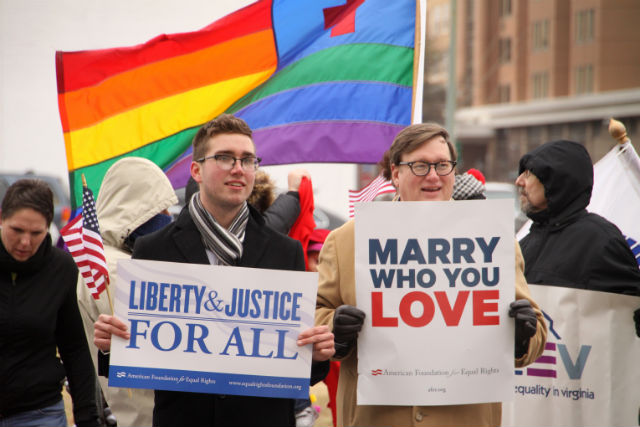
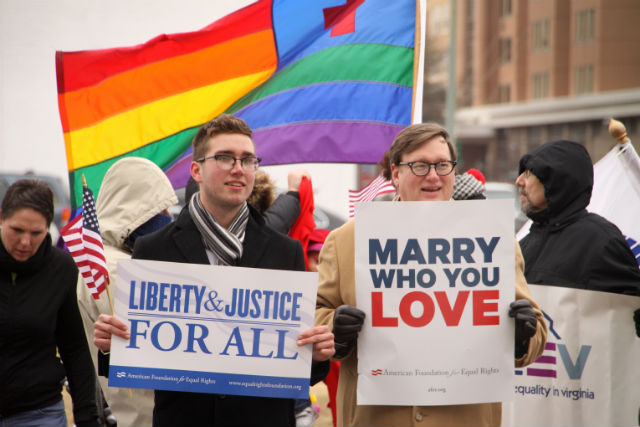
 Spencer Geiger (left) and Carl Johansen protest for equal marriage outside the Walter E. Hoffman U.S. Courthouse as oral arguments in the case of Bostic v Rainey proceed on February 4, 2014 in Norfolk, Virginia. (Photo by Jay Paul/Getty Images)
Another court has ruled Virginia’s ban on same-sex marriage is unconstitutional.
In a 2-1 decision, the U.S. Court of Appeals for the Fourth Circuit upheld a previous ruling by the U.S. District Judge Arenda L. Wright Allen.
“It concludes that the fundamental right to marriage includes a right to same-sex marriage and that therefore Virginia’s marriage laws must be reviewed under strict scrutiny. It holds that Virginia has failed to advance a compelling state interest justifying its definition of marriage as between only a man and a woman,” Judge Henry F. Floyd wrote for the majority. “In reaching this conclusion, however, the majority has failed to conduct the necessary constitutional analysis. Rather, it has simply declared syllogistically that because ‘marriage’ is a fundamental right protected by the Due Process Clause and ‘same-sex marriage’ is a form of marriage, Virginia’s laws declining to recognize same-sex marriage infringe the fundamental right to marriage and are therefore unconstitutional.
“Stated more particularly, the majority’s approach begins with the parties’ agreement that ‘marriage’ is a fundamental right.”
In February, Judge Allen found that Virginia’s same-sex marriage ban violates the Due Process and Equal Protection Clause of the Fourteenth Amendment. Today’s ruling does not legalize marriage in Virginia, as it was stayed until a mandate is released. That could be at least 21 days. It applies to the entire Fourth Circuit: Maryland, North Carolina, South Carolina, Virginia and West Virginia.
“We recognize that same-sex marriage makes some people deeply uncomfortable,” Floyd wrote in the ruling release today. “However, inertia and apprehension are not legitimate bases for denying same-sex couples due process and equal protection of the laws. Civil marriage is one of the cornerstones of our way of life. It allows individuals to celebrate and publicly declare their intentions to form lifelong partnerships, which provide unparalleled intimacy, companionship, emotional support, and security. The choice of whether and whom to marry is an intensely personal decision that alters the course of an individual’s life. Denying same-sex couples this choice prohibits them from participating fully in our society, which is precisely the type of segregation that the Fourteenth Amendment cannot countenance.”
The ruling can be read here.
“Today is yet another victory for the principle of equality that is so central to the American experience, and I am proud that the Commonwealth of Virginia is leading on one of the most important civil rights issues of our day,” Attorney General Mark Herring, who declined to defend the ban, said in a statement. “The Fourth Circuit, the 10th Circuit, and every federal district court that has considered the question since Windsor has reached the same conclusion we did about the Constitutional guarantee of marriage equality. But this is about much more than who wins or loses in court. We should never lose sight of the fact that we are fighting for the right of loving, committed couples to enter into the bonds of marriage. These fellow Virginians are asking the Commonwealth to convey to them the same rights and responsibilities that every other couple enjoys. They are asking to be treated equally, and if our Constitution guarantees anything, surely it is that.”
This story will be updated.