By 2040, D.C. wants to 75 percent of commuters to travel to D.C. via a mode other than a car. The MoveDC plan in its current form includes incentives like better bike and transit infrastructure and disincentives like a toll to enter downtown at certain times.
But what the city can’t control is businesses offering their employees free parking. A recent study from Virginia Tech highlighted by CityLab shows that, when D.C. area commuters are offered free parking, they overwhelming choose to drive rather than using transit.
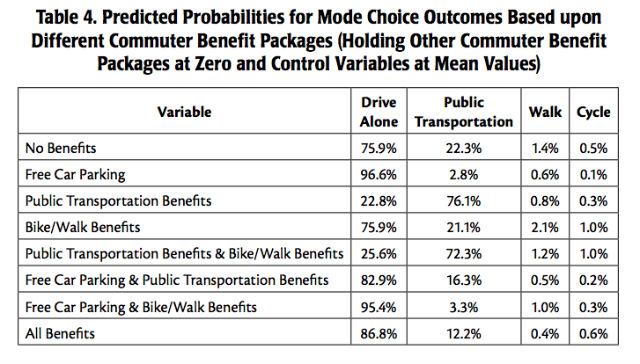
On the flip side, when transit benefits are offered, commuters will chose public transportation over driving. When both free parking and transit benefits are offered, 82.9 percent of commuters are going to drive.
Here’s what study authors, Andrea Hamre and Ralph Buehler, concluded.
Overall, our results support earlier findings in the literature that suggest com- muter benefits for walking, cycling, and public transportation may be effective at supporting TDM objectives. Free car parking tends to be associated with more driving to work, public transportation benefits tend to be associated with riding public transportation, and trip-end facilities at work such as showers/lockers and bike parking tend to support walking or cycling. Our results also add to the literature by presenting an evaluation of the joint supply of benefits. While benefits for alternatives to driving are associated with individuals choosing to walk, cycle, and ride public transportation, free car parking is associated with driving, and the joint provision of free car parking along with these other benefits may blunt the efficacy of efforts to get commuters to walk, cycle, and ride public transportation to work.
The survey looked at the modes used by 4,630 “adult full-time workers living in the urban core or inner suburbs.”