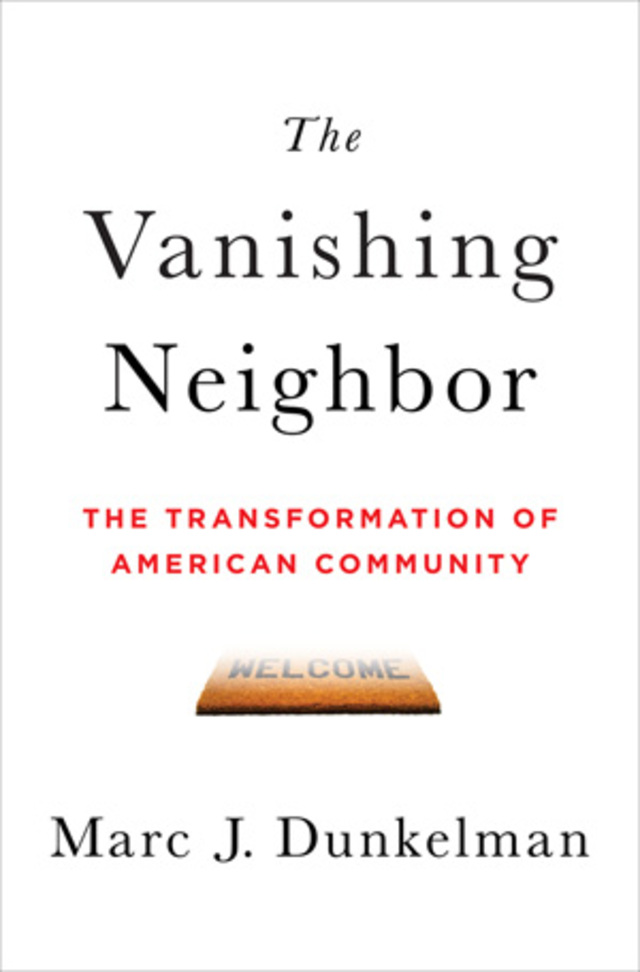
 When Robert Putnam first wrote about declining civic participation and people trading bowling leagues for just “bowling alone,” Mark Zuckerberg was still in middle school. So how have American social lives changed since then? Marc Dunkelman will address this at Politics & Prose on Monday, August 11th in discussion of his new book, The Vanishing Neighbor: The Transformation of American Community (Norton, $25), at 7 p.m.
Dunkelman writes—and political thinkers like Alexis de Tocqueville and Charles Murray agree—that “neighborliness” is a key feature of American exceptionalism. Sure, plenty of countries appreciate hospitality, but the “proverbial cup of sugar” between neighbors was considered a uniquely American concept. Along with driving a neighbor to the doctor or watching their kids, “voluntary assistance between unrelated people” marks a certain level of intimacy with one’s middle “ring” of social connections.
Yet these neighborly favors might not feel so familiar anymore. Dunkelman suggests that our inner, middle, and outer rings have blurred due to the Internet and social media, and being a neighbor means something different today. Among other evidence, he presents anthropological research showing that a human brain can really only accommodate a “personal village” of about 150 people, a number exceeded by many Facebook friend lists. Consequently, our personal villages’ available “slots” tend to be closed off.
But don’t worry, The Vanishing Neighbor says! We’re still figuring out how to use technology to our collective advantage. We are just in a transition period, where we should learn how to apply the richness of “yesterday’s institutions” to twenty-first century innovation.
This is important to do, the author explains, because we are currently feeling the pains of this transition without a stronger sense of community. For example, our society is more integrated than ever, but we are less aware of what is going on with those around us, political cooperation is stifled, and the economy is hurting. Mindful action is needed to improve the trajectory.
Dunkelman is a senior fellow at the Clinton Foundation and a research fellow at Brown University. He has written for the Washington Post, the Wall Street Journal, National Affairs, and Politico. He lives in Providence, Rhode Island.
The event is free.