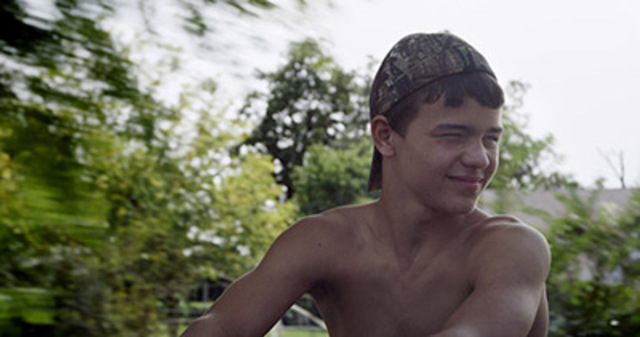
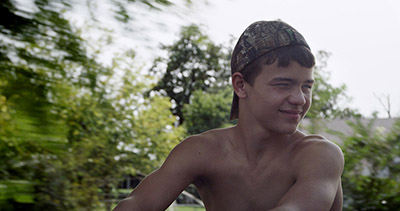
 Andrew (The Orchard)
The documentary Rich Hill begins with contrasting views of small town America. Fourteen-year old Andrew’s dimly lit home is right by the train tracks, and you can hear the train passing from inside the house. This is the kind of place where an impoverished kid in the Ozarks has to live. Directors and cousins Tracy Droz Tragos and Andrew Droz Palermo cut to the idealized view of small America: the town sign — RICH HILL POPULATION 1,396; the shiny public school with its fresh-faced cheerleaders; the man riding a tractor, working the farm. It’s a seductive image of American life, but for many, it’s an unreachable dream. Rich Hill shows the harrowing reality of life in Rich Hill, Mo. and its devastating effect on children.
Rich Hill focuses on three boys — Andrew, Appachey and Harley — providing intimate access to their dreams and, mostly, their heartbreaks. Andrew’s father is a Hank Williams Sr. tribute artist, and another filmmaker may have tried to run with that. But the emphasis here is rightly on Andrew, a young man who somehow remains self-possessed while his family moves from one small town to another. He’s the only boy here with a father figure. Appachey, whose father abandoned his family, tells us that people expect good things from him in the future, but he says this in a body language that expresses nothing but defeat. He’s 12-years-old.
The filmmakers play on assumptions the viewer may have about the poor. When we meet Harley we’re told that his mother is in jail, but we’re not yet told why. At first you may assume neglect, something that led this kid to his violent, unstable personality. We eventually learn that his mother is in jail for attempting to kill her husband after he molested his stepson. Withholding this information isn’t just dramatic license; we see Harley struggling to tell the camera crew, and the viewer, about his abuse, and he can’t face the camera when he finally tells the filmmakers he was raped. We can’t face him either, but we can’t look away.
The film depicts living conditions that anyone reading this would consider terrible, only to hear someone say, “We have it better now.’ Appachey’s mother, who seems rough with her son, tells the filmmakers that when she had her first child at 17, she went from childhood straight to adulthood. She comes to the heartbreaking realization that she never had any hopes or dreams, and she never will.
Co-director Andrew Droz Palermo is also the film’s cinematographer, and his compositions and natural lighting are gorgeous, giving these impoverished characters a visual dignity while not shying away from difficult living conditions. Throughout the film, the filmmakers observe these small town residents celebrating Independence Day, setting off fireworks sometimes photographed in an impressionistic blur that recalls Beasts of the Southern Wild. These beautiful images send a hard message: this is America, the filmmakers seem to say, the country we live in and celebrate, the people she has thoroughly defeated still in love with it. It is a beautiful country, and Rich Hill is a beautiful, heartbreaking film. But its beauty also suggests a plea to the viewer: how do you keep America beautiful?
—
Rich Hill
Directed by Andrew Droz Palermo and Tracy Droz Tragos
Unrated
Running time 91 minutes
Opens today at West End Cinema and the Avalon