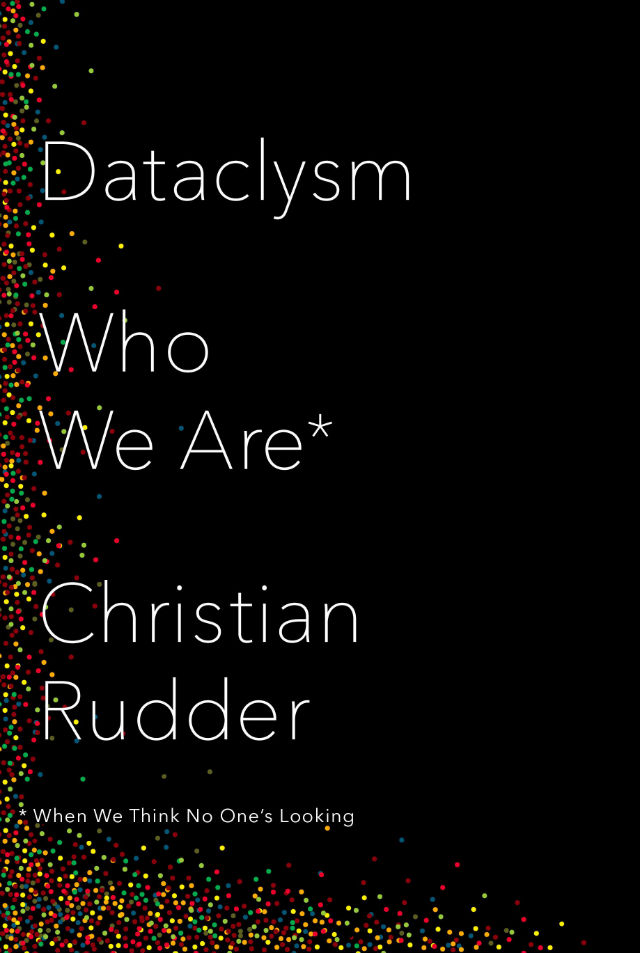
 Online dating: great for meeting your soulmate and helping to research the human condition. OkCupid co-founder Christian Rudder has analyzed a lot of data from the site’s compatibility surveys, and he puts it together in Dataclysm: Who We Are When We Think No One’s Looking (Crown, September 2014). He will speak about the book with Megan Garber of The Atlantic at Sixth & I Historic Synagogue Monday, September 22 at 7 p.m.
Rudder launched OkCupid with three co-founders in 2004, and it now has 30 million members. New users answer as many questions as they want to calculate their “match” score with fellow members on a 100-point scale. This accomplishes OkCupid’s goal of “getting you talking to someone,” Rudder says.
But survey results can only be as honest as respondents are with themselves. Add in user rating and messaging data, and Rudder is able to see the difference between what we say and what we do. Dataclysm also explores trends from Facebook, Twitter, Google, Gallup, Craigslist, and other dating sites.
Statistics might never be as approachable, funny, or fascinating as they are in this book. Rudder addresses the controversy of Big Data, but points out that it can tell a side of the story that has long been ignored. Going forward, he writes, history won’t only be told by the loudest or most famous people. The experiences of the masses are now available in a way they weren’t before.
Everyone loves visual data, and there is tons of it in Dataclysm. The book expands on the concept of OkCupid’s blog, OkTrends, which looks at dating behavior through self-reported and observed data. The chapters are divided into three main themes: “What Brings Us Together” (like our attraction to extremes, how we bond on and off Facebook, and men’s shared affection for 20-year-olds); “What Pulls Us Apart” (how different races describe themselves, how we’re less accepting than we think, and fast-escalating Twitter rage); and “What Makes Us Who We Are” (digital “gaydar”, online popularity contests, and how we pay in “Likes”).
Some findings are optimistic. A study of words used on Twitter shows that we are adapting to write with more meaning, and feedback from OkCupid’s blind date experiment suggests that in person, looks don’t matter that much. Some of it is just interesting, like how long people take to write the perfect pick-up email on OkCupid. Elsewhere, you’ll wince through evidence of prejudice in Google searches and dating sites.
Could data possibly drive change after exposing our true selves? “Data is going to sway opinions,” Rudder tells DCist, as it provides clarity and current numbers. But he warns against asking the question, “What is the data good for?”
“Knowledge, period, is good,” he says, and will help inform choices.
A main takeaway from Dataclysm is the potential for big data not just in marketing or surveillance, but for answering human interest questions. Rudder explains that it “supplements and enhances old-school behavioral science,” and “must be used in conjunction with intuition.”
Since OkCupid’s forte is love and sex, Dataclysm has a couple of lessons for single readers. For example, Rudder tells DCist that one of their most telling survey questions is whether or not you like horror movies. “Close to 70 percent of long-term couples answer the same way,” he says, and adds that it’s a similar rate to answers about belief in God.
Rudder studied mathematics at Harvard and was creative director at TheSpark.com (part of SparkNotes) before starting OkCupid. He plays in the indie rock band Bishop Allen. Rudder is married and writes in Dataclysm that he has never used online dating services.
Tickets can be purchased over the phone or online, for $14 each or two are free with a book purchase ($28). Doors open at 6 p.m., and a Q&A and signing will follow the discussion.