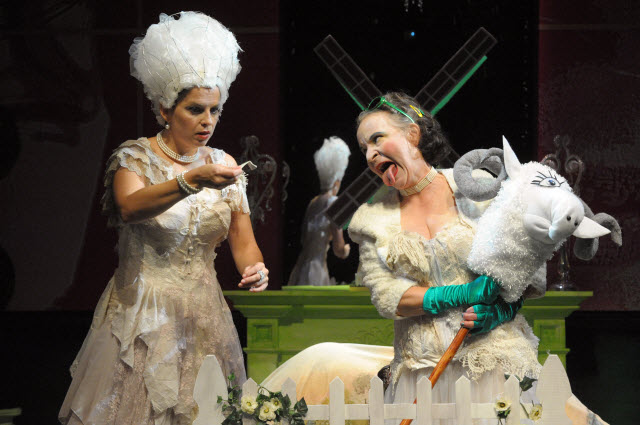
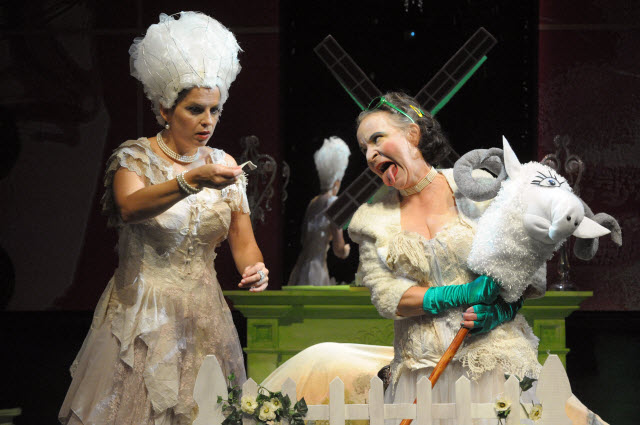
 Kimberly Gilbert and Sarah Marshall in Marie Antoinette. Photo: Stan Barouh
By DCist Contributor Jonelle Walker
Sarah Marshall has had the kind of career that drama school graduates salivate over. In her decades on the D.C. stage, Marshall has added a diverse cast of characters to her repertoire, ranging from the warm Barbara Apple in Studio Theatre’s Apple Family Plays to Grusha, a grumpy maid, in Shakespeare Theatre Company’s The Government Inspector. Somehow, Marshall has also managed to fit in prestigious teaching positions at Georgetown University and Duke Ellington High School for the Performing Arts. All the while, she’s amassed a staggering 17 Helen Hayes Awards nominations, taken the stage at every major house in town, and rightfully earned a place among the city’s most respected actors.
The accomplished performer’s latest project is Woolly Mammoth Theatre Company’s season opener, Marie Antoinette. David Adjmi’s play takes on a contemporary telling of the fall of the young queen, done in by an indulgent aristocracy and a public image problem. Marie Antoinette’s dubious quip — “Let them eat cake!” — serves as inspiration for Woolly’s 35th anniversary season, which seeks to explore the dividing line between haves and have-nots. Marshall, a member of Woolly’s acting company, is frequently featured on their stage and will also appear in the final production of the season, Robert O’Hara’s Zombie: The American.
DCist spoke with Marshall over the final weekend of rehearsals for Marie Antoinette, in which she plays The Sheep. The show runs through October 12.
You’ve had an incredible career on the D.C. stage and as a longtime Woolly Mammoth company member. What was your first production with Woolly Mammoth?
The first production I ever did with Woolly was a play called The Vampires by Harry Kondoleon in 1988. I think I became a company member in 1990 or there about.
How has Woolly grown and developed in your time with the company?
I was thinking about this actually watching rehearsal the other day. Woolly has been able to grow so amazingly in terms of the physical productions of the show. I think the acting has always been fine. We have such a great community of actors in D.C. and the company. The company itself has grown, and I know [Artistic Director Howard Shalwitz] is committed to using acting company members in every show. And now, as the theater has become deservedly successful through the years, the physical productions can also shine.
In this production, you get to work with fellow Woolly company members Kimberly Gilbert and Dawn Ursula. How has that informed the rehearsal process?
I have never worked with Dawn before, and so we are having a great time getting to know one another. I am only on stage with her ever so briefly, unfortunately, but we have lots of dressing room time together and we will both be in the Zombie play [Zombie: The American] at the end of the season. As to Miss Kimberly Gilbert, this is my fifth show with Kim and I do adore her. We are easy and comfortable with one another on stage. Lots of trust built up over the years.
Though the Occupy movement is slowly becoming as much a memory as the infamous one-percenter herself, how does Marie Antoinette speak to the Occupy generation?
If the aristocracy represent the very rich and Wall Street, perhaps these people are clueless as to how the rest of the world is living? What would it take to change that? Revolution? Only if something catastrophic were to happen I suppose. In Marie Antoinette we see this sort of childlike innocent clueless ruling class who are so out of touch. Might this speak to the Occupy generation? Maybe so. Maybe they will have some kind of catharsis when the Aristocracy is guillotined.
What does “Let them eat cake!” mean to you?
[It] infuriates me actually. Marie Antionette never said that. That was all part of the smear campaign against her to make the “people” hate her and it fueled the revolution.
It seems that Marie Antoinette raises a clash of modern values: disgust for the decadent leisure class versus support for strong, independent heroines. How does your character interact with that conflict? How does it strike you as a female artist?
I don’t think Marie was all that independent actually. She was brilliant and trained into the world she lived in. She was murdered and she was innocent. She was a victim of an amazing smear campaign. They made up all kinds of hateful things about here because she was a woman and a “foreigner.” I have learned so very much about her doing this production. An amazing and fascinating woman. Is she a hero? Not so sure about that. But I have tremendous sympathy for her and can’t really blame her.
The character that I play I do believe was written for a male to play. I love that [Director Yury Urnov] and Howard wanted to use a woman in the role. The Sheep is quite strong and rather wise and is not caught up in the drama of the court. The Sheep tries to warn Marie, but can’t save her. I love how this already female-centric play is made more so by having The Sheep be played by a woman. Let’s tip the balance wherever and whenever we can, I say! I’ve been lucky to be cast in male roles a good deal. That’s the truth!
What should audiences know about Woolly’s 35th season?
The season has major overtones of the trouble our society and world is in here in 2014. I am in this show and the one at the very end of the season. Both are mirrors — crazy Woolly Mammoth mirrors — held up to society. I don’t know the other plays, but I imagine they will do the same.