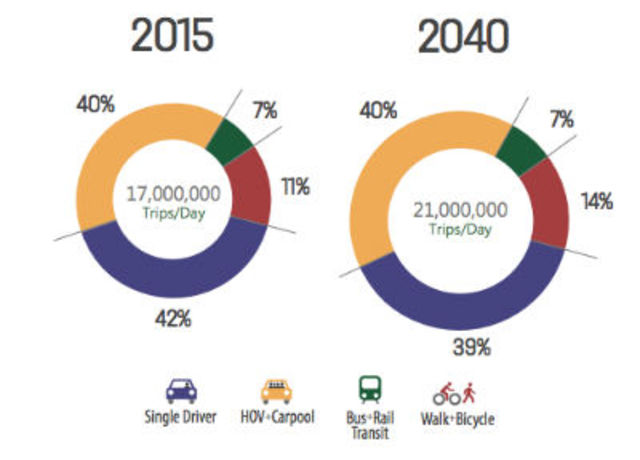
 Daily travel, mode share.
A long-term regional transportation plan that includes streetcars, commuter rail and road widening is projected to decrease trips by single drivers while cycling and walking — as well as morning congestion — increases.
The analysis [PDF] by the National Capital Region Transportation Planning Board “uses forecasts of future population and job growth patterns along with the system of roadways and transit planned in the [Constrained Long-Range Transportation Plan] to predict future changes in travel patterns and travel conditions.” The plan looks at all the major transportation projects (more than 500!) scheduled for the D.C. area between now and 2040.
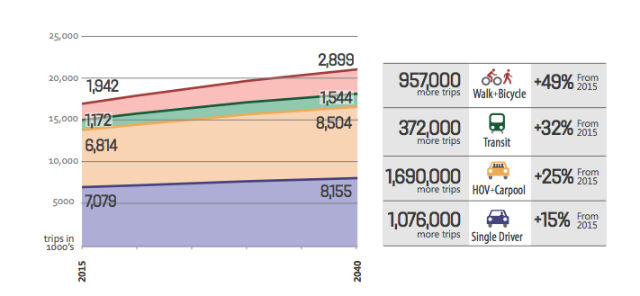
With the region’s population estimated to grow by 25 percent between now and 2040, the total number of trips taken is projected to grow by the nearly the same percentage. That breaks down to about four million more trips taken per day across all modes. Each mode will see an increase in users, but single driver travel will grow slower than the other modes (carpooling, transit and walking/cycling.)
That’s just part of the good news found in the analysis: A three percent decrease in driving per person “measured as vehicle miles traveled”; a four percent decrease in commutes taken by single drivers; and a 27 percent increase in jobs accessible by transit.
 .
.
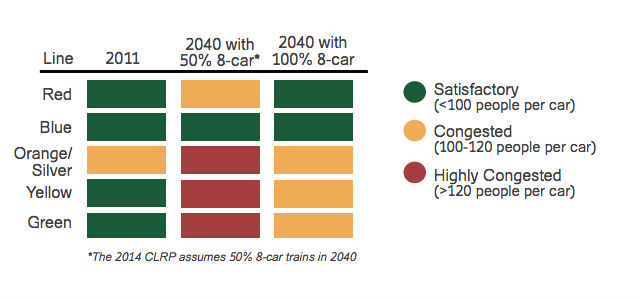
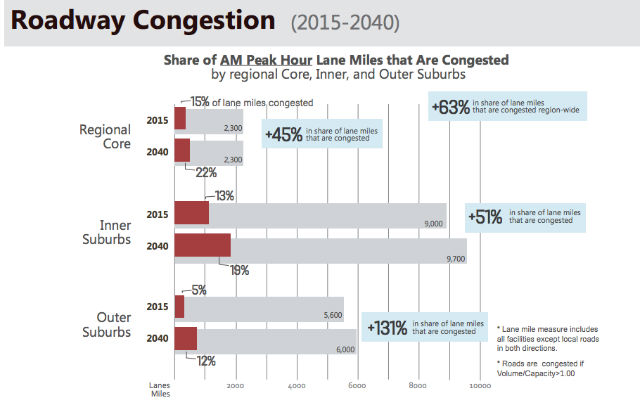
But there’s bad news, as well. Growth is projected to “outpace future highway and transit capacity, meaning morning rush hour congestion is anticipated to grow on both systems.”
Just take a look at this Metro projection.
And this one for roadway congestion.
But all is not lost! From the Metropolitan Washington Council of Governments:
Officials noted the plan update does not currently include funding for all 8-car Metro trains during rush hour or station improvements, which are priorities in Metro’s Momentum Plan and the TPB’s Regional Transportation Priorities Plan. Similarly, the region’s localities have identified roadway improvements that could further reduce congestion that are also not in the plan.