Rachel Kurzius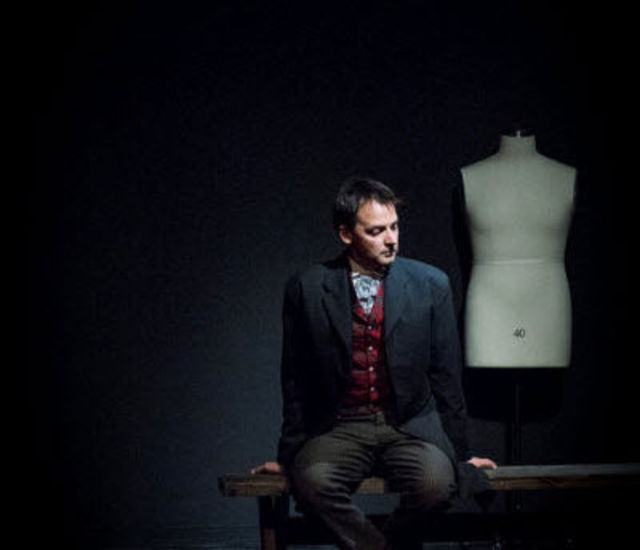
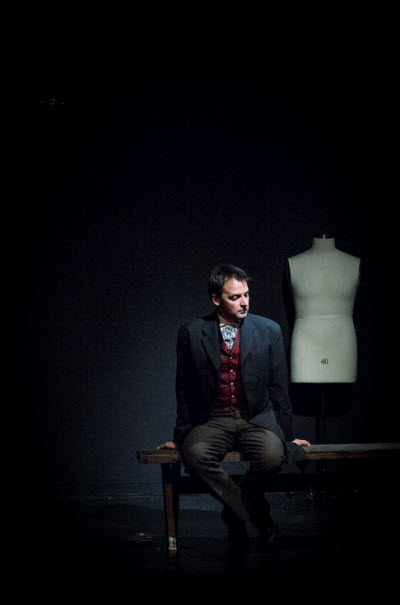 Marcus Kyd as the Devil. Photo by Teresa Castracane
By DCist contributor Rachel Kurzius
Keyser Soze said “The greatest trick the devil ever pulled was convincing the world he didn’t exist,” but he’s wrong. Humans rely on this personification of evil far too much for him to just disappear. As The Devil in His Own Words demonstrates, the greatest trick the devil ever played was being so goddamned relatable.
“Good” characters run the risk of being boring. Stories from East of Eden to Snow White and the Huntsman have goody two-shoes protagonists that possess none of the magnetism of their story’s anti-heroes. After all, how can an audience relate to someone imbued with omniscience or unerring purity? At least the story of a character succumbing to temptation is accessible, and even the embodiment of villainy—the devil himself— can be sympathetic.
The Devil in His Own Words, playing at the Capitol Hill Arts Workshop through October 4, understands this. A decade ago, the one-man show’s star Marcus Kyd read Paradise Lost while looking for a monologue. He found the Devil instead. Inspired, Kyd created a show that weaves together works of scripture and literature depicting the Dark Lord through the ages. The Taffety Punk Theatre Company formed to produce the show.
The currently running production of The Devil in His Own Words is a remount of Taffety’s debut play, and marks the company’s tenth anniversary. Kyd returns for his role as the Devil, though he only briefly dons the horns and pointed tail of modern Satanic lore. Most of the time, he simply wears a dapper embroidered suit.
Kyd carves out the stage in the Black Box Theater with zest, using accents, props, lighting, and music cues to differentiate the many versions of the Devil that he embodies throughout the show. He returns to some of these versions of the Devil again and again, including a hilariously sardonic Satanic stand-up comic at the front of the stage and a contemplative guy trying to talk to his old friend Cain on a bench upstage left. Other incarnations, like a Safeway shopper with creeping menace and a literally hellish manager, we only meet once.
Lise Bruneau’s adroit direction makes it clear when Kyd shifts to a new iteration of Satan, but trying to guess all of the references that appear on stage is a bit like reading T.S. Eliot without footnotes. Translation: good luck. That’s okay, though, because attempting to identify each source misses the point.
So then, what is the point? This conceit could get tiresome — Kyd running around the stage, alternating between sitting and standing, putting on and taking off his jacket, and adopting new accents in loosely-related skits — but it works.
Kyd’s textual sources become entirely different characters, each feeding off our preconceived ideas about Lucifer, Beelzebub, the Chief of Demons, and the Son of the Morning. The conversation on stage is one-sided, as any one-man play is bound to be, but these various interpretations are in dialogue with each other. And of course, any conversation with the Devil might really be a conversation you’re having with yourself.
It’s one-off conversations with Jesus and Moses where Kyd really plays the Devil’s advocate. These good guys have a lot in common with Satan, according to the Dark Prince himself: God made them sacrifice everything and then abandoned them. Despite only hearing the Devil’s portion of these conversations, they feel fully realized and convincing.
The Devil paints a picture of God as someone likely crooning “You Only Hurt the Ones You Love” on heaven’s stoop. Because really, is this how you treat your archangel, or your man on the ground, or your son? “If he wanted me to obey, I would have obeyed,” the Devil tells Moses. If God is all-powerful, then isn’t the world exactly as He wants it? Even if you don’t leave the play with sympathy for the Devil, you have to wonder why God let him turn our world into his playground.
The Devil in His Own Words becomes an intense, theological take on meeting an old friend who was characterized as a monster after a rough break up, and coming to wonder if maybe their ex was the real jerk. But in making us question the goodness of God, is this play just another trick of the Devil?
The Devil in His Own Words plays through October 4. Tickets, $15, are available here.