 Photo by Ronnie R.
“Show me where the Europeans are, Jorge.”
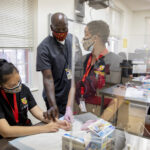
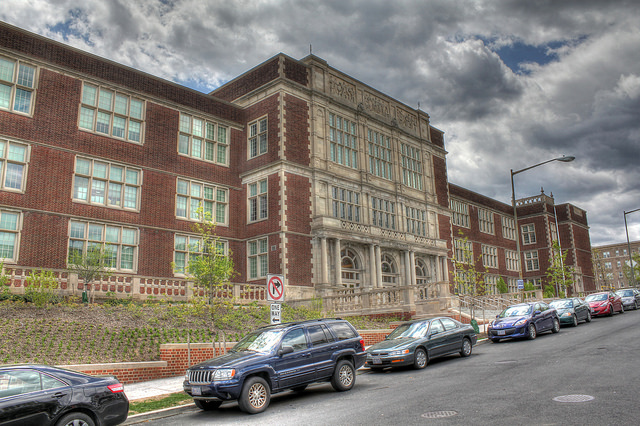
Inside an International Academy classroom at Francis L. Cardozo Education Campus, a teacher directed a student to place a sticky note on a projected painting of Christopher Columbus arriving in America. The exercise was part of a U.S. history lesson on the explorer that included English vocabulary words like clothing and gun. “Barco” one student said aloud, trying to help another student who was directed to identify the ship.
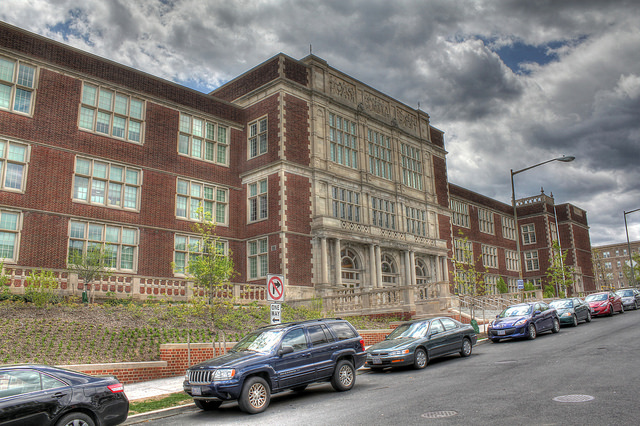
These students are part of Cardozo’s International Academy, instituted at the D.C. high school this year to better serve an influx of children in need of English Language Learner (ELL) support. Part of the Internationals Network for Public Schools, the research-based program is tailored for students who have newly arrived in the U.S.
Dr. Tanya Roane, principal of Cardozo for the past three years, said the school has seen a “huge shift in demographics” over the past year. The International Academy was started to “address the needs of our students,” she told officials, including Chancellor Kaya Henderson, at a presentation yesterday.
During Roane’s first year at Cardozo, 133 ELL students qualified for support. By August 2013, that number had grown to 177, and by the end of the year the number was over 265. The vast majority of the students who arrived after the school year began were at a beginning level.
Last October, school officials, including Chief of Special Education Dr. Nathaniel Beers, observed the INPS academy at T.C. Williams in Alexandria. “The things that we saw in that building — the engagement of the students, the way they were having academic conversations — were things that, when I had come here, despite all work that the teachers were doing, the types of conversation were much less rigorous,” Beers said. “We needed to change that.”
Just one month into the school year, 164 in-boundary students are enrolled in the Academy, with 200 spots available. Associate Principal Megan Sands, who oversees the program, expects the Academy to be at capacity by December. What happens after that — and how to scale the program in different ways for different schools — will be explored in the coming months.
The students are primarily from El Salvador, Honduras and Guatemala, but also from the Dominican Republic, Ethiopia, Mexico, Burma and Vietnam. The most commonly spoken language is Spanish, with Amharic, French, Rohingyar, Vietnamese and Tigrinya also represented. A whooping 75 percent of the students are male, and many have been in the U.S. for less than one full academic year.
Grouped into teams, the ninth and tenth grade students are taught in English while paired with a fellow student who speaks the same language to provide support. The goal, Sands said, is to increase the heterogeneity of the Academy, which forces students to use English.
“We teach them the language while they are learning the content,” Sands said. Teachers who work with the same teams are in constant communication, and are working toward making interdisciplinary connections between all the courses, including math and environmental science. Foundational courses are also available for students with gaps in their formal education.
DCPS hopes to expand the Academy to serve 11th grade next year and 12th grade the year after that.
Cardozo, Columbia Heights Education Campus and Roosevelt Senior High School have the greatest population of secondary students in need of ELL support. While the region has seen a huge influx in children arriving illegally from Central America, DCPS is legally prohibited from asking students about their immigration status. “We support all of our students, regardless of their immigration status and are proud of our diverse student population, which includes children from all over the world,” DCPS spokeswoman Melissa Salmanowitz said.
The International Academy is primed, not only to prepare students to graduate high school, but to also pursue post-secondary education. Three of the four students from the Academy who addressed school officials yesterday said they plan to go to college.
Kevin, a student who arrived from El Salvador nine months ago, said the Academy is “not easy, but it’s not difficult.” Attendance is better, he said through a translator, with fewer students sleeping during class.
When asked about the majority male population, Catherine, a student from El Salvador who’s been in the country for 10 months, said, “It doesn’t make a difference because here they teach us about gender equality.”
The four students all spoke positively about the International Academy, saying they are learning more than in previous classes.
“We want to learn,” Kevin said.