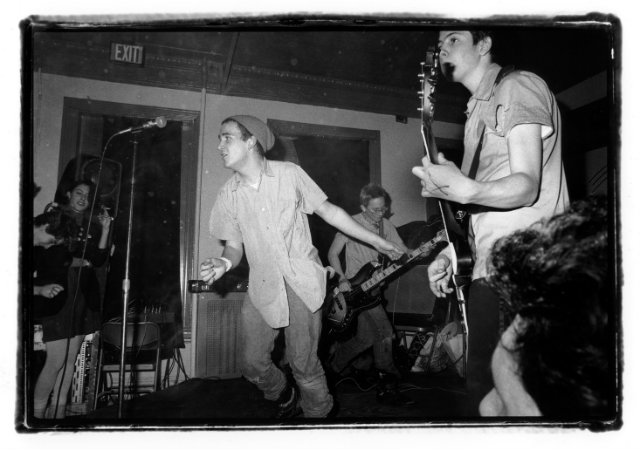
 Minor Threat, from back in the day. Photo © 1980 by Susie Josephson Horgan. Courtesy Dischord Records.
The first 30 seconds of Bikini Kill’s “Rebel Girl” blares from speakers while students hunch over today’s quiz. Professor Eugene Montague stands patiently at the podium, unaware of the puzzled looks his classroom is receiving from passersby.
This isn’t a typical college course quiz: it asks readers to identify a song based on a short clip and then answer in-depth questions. For instance, “what was the political, social, and musical movement with which this song and band is associated?” Or, “how do the lyrics and the way they are declaimed present the aims of this movement?” After a minute or two, Montague collects the quizzes, returns to his podium, and grins at his class. “Who’s first?”
It’s the last meeting of what a university registrar would call “MUS 1104;” a summer class at George Washington University entitled “D.C. in the History of Punk Music.” For the last class, students will present their final projects; individual presentations on a punk-related topic of their choice.
The first presenter, decked out in a GWU basketball uniform, created a Google Maps satellite tour of landmarks in the harDCore movement. She tours the audience from Wilson High School to Georgetown storefronts and Glover Park’s now-defunct The Keg. Another presenter pulls a notepad from her Longchamp tote bag to offer a sociological analysis of punk as a social movement, comparing the U.K. punk style and mentality to that of American bands. She concludes with the paradox of punk: a community based on individualism. If you didn’t know better, you’d guess these students were diehard punk fans who’ve been harboring Dischord LPs for years.
But they’re not. Montague says that only a handful of them were remotely familiar with punk before signing up for his class. “One of the icebreaker questions I posed at the beginning of class was, ‘what’s your favorite punk song?’” Montague explains. “A lot of students said, ‘I don’t listen to punk, so I don’t have one.’”
By his estimate, maybe two or three of the sixteen students had ever heard of Bad Brains or Minor Threat.
So, the depth and breadth of their final presentations are, quite frankly, astonishing. Since the class is called “D.C. in the History of Punk Music,” students received not only a crash course in bands like Rites of Spring and Bad Brains, but also a historical perspective of the entire punk canon. Past “Listening Quizzes” also featured bands like The Who, Television, and Hole.
Montague’s suggested reading list for the class features, among many others, a Spin Magazine review of a 1996 Sex Pistols reunion concert, scholarly essays on riot grrrl and punk fashion, and, of course, Mark Andersen and Mark Jenkin’s essential book Dance of Days (required reading for anyone into D.C. punk). He’s played clips from documentaries like The Legend of Cool Disco Dan and American Hardcore. One week’s lecture examined offshoots of punk like New Wave and Straight Edge.
Taking (or teaching) this class would be a dream come true for many in the District, but Montague wasn’t exactly hanging out at the Georgetown Haagen-Daaz with Ian and Henry back in the day. Montague, who has a Ph.D. from the University of Pennsylvania, studied music performance at Trinity College in Dublin and music theory at the University of Massachusetts-Amherst. Although he grew up listening to and loving punk music, he only moved to the D.C. region in 2009, when he was hired by GWU.
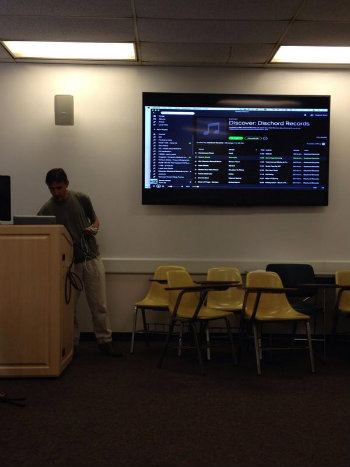 Professor Montague teaching his class. Photo by Tori Kerr.
Montague had taught classes on the history of punk before at other colleges, but he felt like the opportunity was greater and more important at GWU. In D.C., he explains, “punk isn’t an abstract notion. It’s a very real thing for many people here.” That notion becomes especially true in his community of Silver Spring, Md. Many of the parents he meets through his school-age children actually went to Wilson High School or tooled around Georgetown in the ‘80s. Sometimes, his outsider identity makes him feel like an “imposter,” which, he believes, isn’t necessarily a problem. An academic musician “always has to justify [himself] in some way,” Montague says. If that’s true, the work he’s done with his handful of summer students is certainly justification enough.
Montague includes one tangential but crucial topic that he hopes students get out of his class: “music can relate to other disciplines, whether it’s culture or history or politics,” he rightly says, “and there are a lot of people interested in politics here at GW.” For instance, Go-Go’s murky narrative is directly related to socioeconomic factors and D.C.’s status as a majority black city.
At the same time that harDCore was infiltrating the streets of Georgetown, Go-Go was growing out of the city’s black communities. The local punk community has certainly had its fair share of brushes with the police, but due to its majority white, upper-middle-class fan base, it didn’t endure the same challenges as Go-Go. What began as a grassroots, community-based music phenomenon quickly fell under police eyes as fights and drug deals became synonymous with Go-Go shows. One notable incident being a stabbing that shut down Go-Go shows at the Franklin Reeves Center (at the now-defunct Club U inside the building.).
And this complicated pattern didn’t go uncovered in Montague’s lectures: one student wrote a paper about this relationship between the two genres. “The whole 1980s history—the drug and crack epidemic, the murder problem—are things that get reflected in the music and musical events,” Montague points out. In that same vein, Montague sent his students on a “field trip” up and down the Red Line to check out the graffiti. No matter what the topic, assignment, or lecture, there’s never a dull moment in MUS 1104.
For Montague, one of the goals of the class is to provide his students—many of whom will only be here for four years—with a sense of “being rooted.” He hopes that his students understand that D.C. is not just a transient, career-driven city. This summer session was the first time George Washington University offered the class; Montague says he can’t wait to hopefully teach it again.
“It’s more than that. It’s something continuing and important,” he says. More than anything, he wants his students to walk away understanding the different ways music can be culturally important.
Speaking to his students, he’s definitely made an impact. Julia Peters, a junior, says that she “didn’t realize D.C. had a scene at all,” but by the end of the class, had learned to appreciate hardcore music because she understood why it’s so abrasive.
Besides the occasional Clash song on classic rock stations, another student, Chris Holbert, says he also only had a “basic association with punk.” Holbert, who has lived in Baltimore for the better part of a decade, is eager to move beyond his Maryland base and learn more about D.C.-based bands. “When you think of D.C., you think of the arts but you think of ‘The Arts,’ you know?” He gestures sarcastically and cites The Kennedy Center as an example. Living just 40 miles away, the thought of D.C. as a hotbed of underground music had never even crossed his mind.
“I don’t hope they all become rabid anti-capitalists!” Montague laughs. “I don’t mean the class to be preachy in any way, but at the same time, they should get the sense that there are alternative forms of music. I’m putting a sense of musical history [behind] what they’re listening to, what they’re aware of.”
Full disclosure: the author is a former employee and alumni of George Washington University.