Rachel Kurzius
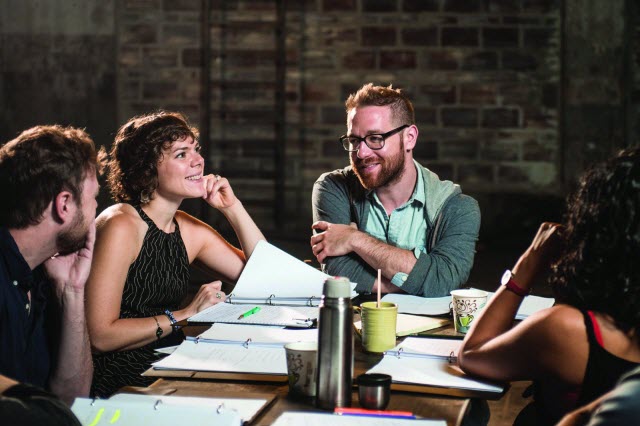 Cast member Tom Story, Playwright Rachel Bonds, Director Mike Donahue. Photo: Teddy Wolff.
By DCist Contributor Rachel Kurzius
Studio Theatre’s building on 14th Street NW feels huge. Converted from an old factory, the complex of theaters and classrooms boasts high, flat ceilings, brightly-painted industrial metal, expansive glass windows, and an elevator large enough to fit a car. Studio’s plays, on the other hand, are known for their intimacy—the relatively small stages play host to naturalistic acting about what happens between people.
The Wolfe Twins, the first play produced through Studio’s new commissioning program, is an extension of the theater’s intimate oeuvre. Written by Rachel Bonds, the play occurs in the cozy common area of a Roman bed and breakfast, as four characters explore the strain of relationships and responsibility.
“Rachel’s plays definitely have a rhythm,” Wolfe Twins director Mike Donahue said during a recent interview. “Pacing is important. She can change a pause, and it might change the whole character arc.”
This is the first project Bonds and Donahue, who are both New York City-based, have worked on together. They bonded over a shared understanding of the flexible attitude one needs to develop a new play. “There could be new pages right up until the end,” Bonds says.
Bonds and Donahue both marveled at how quickly The Wolfe Twins came together, from rough sketch to world premiere in less than a year. Studio Theatre awarded Bonds the commission in summer 2013. She got married in October of that year and spent part of her honeymoon in Rome. Bonds sent Studio the first draft in January 2014, inspired by a B&B from her trip and the experience of navigating a foreign country. Studio and Bonds have been in motion ever since, and the play is set to open on October 15.
Adrien-Alice Hansel, Studio’s literary director, credits Bonds for the fast turnaround time. “When she sent us that first draft, it was clear that this play didn’t need more thinking about what it needed to say,” Hansel said. “It needed actors to put their mouths around it.”
The audition process became part of workshopping for Bonds and Donahue. Bonds had originally written Raina (Jolly Abraham), one of the characters populating The Wolfe Twins‘ B&B, as a colder, more withdrawn person. “Raina changed during auditions,” Bonds says. “She became more herself.” Now the character radiates warmth. “It makes Dana’s reaction to her more interesting,” Donahue said.
Dana, one of the show’s titular twins, is played by Birgit Huppuch, an actress Bonds and Donahue were already familiar with. On the page, the character comes across as high-strung and insecure at first. Glimmers of a headstrong, almost brutal person emerge and retreat throughout the course of the show.”It was important that she wasn’t unlikable,” Bonds says. “I want people to identify with her just as much” as her more gregarious brother Lewis (Tom Story).
Whether The Wolfe Twins will successfully explore the ways intimacy breeds rot depends on the actors developing a chemistry with one another and with the setting. The play consists of repetitive motions—entering or leaving a doorway, hanging up or putting on a coat, drinking coffee.
“It matters how someone is sitting,” Donahue says. “How they interact with a chair says how comfortable they feel.”
Because Studio has four theaters, none holding more than 225 seats, the cast of The Wolfe Twins has been able to rehearse in its theater since September 24. A lucky break: Often, practices in the actual performance space don’t start until mere days before opening night. The additional rehearsals mean that the cast can get comfortable with all of the props the show requires.
The small size of the theater helps convey these nuances. “In theater, you’re always ‘right there,'” Hansel says. “But ‘right there’ is way more visceral at four feet than at 60 feet.”
In a little more than a month from now, The Wolfe Twins will finish its run at Studio Theatre. “Theater is ephemeral. We all know and are attracted to that,” Hansel says. “But it’s exciting to craft something that will have a life beyond us, to give people the materials to create and be a part of the career of a writer starting to take off.”
Studio Theatre Artistic Director David Muse also extended commissions to Mark “Stew” Stewart and Vivienne Franzmann, as well as a soon-to-be-announced group of playwrights. “We want Studio to be a place where a play can speak at its own volume,” Hansel says. But it’s even simpler than that. “It’s just a really good use of our time to help launch something.”