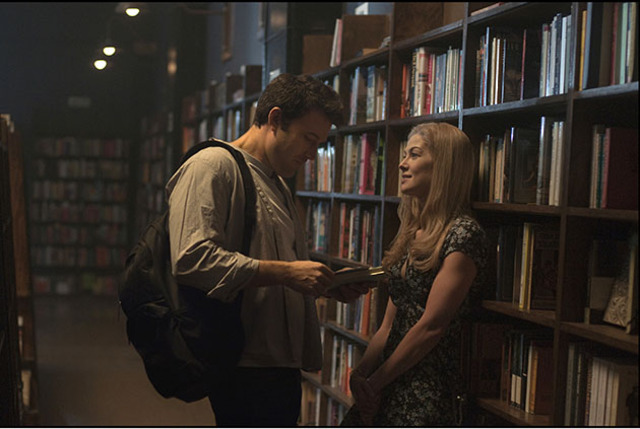
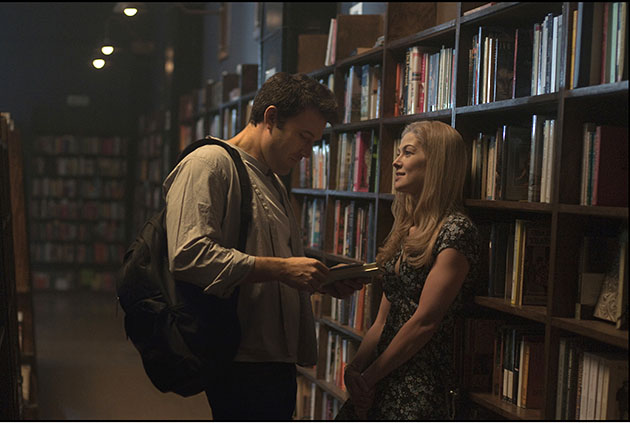
 Ben Affleck and Rosamund Pike (Merrick Morton/©2014 Twentieth Century Fox and Regency Enterprises)
“What are you thinking? How are you feeling? What have we done to each other?” David Fincher’s adaptation of the best-selling novel by Gillian Flynn (who adapted her book for the screenplay) opens with the head of Amy Dunne (Rosamund Pike) leaning back in a Hitchockian close-up of blondeness caressed by her husband Nick (Ben Affleck). It’s an intimate moment, but one fraught with tension. Nick narrates his story over this image, and his notion to unspool his wife’s brain suggests the depths of his violence, or so we are led to believe. But this isn’t simply a tale of domestic violence and murder. The movie is a bleak if superficial story of a marriage gone bad, and a movie about storytelling — the stories we tell ourselves and the stories we believe.
The credit sequence establishes the film’s tone for good and for bad. Titles are superimposed over shots of a morning in Midwestern suburban America, but words fade quickly away before you have a chance to absorb them. If you’re going into the film cold, as I did, you might guess from the title that this fleeting marquee conveys a sense of loss, of something gone before you have a chance to appreciate it. These titles also reflect a film that, while entertaining enough, feels more ephemeral than the director’s best work.
Gone Girl‘s action begins on the morning of Nick’s and Amy’s fifth wedding anniversary (the wood anniversary). One of the first things Nick does is go to a bar, albeit a small-town joint called The Bar that he runs with his twin sister Margo (Carrie Coon). The dawn’s early lubrication raises concerns about the nature of his marriage, though the timeline becomes more complicated than we are initially led to believe. Still, Nick is drinking on the morning of an anniversary that, if it doesn’t exactly mark a loveless marriage, commemorates one with almost none left. It’s not an all-day bender. But he returns home to signs of a struggle and his wife Amy is gone.
The Dunnes live in a McMansion in North Carthage, Mo., a fictional town but one that recalls the real and very depressed town of Carthage, Mo., in spitting distance of the Precious Moment Chapel and not far from the Vegas-in-the-Ozarks of Branson, which Dunne’s lawyer Tanner Bolt (a lively Tyler Perry) refers to in passing. These moments in the heartland of America are less than precious.
The movie unspools like a procedural at first, territory that Fincher tackled more successfully in Se7en and Zodiac. But Gone Girl turns into a dry media satire of press manipulation and image-making, which makes tabloid-fodder like Ben Affleck a smart casting choice. If his thespian qualities are often tainted by colorful media reports, so is the character he plays, an unsympathetic husband whose guilt has been preordained by a bloodthirsty hungry media machine.
Where Gone Girl works best isn’t as a procedural or a satire, but as a wicked thriller. I don’t want to spoil the film’s central twist for anyone who hasn’t read the book (I haven’t), though you can probably guess what it is. Let’s just say the film, like another recent movie whose plot reviewers are loath to spoil for readers, turns out to be more than a thriller but a dark study of relationships.
Running two-and-a-half hours, Gone Girl is not the most efficient storytelling of Fincher’s career. It only felt like two hours. I like it, but I pose the same question that my professional superior Anthony Lane poses in his New Yorker review: “Why doesn’t the movie claw us as The Social Network did? Who could have predicted that a film about murder, betrayal, and deception would be less exciting than a film about a Web site?”
—
Gone Girl
Directed by David Fincher
Written by Gillian Flynn
With Ben Affleck, Rosamund Pike, Neil Patrick Harris.
Rated R for a scene of bloody violence, some strong sexual content/nudity, and language.
Running time 149 minutes
Opens today everywhere