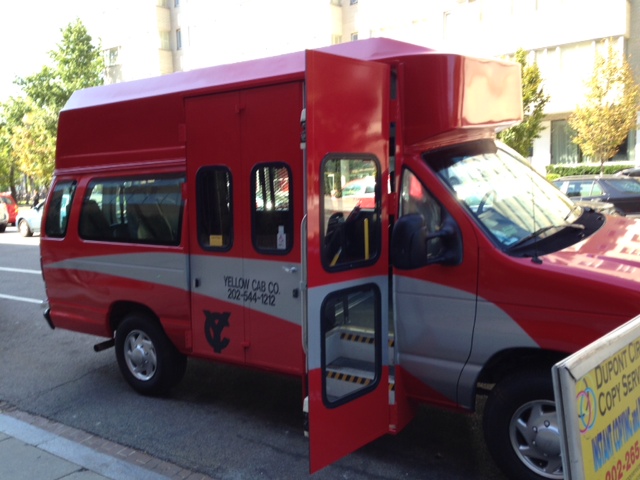
 Photo by Matt Cohen.
For D.C. residents with disabilities and no means of personal transportation, MetroAccess is what they rely on to get around. But a new program introduced by city government and the D.C. Taxicab Commission will shift about 100,000 of those rides annually over to special taxi vans and buses acquired from WMATA.
At the Fresenius Medical Center in Dupont Circle today, Mayor Vince Gray and DCTC Chairman Ron Linton unveiled the first in a series of 33 new handicap accessible taxicabs that have been acquired from WMATA. Under the new Coordinated Alternative to Paratransit Services, residents with disabilities now have the options to call a special cab to come pick them up to take them to appointments rather than relying on MetroAccess vehicles.
The benefit, Linton tells DCist, is that it’ll save up to $1.8 million in savings “due to a reduction in subsidy payments to MetroAccess.” But for riders, the new CAPS-DC program makes life a little easier for them: the program will have no impact on out-of-pocket costs—still $5, rides can be booked one hour in advance, companions can accompany them at no additional costs, and the cabs won’t be making multiple stops.
Right now, the CAPS-DC program, which is working with two cab companies, Transco, Inc. and Yellow Cab, is launching with 33 of these new wheelchair-accessible vans and mini-buses acquired from WMATA, but he says they expect to have 66 by the end of the year. “What we told Metro is we’ll take as many of the rides as they’ll release to us,” Linton says. “Right now, we have a memorandum understanding that comes to 100,000 rides a year of MetroAccess patients who want to use our service.”
But with this new plan that aims to make transportation smoother for residents with disabilities, the main goal is making sure those residents know they have the option to use the CAPS-DC program. DCTC spokesman Neville Waters tells DCist there’s about 1,500 people eligible for the program and the Commission has sent mailers to them informing them of the new option. Neville also says they plan to make information available at various area health care facilities where MetroAccess and, now, potential CAPS-DC riders are patients, so as to make them aware of the new riding options.