 Via Urban Institute.
A new analysis from the Urban Institute confirms what you already know: Affordable rents in D.C. are disappearing as higher-cost rentals proliferate.
In the latest chapter of their Our Changing City series, the Urban Institute looks at housing, from rising rents to home sale prices.
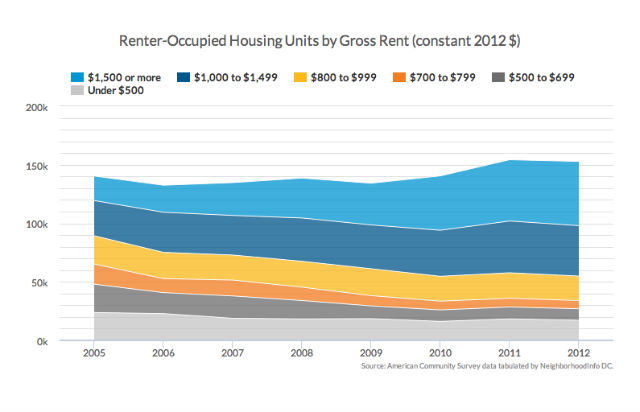
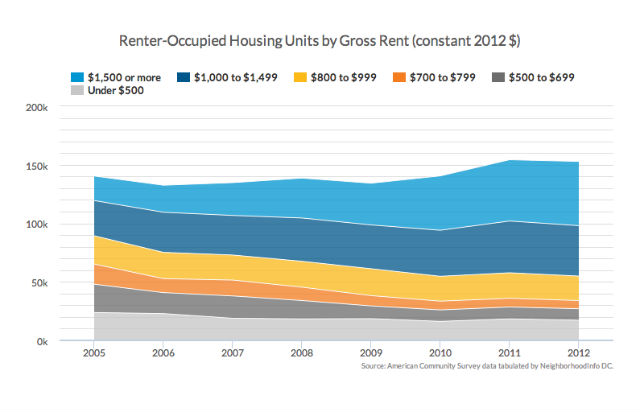
In disturbing news for renters, the Urban Institute found that the number of rentals available for under $800 a month shrunk by half between 2005 and 2012.
While the rental market has grown—from 2005 to 2012, roughly 12,500 more apartments and homes were occupied by renters—the number of lower-cost, market-rate units fell steadily, as higher-rent units took over a greater share of rentals.
In 2005, over 65,000 rentals were available for under $800 a month (in 2012 dollars); by 2012, that number had fallen to roughly 34,000 units. Meanwhile, the number of rentals for $1,000 or more shot up from about 51,000 units in 2005 to nearly 98,000 in 2012.
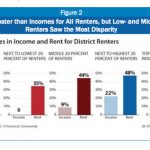
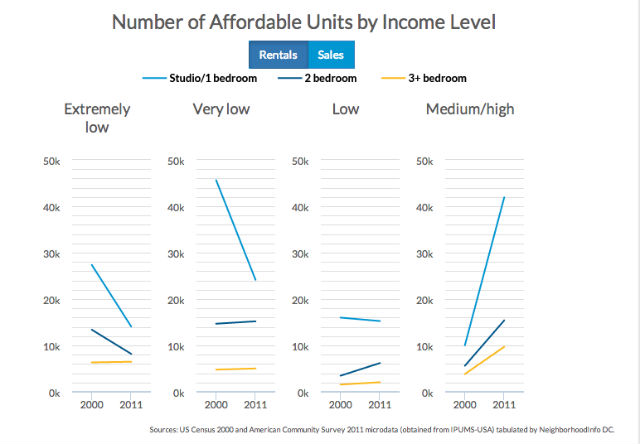
Meanwhile, the number of affordable units for low income people has plummeted.
 Via Urban Institute.
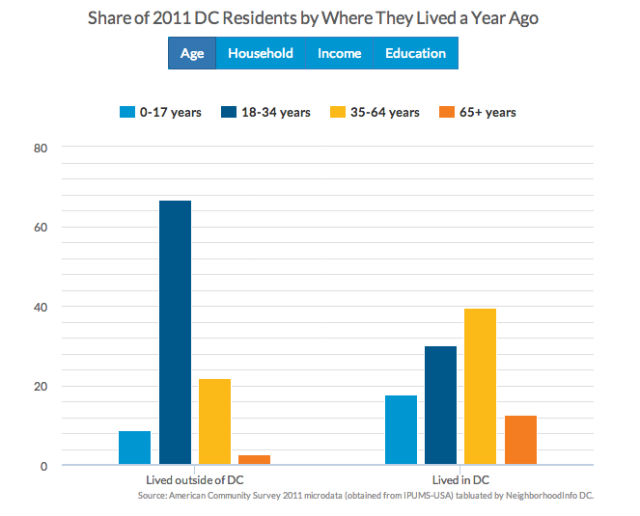
Who’s driving this demand? Why, young, educated people, of course.
In 2011, nearly 67 percent of people who moved to the city within the past year were ages 18 to 34, up from 57 percent in 2005. Meanwhile, only 30 percent of current residents were in that age range. The share of new residents with bachelor’s and graduate degrees (65 percent) in 2011 was higher than the share of degree-holders already living in the city then (42 percent).
 Via Urban Institute.
Maintaining housing diversity will be key if D.C. wants to remain an inclusive city, the Urban Institute writes.
The Housing Production Trust Fund and the DC Local Rent Supplement Program, which use local tax dollars to subsidize developers and providers of affordable housing, are critical to achieving the task force’s goals. DC’s Inclusionary Zoning policy, implemented in 2009, also may prove to be an important tool to spur development of affordable housing and mixed-income communities. The policy requires that new residential buildings set aside a percentage of its units for low- and moderate-income households. The policy has gotten off to a slow start, but is beginning to make progress.
But the needs are still great. As DC continues to grow, inclusive housing policies will help ensure that the city remains affordable for all its residents.