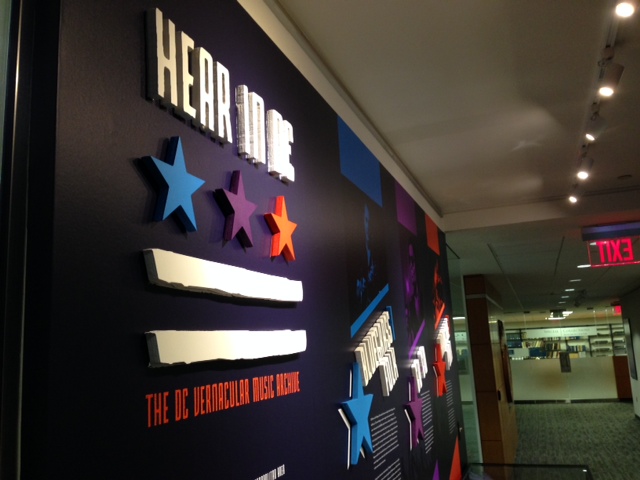
 Photo by Matt Cohen.
What’s the sound of D.C.? Ask most native Washingtonians and they’ll either mimic the distinct syncopated, dotted rhythm of a go-go beat or maybe hum the iconic bass line of Fugazi’s “Waiting Room.” Culturally speaking, D.C.’s two biggest contributions to the history of music is go-go and hardcore punk. A fact that has led to no shortage of books, documentaries, and now, archives, chronicling and documenting the history of these two storied musical legacies.
But while a lot has been written and archived about go-go and D.C. punk—most recently, the D.C. Public Library opened up a formal D.C. Punk Archive—there’s a whole history of local music that a lot of Washingtonians. And that’s where George Washington University’s D.C. Vernacular Music Archive, which officially launched yesterday, comes in.
In addition to archiving the local punk and go-go scene, GW music professor and author Kip Lornell, one of the archive’s main organizers, says a survey of the storied history of D.C.’s folk and bluegrass scene is also a big part of the archive. At yesterday’s archive launch, Lornell was joined by a panel of local music experts and icons—including D.C. Music Salon founder Marc Eisenberg, Dischord Records co-founder/Fugazi, Minor Threat, The Evens frontman Ian MacKaye, Folklore Society of Greater Washington founding member Andy Wallace, and folk musician and author Steven Wade—for a three-hour symposium that proved exactly why the city needs an archive like the D.C. Vernacular Music Archive.
“Growing up, I never new about the legendary bluegrass scene in this town,” MacKaye said during the panel. “That speaks to the kind of cellular nature of this town.” Indeed, while the story of harDCore and go-go is well documented, Wallace boiled down 50-plus years of folk and bluegrass history in the D.C. area to about an hour-long talk. Fascinating tidbits about various, long-gone venues around the city that became mainstays for the region’s folk and bluegrass musicians. For example, did you know that the legendary Georgetown club The Cellar Door was where Emmylou Harris and Mama Cass Elliot of The Mamas and the Papas got their start? Neither did I.
With the D.C. Vernacular Music Archive, Lornell aims to preserve and make the history of the region’s folk and bluegrass scene as ubiquitous as the go-go and punk scene. While that scene has produced a handful of legendary, nationally recognized musicians like Takoma Park native John Fahey, there’s a number of others that are widely unknown outside of the folk community. GW, which already has its own history with folk music via the Lisner Auditorium, as well as offering a class on D.C. punk, makes it a perfect place to host such an archive, Lornell says.
And in terms of go-go, which is Lornell’s area of expertise—he’s the co-author of The Beat!: Go-Go Music From Washington D.C.—he admits that there’s not a definitive archive of that culture. Part of his goal is to use all the research he did for that book to help create something of a comprehensive go-go archive.
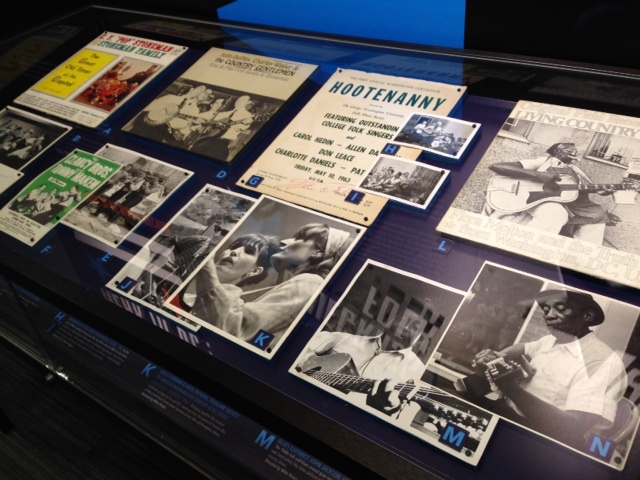 Photo by Matt Cohen.
But with a new D.C. music archive, one begins to wonder if it will compete with the other area music archives. Quite the opposite, Lornell says. “Approximately five weeks ago, I called a meeting of all the archives in town with local D.C. connections—D.C. Public Library, University of Maryland because of their local punk fanzine collection, the Library of Congress’s Archive of Folk Culture, Smithsonian Folkways, American History because of D.C., and, because of [Duke] Ellington, the UDC Jazz Archive,” Lornell tells DCist. He met with them to see how they can all work together.
“Part of the discussion was building upon people’s strengths,” says Lornell. “There can always be that underlying sense of competition, but if you have a particularly well-established archival radius on a very specific thing, then it seems stupid to try and compete with someone who’s already well established.”
One thing Lornell wants the D.C. Vernacular Music Archive to specialize in, and to distinguish it from other local music archives, is oral histories. “Looking at what’s going on now, preserving it, archiving it, is our primary mission,” he says. Putting together comprehensive oral histories of certain music scenes and famed venues—like the longtime activist church St. Stephen’s and the Incarnation Church in Mount Pleasant, which has a long history of hosting local punk shows—is something he’s most interested in.
Additionally, Lornell recognizes that there’s still a lot of musical genres with rich histories that’s under-documented in D.C., such as jazz or indie rock. “It seems to me that the niche here is a general niche, but go-go—we already have a pretty good core of go-go stuff here—and the folk music society stuff makes sense here,” he says. “But nobody really has claimed indie rock or the independent record labels of D.C., or some of the other things.”
Still, both Lornell and Eisenberg, who’s working closely with the archive, recognize the importance of multiple D.C. music archives, even if there is some overlap. “We’re in a very lucky place…that folks are all coming to these realizations at the same time, Eisenberg says. “That it’s important to recognize our [local] music, to save it, and to interact with it.”