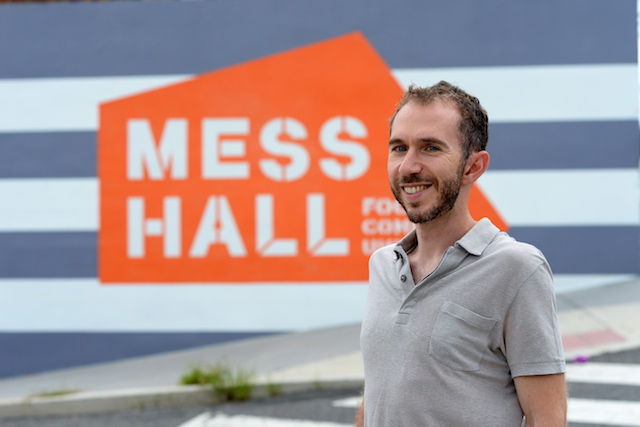
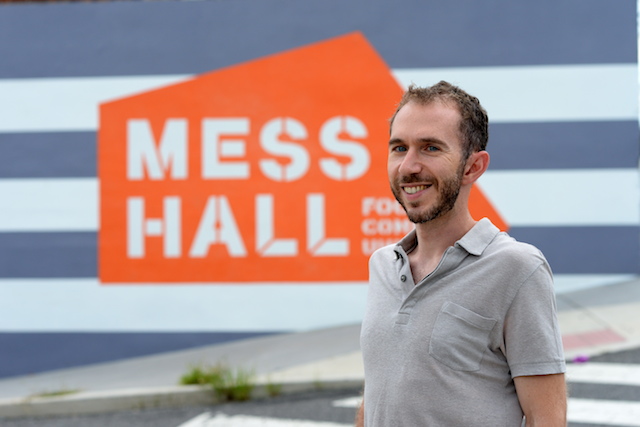
 Photo courtesy of Al Goldberg.
By DCist Contributor Victoria Finkle
It takes a strong stomach to start your own business, but there’s growing support for those looking to get into the notoriously difficult food industry.
The culinary world has taken a cue from Silicon Valley with the advent of food incubators, which work a lot like their tech analogs. It’s a temporary home for budding food businesses to begin cooking, plan growth and navigate the labyrinth of licensing and regulation.
There are now several hundred food incubators cropping up across the country, including several in D.C., like Union Kitchen and Eats Place.
DCist caught up with Al Goldberg, the founder of Mess Hall (703 Edgewood Street NE), a food incubator in the Edgewood-Brookland neighborhood that officially opened last week. Below are some highlights from our conversation, which has been condensed and lightly edited for clarity.
What got you interested in the food incubator concept? How does that fit with your background?
I came from restaurant kitchens, working every position in the restaurant, everything from busboy to waiting tables. Then I started as an account executive at a catering company that specializes in corporate catering.
I decided I wanted to open up my own space, and I had a couple friends I wanted to do it with.
It was trial and error with the commercial real estate market, trying to find the right space for about two years. We were a couple of years into it before they had to go on and do their own thing, and I thought, “Well, I don’t want to let this food entrepreneur thing die.”
We had such a perfect concept in my mind, and why couldn’t we get this off the ground?
Why is there this strong demand for food incubators lately? Is it related to how difficult it can be to get a small business going?
The barrier of entry into the food business is prohibitively high. The startup costs are high, the risks are high, and I think somebody has to help these small, fledgling businesses.
This is a way to really address a need. You can’t just go to a coffee shop and start up a catering business. You need some sort of facility, you need infrastructure, you need licensing. And all of those are things that you can do out of Mess Hall.
You’ve been in D.C. for more than a decade, and the local food scene has evolved so much in the past few years. What are the biggest changes you’ve noticed?
There’s so much more craft behind the production. We hear people say, “We want to meet the farmer or we want to meet the producer.” They want to ask questions. They want to be engaged. People go to events at Union Market. People go to the farmers’ market, more people are doing CSAs. I think people want to have much more connection with their food.
I also think that people in D.C. that are residents have this solidarity; you’re seeing families that are going raise their kids in D.C. and they want to see small businesses survive.
What’s the business model for Mess Hall?
We’re membership-based. We don’t allow someone to come off the street and use Mess Hall for a day.
It’s about creating a collaborative community. We’re trying to provide a home — it’s a temporary home, but it’s a home — for these businesses to cook, share and collaborate. And connecting them with real revenue streams in an environment that’s nurturing and that helps keep their costs down so that they can have some long-term growth and ultimately make their own “food jump” and graduate to brick and mortar.
There are some really interesting networking events that are on the horizon that connect our members with some really great resources, for example professional services. There’s a direct line of communication with other sales outlets, like some of my own catering contacts from the 14 years I was in corporate catering, and with some great retailers.
What makes D.C. ripe for food incubators, or for helping small restaurants and manufacturers?
D.C. is a tough space to open up a catering company or get into food manufacturing, the way it’s laid out and the population density.
If you’re going to cook something, you’re typically going to need a grease hood, which means running black iron up 10, 11, 12 stories to the roof. That stuff goes by weight, but it’s something like $75 per linear foot. You can’t just put that in an existing building without disrupting a whole bunch of law firms in between. And there’s not a lot of single-story buildings around here and there’s not a lot of commercial manufacturing zones and a lot of stuff has been turned into condos.
So there’s not really a lot of space that can be utilized for food production, given the zoning and the existing buildings.
So what types of businesses are you focused on helping?
Mess Hall is really quite a few things to a lot of different entrepreneurs.
We have what I call this “back of the house” space, which is the kitchen in a restaurant. And the “front of the house” is the dining room.
The back of the house is kind of the bread and butter of Mess Hall, which is the manufacturing. So people can come in and make anything from pickles to kombucha to pies and cakes and cookies — you name it. Bread baking, there’s all kinds of things people want to get into. Cold-pressed coffee.
But the front of the house is actually an event space. A restaurateur can come in and have a pop-up contest concept. They can attract investors, they can do test marketing.
Everything is very modular. Everything is on casters, so we can transform this room and that room. There’s various entrances. We can create different experiences for different people.
You held your first event late last month, the finale of Launch Pad, which was a pitch contest you sponsored for entrepreneurial hopefuls. Four finalists gave presentations on their business plans to a panel of judges, with the audience also getting a chance to vote.
The contestants were really diverse: Lulu’s Ice Cream, which is made with liquid nitrogen; Fruitcycle, a local fruit snacks company that uses gleaned apples and other fruit that would otherwise go to waste; Singer’s Significant Meats, a pastrami and corned beef restaurant and wholesaler; and popular biscuit business Mason Dixie, which won the contest.
How did that all come about?
That was just, I guess, born out of empathy. I wish somebody had given me this really magical start. We found all these amazing prizes and people to work with. [The grand prize included a six-month membership to Mess Hall; a $500,000 investment opportunity through EquityEats, a new crowdfunding platform; and more.]
We didn’t know what we were going to get, and we got a whole bunch of interesting concepts. There were almost 50 applicants and they were all just so different.
The intention was to demonstrate that we’re a unique concept with a great understanding of the needs of small food businesses. Launch Pad put an exclamation mark on our mission and is a great indicator of things to come.
There was a lot of talk about collaboration among attendees and contestants at the Launch Pad event. How common is that in the food industry?
A lot of people would tell you that it’s not, but it’s always been my experience that it has been. When you tell people that it’s OK to be collaborative and to help people, and even if you go so far as to tell them it’s expected, people are inherently helpful, and I think they want to share experiences that they’ve had.
The nature of the [Launch Pad] event was a competition, but it was the furthest thing from cutthroat. I saw all the contestants started following each other on Twitter. They were promoting each other, talking about how to collaborate.
So how did you end up in the Edgewood-Brookland neighborhood?
After this huge drought of not finding any spaces, it actually came down to negotiating on three different spaces all at one time and they were all in Brookland and Edgewood.
Part of it is that Ward 5 has a lot industrial space, and we’re zoned for commercial manufacturing. Most of the commercial manufacturing is located in Ward 5.
The other thing is that Brookland is a little bit of a food desert, and I like the idea of seeing some really interesting food come out of Brookland. I don’t think it would be as sexy if we were on 14th Street, not that you could afford to put a concept like ours there with the 10,000-square feet that we need.
I moved to the U St corridor over ten years ago, and I kind of felt the same way. One of the cool things about moving to the U Street corridor back then was there were some new restaurants that were popping up here and there and the neighbors all said, “Let’s go and spend our dollars over at these restaurants, because the restaurants are going to take care of us.” And what we meant when we said that is, if we could patronize these restaurants, there would be an increased level of police and safety and that would beget more people and more safety and just a better quality of life.
When we moved there we thought we’d be there a year or two years and flip our house, and here we are raising two kids there. And there are a lot of kids there.
I see a lot of similarities between U Street corridor from ten years ago and Brookland and Edgewood. You’re seeing that people are going out to the restaurants and bars on 12th Street [NE] just because they want to give them their dollars in the hopes that this will be the catalyst for some really incredible things to happen in that neighborhood.
I think there are a lot of really positive food things going on. Not everyone knows about some of the things that are on the horizon, but you’re going to see some really cool things coming out. There are a couple of things in the works that are really nearby.
Any hints about what’s to come?
I’m completely sworn to secrecy.
Ok, we’ll keep an eye out. In the meantime, what’s next for Mess Hall?
We just had our food inspection done; that was a big milestone. We were able to host events because we had a certificate of occupancy. But now we’ve got members that are already moving in. It’s just going to be a buzz of some really creative and supportive people.
We’re still very much taking memberships. There are some really great pop-up concepts that have approached us that I’m super excited about.
At the end of the day, it’s kind of an art gallery for food where it’s going to come down to the creativity of the people that are using the space.
And finally, where do you like to grab a bite in D.C. these days? Any favorite restaurants?
My absolute favorite space in town is Little Serow. There’s no secret about that.
Sometimes I’ll run over to Le Diplomate late at night and sit and work by myself and get some food over there. Love that space. I love Sona Creamery — that’s in Eastern Market. One of my all-time favorite places, as well.