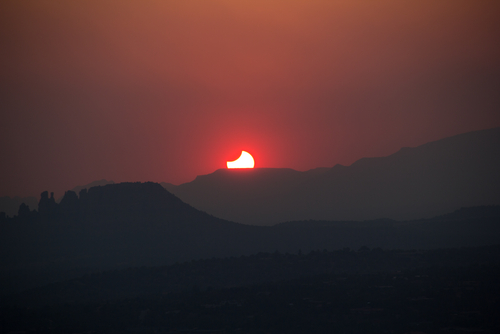
 Image via Shutterstock.
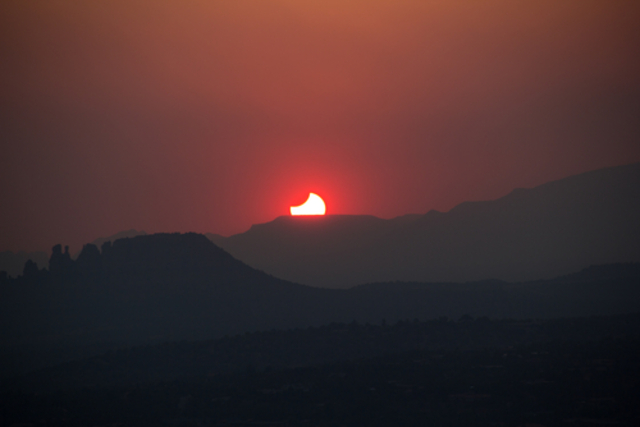
Prepare those makeshift filters, D.C., there’s going to be a partial solar eclipse late tomorrow afternoon.
According to NASA, the partial solar eclipse, which occurs when the moon blocks out part of the sun from Earth’s view, is set to occur just before sunset and will be visible to most of North America, including D.C.
While you could watch it anywhere not obscured by trees alone, members of the Washington Area Astronomy Meetup will gather at 5:30 p.m. tomorrow near the Washington Monument armed with a telescope with a solar filter. The eclipse is expected to start in D.C. at 5:52 p.m. and peak at 6:17 p.m.
Like any solar eclipse, you shouldn’t look directly at it because it will burn your eyes right out of your socket! Just kidding, that won’t happen…probably. But, as NASA emphasizes, even look directly at a partial eclipse without proper eye protection “risks permanent eye damage or blindness.”
So how can one marvel at the beauty of a solar eclipse without risking eye damage? Three ways that NASA suggests:
- Projection: “Place a pinhole or small opening in a card, and hold it between the sun and a screen—giant sheet of white paper works—a few feet away.” This will project an image of the solar eclipse onto the screen, so you can see it without any risk of permanent damage.
- Filters: There are filters specifically designed for looking at solar eclipses that you can find in most hardware stores. “One of the most widely available filters for safe eclipse viewing is a #14 (or darker) welder’s glass,” NASA says. Also, “aluminized mylar manufactured specifically for solar observation can also be used.
- Telescopes with solar filters: “There are sun-specific telescopes available for sale — or perhaps through a local astronomy club—that are also safe for viewing a partial eclipse,” NASA says.
Also worth noting: sunglasses aren’t adequate protection to watch a solar eclipse!