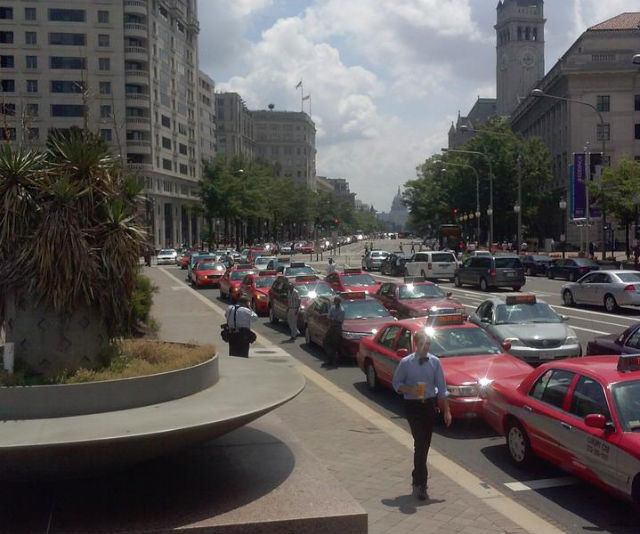
 Photo by Sarah Anne Hughes.
The D.C. Council passed a bill 12-1 today that regulates “ridesharing” services like Uberx and Lyft.
The bill imposes new commercial insurance requirements on private vehicles-for-hire, requires criminal background checks that go back seven years, asks companies like Uber to establish zero-tolerance policies for drugs and alcohol, mandates “trade dress” (like a decal) to be displayed, and allows hack inspectors to examine the phones of drivers suspected of picking up an illegal street hail.
The vote was preceded by debate on nine amendments proposed by Councilmember Jim Graham, who said he had “very serious concerns” over whether the bill “goes far enough to sufficiently protect the public and … engender a fair competition in the industry so that we can have a level playing field.”
“For the Council to allow self-regulation of these profit-making ventures is indeed like having the fox guard the chicken coop,” Graham said.
Four of Graham’s amendments were accepted as friendly, but the other five failed. The amendments included mandating FBI finger printing background checks, opening Uber and Lyft to Freedom of Information Act requests, and requiring these companies to make available their driver inventories. Graham voted against the bill.
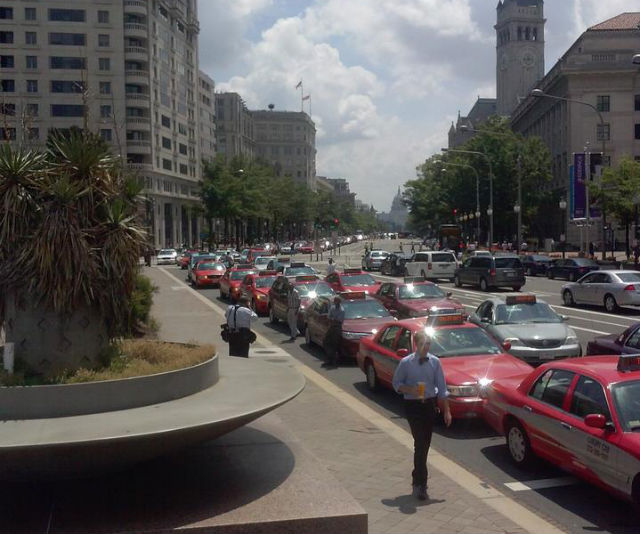
Cab drivers organized by the Teamster-affiliated Taxi Operators Association once again protested outside the Wilson Building by blocking traffic and honking horns before the vote.
“The illegal private sedan services currently do not follow the same rules and regulations that taxi drivers must follow, and the bill in its current form falls far too short in providing fairness,” the Association said in a release. “Because of the private sedan services’ huge competitive advantage, D.C. taxi drivers are losing work and are struggling to make ends meet.”
D.C. Taxicab Commission Chairman Ron Linton also opposed the legislation, writing in a letter to the Cheh, “The bill deprives the Commission of the basic tools it needs to hold companies and drivers accountable in a timely manner for violations of the basic standards for safety and consumer protection which the bill purports to protect.”
Linton also opposed allowing people driving vehicles with Maryland and Virginia plates to operate as private vehicle-for-hire, as that “complicates street enforcement.” D.C. cabs must have D.C. tags for trips in the city.
Uber, on the other hand, celebrated today’s vote. “With this legislation, D.C. has become a trailblazer in the transportation industry by embracing innovation, supporting consumer choice and empowering small business owners,” the company said in a statement.
Read more about the new regulations here [PDF].