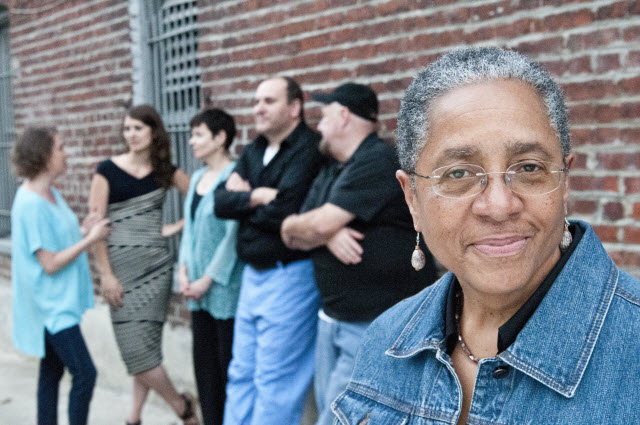
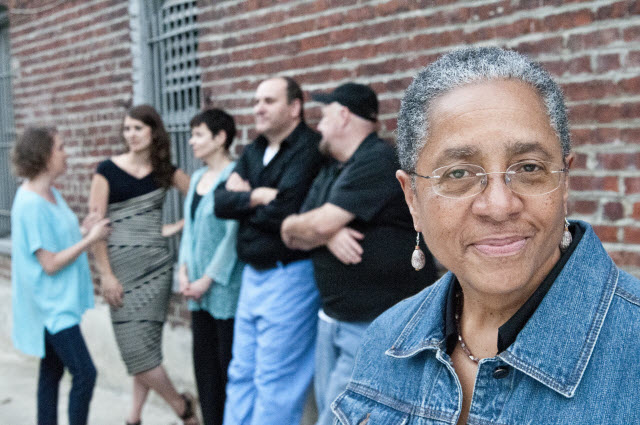
 Caleen Sinette Jennings. Photo by Teresa Castracane.
By DCist contributor Jonelle Walker
In 2005, Caleen Sinnette Jennings was sitting with one of her students on a bench discussing community outreach work when the student said something striking. “It resonated with my whole body,” Jennings said, “and I knew that it was something I had to write about. I knew it was a play.” The student confided in his professor his worries that, despite his social justice work, there were “not enough lifetimes” to make up for the damage done by his ancestors to the black community.
Two years later, Jennings — a professor of theatre at American University who, full disclosure, taught this reporter — had a draft of Not Enuf Lifetimes ready to workshop. Among the readers for the workshop were the student who inspired the piece and a young actor, now known as the multi-hyphenated theater artist Psalmayene 24, who will direct the play’s premiere production with D.C.-based playwright collective, The Welders.
In the few days before previews begin for Not Enuf Lifetimes, Psalm, as he is known to his colleagues, reflected on the journey that brought him from reading the piece to directing its premiere. “It sort of represents a way for me to see my own journey as an artist evolve and develop,” he said. His character from the workshop, Dante, has made it to the final draft through years of workshops and revisions which presented an uncommon chance to see the character develop and make a fresh connection to characters new and old. “To have the pleasure and opportunity to deal with this piece through the eyes of a director is a gift,” Psalm said.
Not Enuf Lifetimes, opening this weekend at the Atlas Performing Arts Center, is the story of a man named Frank Riley who has a struggling relationship with his son, Ian, a white medical student who has dropped out of school to start an after-school daycare in a housing project. More than that, says the play’s director, it is a piece consumed by legacy. “It’s really a story about how human beings grapple with this idea of legacy and how it can haunt us in ways that we may not even fully be able to deal with,” Psalm said.
Legacy has been on the forefront of Psalm’s mind during the production process after the loss of his beloved grandfather, who has served as an inspiration for Psalm’s directorial approach and provided him with artistic grounding. The sudden grief connected him to questions central to Not Enuf Lifetimes: “Losing my grandfather [had me] really thinking about, how am I going to carry on his legacy and what exactly does that mean, and where does his legacy and my legacy coincide and overlap?” Working on the piece, too, provided Psalm with a constructive way to confront the healing process. “This piece has been a way to transform that grief into something that transcends it.”
Legacy must be on the mind, too, of Caleen Sinnette Jennings—who serves as both playwright and company artistic director for this production—as The Welders begin their search for the second generation of playwrights for the collective, a group they are calling Welders 2.0.
This current generation of the The Welders, founded in 2013, are comprised of local playwrights Bob Bartlett, Renee Calarco, Allyson Currin, Gwydion Suilebhan, and Jennings in addition to Executive and Creative Director Jojo Ruf, who have set out to produce five works in three years. At the end of that three years, the entire organization is handed down to a completely new team of playwrights (hence, 2.0.) and the cycle begins anew.
As playwright, Jennings received “fabulous, really tough” feedback from her fellow “Welders” as she was developing Not Enuf Lifetimes. The ability to seek out and receive comprehensive feedback from her contemporaries, Jennings says, is one of the unique advantages of working with the collective: “The great thing about the structure of the organization is that you never feel alone …. They totally get how you feel as a playwright walking into this. It’s almost like you don’t have to speak in full sentences.”
In the Welders’ model, each playwright is provided with a slot and budget to create whatever they would like, whether that is their own original work or something completely different. During a given playwright’s slot, the other “Welders” provide production support as point persons for marketing, production, outreach, and any other duties as assigned, in addition to their work as sounding boards and critics.
For Jennings, her duties as artistic director included spending the week before previews running around looking for a gun. A prop gun, she is quick to clarify.
In the rehearsal room, Psalmayene 24, like Jennings, has had to tackle the “nuts and bolts tasks” demanded of any production in addition to this particular play’s heavy themes. The director celebrated shaving 12 minutes off of the run time of the show without having to cut any text. “Pacing is one small part of directing, but the rhythm and pace of a show is key, especially with a show like this,” he said.
In tandem with the practical demands of rehearsals, Psalm and the cast worked together to dive “heart-first” into the depths of the piece, confronting difficult questions and exploring some uncomfortable truths about American history.
When contending with Not Enuf Lifetimes‘ weighty topics, the key directorial method has been frank and intense conversations with the cast. “We are dealing with epic themes: slavery and racism,” said Psalm, “We’ve been grappling with these epic themes and the legacy of violence that this family and this country has been dealing with.” Psalm is thankful, however, he says, for Jennings’s ability to present the play’s difficult subjects of race, disenfranchisement, and violence within the “really personable story of the Riley family.”
As rehearsals began — and the artistic torch of sorts passed from Jennings to Psalm — a question from director to playwright cemented the intended aim of these ideas: What do you want the audience to walk away with? A simple question that determined not only the plot ending of the play, but also provided a road map for the director to follow towards the final product.
“With theatre, it’s really all about, not only the experience that the audience has in the physical structure of the theatre, but also what happens when they leave and what conversations and what sort of positive actions come out of experiencing a theatrical event,” Psalm said. Ultimately, he said, he wants audiences to consider their legacy as people, as Americans, and, particularly, as parents: “There’s a moment in the end that I think can be a potential springboard for parents wanting to reach out to their children. I hope that it inspires people to really live their lives in ways that are productive and creative and I really hope it inspires parents to make authentic connections with their children.”
Not Enuf Lifetimes runs at the Atlas Performing Arts Center (1333 H Street NE) through November 15. Pay-what-you-can previews run tonight (Wednesday) through Halloween at 8 p.m. Tickets all other nights, which are $20, are available here.