By DCist contributor Alex Tebeleff. All photos by Rob Cannon.
It’s a strong statement to call your coalition The Future of Music, but the topics discussed at their yearly policy summit impact how musicians, music fans, and music industry types can work together to make the future of, well, music a little more promising. Of course, there are significant systematic issues that keep everyone in the industry from proper compensation. Figure that out, and you save the future of music.
According to FOMC communications associate Kevin Erickson, the spirit of the coalition was based on the DIY independent music movement. Day-to-day, the organization lobbies for music policy issues on the Hill, such as copyright law, issues of ownership and authorship, and net neutrality. What’s most surprising is that the same issues that hurt musicians’ abilities to make a living also hurt all parts of the music industry. It’s a reminder that if musicians aren’t properly taken care of, everyone else in the industry will fall.
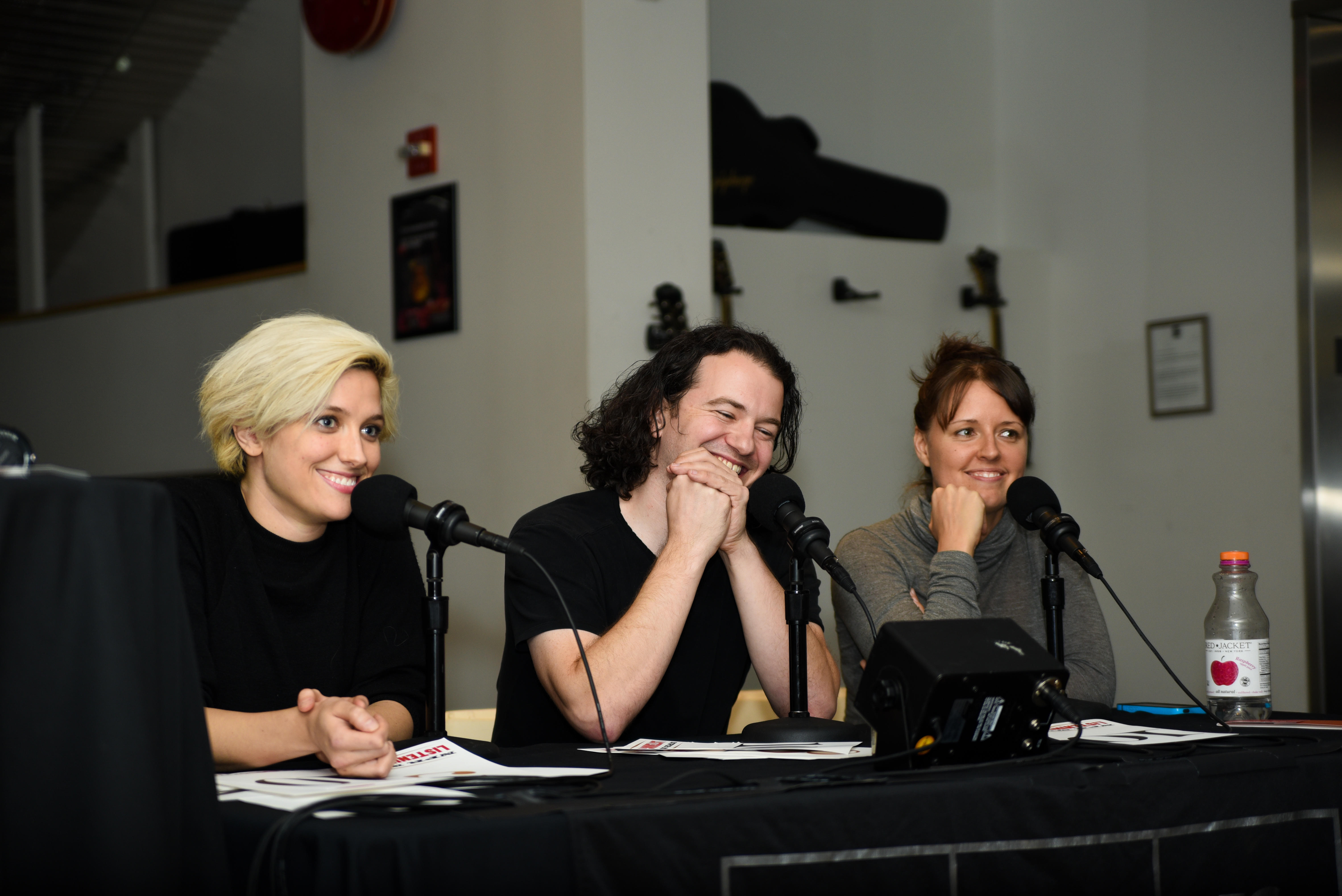 All Songs Considered Listening Party Panelists Katie Alice Greer, Stephen Thompson and Emily White
Day one’s opening panel, “In Service: Innovation In the Musician’s Toolbox,” featured a diverse group of individuals. Bandsintown consultant* Randy Nichols spoke of his background as a manager, while SoundScry CEO Brett Sechrest brought the most practical idea of the day for creating a new income source for musicians. He suggested a push for fan investment, as seen in his fan/artist shared revenue focused platform.
The fact that over half the speakers’ technological platforms involved live performance (AtVenu, Bandsintown, Eventbrite) highlighted how both the personal and financial focus of the music world has moved toward live music. Though much of the conference would dig into recording royalties, copyright and publishing, live performance is obviously becoming a larger part musicians’ incomes.
The “Transparency” discussion was the most illuminating of the day. Panelist Jim Griffin noted that even though there are three forms of identification to ostensibly manage and record who owns what and who should be compensated for a recording (IRSC, ISWC, and ISNI), there is no structure to use that information in an even remotely efficient way.
What would a public database for this information really do? Silverman pointed out that even with a structure to record what royalties should be going to whom and when, the institutions are the real problem. They lack clarity in the way they pay artists, who usually don’t have the expert knowledge that labels and publishers have. In the end, according to Silverman, opacity is a cost for everyone, larger labels included.
The honors ceremony at The Hamilton was a swankier affair and targeted at the more industry-focused elements of the summit. Denver-based Youth on Record also spoke at an earlier session about bringing local musicians to teach students in alternative high school classrooms across their city. Those musicians served as the backing band for the night, a well-deserved opportunity for musicians devoting their time to their community in an unusually positive way.
 Youth on Record perform at the Honors ceremony
Though most were there to socialize and listen to the speeches from honorees like Damian Kulash of OK Go, Merge Records, and former Pink Floyd manager Peter Jenner, not listen to the short sets from a mix of performers, the involvement of Youth on Record made the music the most special part of the night. Also honored was the Girls Rock! Camp Alliance, whose local chapter recently offered a weekend-long camp for adult women, as well as Congressmen Bob Goodlatte, John Conyers, Howard Coble and Jerrold Nadler.
 Girls Rock! Camp Alliance Founders accept their award
The first panel of day two, “The Legal Genius Panel,” pushed the conversation on how copyright and issues of ownership between creators and the people who get the creation out there (like labels and distributors) affects musicians. Speakers explored the transition from royalties based on a physical product (like CDs) with a set sales price, to income from services (like Spotify or Pandora) that vary widely.
According to the panel, labels are finding any way they can to do deals with the streaming services, usually charging an entrance fee for the label, without a thought to and with no financial benefit for the actual musicians who are featured on the service. Worse still, the laws are so out of date on the legal end of this issue that larger labels are continuing to find ways to pay artists less and less.
The 360-deal — where the artist gives up money on all income streams to the label, including merchandise, tour proceeds and, most seriously, publishing royalties — further shows the desperation of these labels trying to hold on to a dying model, taking advantage of artists even in the long term.
One of the only positive developments highlighted by the panel has been the creation and growth of SoundExchange, which collects royalty money for artists and labels and then distributes it. This positive development is still tempered by the fact that the streaming services from which SoundExchange collects royalties design deals with labels that neglect the artist to a stunning rate.
The keynote address for the day came from the Deputy Director of the President’s Committee on the Arts and Humanities, John Abodeely. According to Abodeely, school programs are a huge focus for the committee, which is particularly crucial in a time when music programs are being cut across the country.
The evidence shows that arts programs help kids who otherwise wouldn’t be engaged in school. It’s an extreme disadvantage for kids to lose arts programs. The statistics shown at the presentation demonstrated that students with arts programs, which are much less prevalent in low income communities, are significantly more likely to have better grades and test scores, creating better future opportunities.
“Do It Together!” panelist and guitarist Marc Ribot urgently and passionately emphasized how important it is for musicians to organize as workers together at all levels, to not be afraid to protest, to go on strike, to be unafraid to fight and push aggressively for legislation to be passed to protect musicians. His ideas were the most specific on how musicians as a lobbying force can be treated properly.
The danger is that average people won’t get involved until a free Internet is already taken away. By that point, it will be significantly more difficult to get it back. Net neutrality is essential for all consumers to have fair and free choice among competition, not just in music but in all aspects of our lives that involve the internet. The issues of paid-for fast lanes and slow lanes decided by media corporations creates class inequality.
The last session of the day featured a conversation between documentary filmmaker Astra Taylor and Priests singer Katie Alice Greer. Greer highlighted the essential goal of many serious musicians: simply to sustain themselves. Taylor spoke eloquently of the structural boundaries created in society that force artists to do things like play corporate sponsored events, and both agreed it’s essential not to attack the artist for doing it.
This discussion led into a wider conversation about social awareness and activism. Everyone is constantly marketed to and used as a marketing tool themselves, but data collection also opens new avenues for discrimination in our society. Taylor’s idea that “art should be threatening” is a simple but powerful idea of how art can be both a window into our society and a tool to destroy not only what is harmful, but also unnecessary, such as the endless marketing machine everyone encounters in their daily lives.
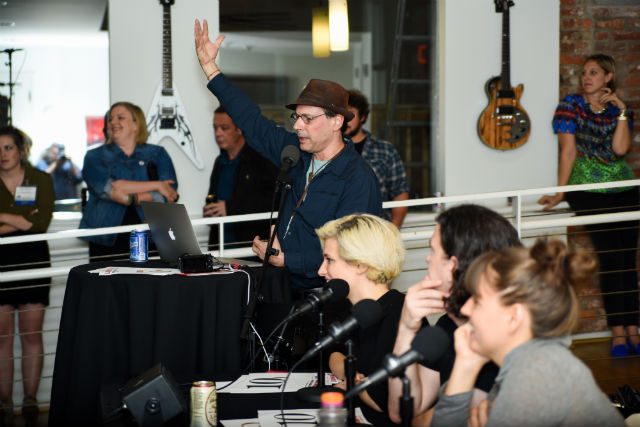 Boilen.
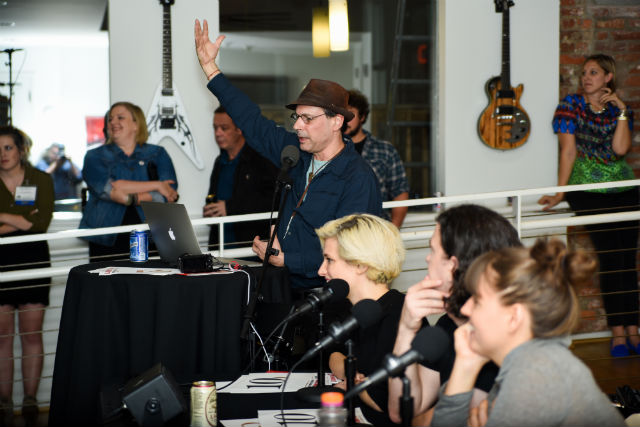
The summit closed with an All Songs Considered listening party, with NPR music and All Songs Considered hosts Bob Boilen and Robin Hilton. The event allowed the audience to hold up a piece of a paper in order to rate on a scale of one to then what they thought of the song Boilen was playing, while Hilton went around the room interviewing people as to their opinions on the songs.
I asked Bob Boilen how technology changes the way the music is heard and made. Boilen has seen a lot of changes over the years as a musician and a music journalist. The fact that he’s been on both sides of the aisle makes him a uniquely qualified person on this subject.
“Think of what records did,” Boilen said, “instead of that piano or guitar in the parlor you could hear a big band without ever leaving the house. Radio magnified that and influenced a new generation of musicians… This next wave magnifies our listening choices and makes for interesting pockets of sub cultures and tiny communities.” He’s completely right, as many of those subcultures were represented at the summit. Boilen’s points show us that all of the technological changes in music have direct impacts on each other. How we create, how we listen and how we consume all work together as technology develops to change the experience of music over time.
Kevin Erickson believes that “musicians can’t just be spoken about. The absence of musicians in the conversations about the reality of technology makes it difficult for people to make informed and relevant policies on the matter.” Erickson, like Boilen, made wise and perfectly accurate conclusions. Musicians must be participants in the process for real change to occur, to finally allow for the creation of the missing pieces in the music industry.
*This has been corrected.