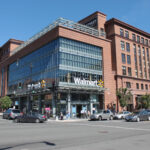
In December 2013, Mayor Vincent Gray and Ward 4 Councilmember Muriel Bowser cut the ceremonial ribbon at the Georgia Avenue Walmart, one of the super center’s first two stores to open in the District.
“We fought for a long time to make sure that this store would really represent what we want in our ward — a high-quality building, fantastic products and wonderful services,” Bowser said at the time.
But nearly a year later, small business owners whose shops are located near the Walmart in Brightwood say they’re in danger of closing and need the city’s help.
Kamran Qureshi, who has been independently running Dollar & Beyond with his brother for the past 13 years, said they were doing “OK” before Walmart moved in directly across the street. “The local community supported us well,” he said.
As Walmart opened, Qureshi and his brother presented their main concern to the media: The removal of on-street parking in front of his store. “The District government removed the spaces to create a turning lane for cars entering [Walmart’s] garage,” the Post reported at the time.
Ten months later, that’s still Qureshi’s main issue, as customers can no longer park out front to make a quick stop. “Now, those good 40 percent customers from driving aren’t coming anymore,” he said.
“This is one thing they did completely in favor of Walmart,” Qureshi said, adding that Walmart passengers can “unfairly” load and unload in front of the store. “They have done their best to put us out of business.”
Qureshi estimates that his business is down 25 to 30 percent, with September an especially slow month. “It’s just a matter of time before we say, ‘We can’t do this anymore.'”
Before Walmart moved in, Qureshi said the auto store next door left because they didn’t want to be “bothered.” He took over the store and expanded next door after taking out loans. Now he’s paying the loans back while changing his staff’s hours depending on business. The number of employees has been trimmed from six people to four, all D.C. residents.
“To tell you the truth, I don’t know how long it is before we go under.”
Qureshi is one of five small business owners profiled in a new report released by Ward 4 Thrives, a community group that opposed Walmart’s move into the area, and Respect DC, a coalition that fought for a community benefits agreement with the company to ensure a living wage. Both groups supported the Large Retailer Accountability Act, which would have required stores like Walmart to pay workers at least $12.50 an hour, but was vetoed by Mayor Vince Gray.
Rena, the owner of the DC Medical Supply, reports a 25 percent decrease in revenue since wheelchair-accessible street parking was removed, while Jose Chavez of Usulután Grocery estimates an 85 percent loss in sales since a bus stop was relocated from his store to in front of Walmart.
“I have customers that tell me, ‘I want to come to your store, but the bus drops me at Walmart.’ They’re tired from work, they say, and just want to get home, so they just shop at Walmart,’” Chavez said in the report.
Willie Baker, the spokesperson for Ward 4 Thrives, said his group thought small businesses would be impacted “tremendously” by Walmart, but also found from owners that the city’s actions had negatively affected them.
“It was bad enough that Walmart was impacting them, but now the city is impacting them by taking away their customers’ ability to park,” he said. “And we didn’t think the city should play favorites that way.”
Baker said he was not aware that the city planned to get rid of parking on Georgia Avenue NW. Qureshi said the exact parking plan was unclear until the changes were made, two days before Walmart opened. After “raising hell” about the subject during community meetings that Qureshi says Bowser attended, Qureshi said he was told small business customers could use the Walmart parking garage at no charge.
“If you don’t help the small businesses and they close up, then you have boarded up stores along Georgia Avenue,” Baker said. The worst thing a neighborhood has is boarded up stores. All sorts of bad things happen in neighborhood stores.”
Ari Schwartz, a solidarity organizer with DC Jobs with Justice who helped compile the report for Respect DC, said shopping locally has a larger impact on the community. “Think Local First DC cites that every $100 spent at a local business returns $68 to your community, whereas shopping at a chain only returns $43,” he said via email. “When you’re shopping locally, that business owner is more often than a big box store banking locally, buying inventory locally, paying local taxes, sending their kids to a local school, all of which puts money back into communities. Walmart and giant corporate chains return their profits to their corporate headquarters and shareholders rather than D.C.”
Mayor Gray’s office has received the report and is reviewing it, according to a spokeswoman.
Both Baker and Schwartz said the report was conducted to give small business owners an opportunity to tell their stories.
“The residents in Respect DC and Ward 4 Thrives weren’t seeking to conduct an academically rigorous study,” Schwartz said of the small sample size. “They wanted to help these business owners get their story out there, because they’re being ignored by the city and they’re worried they’ll go under. Unfortunately there wasn’t the time to do a more expansive look into businesses further from the Walmart, because it’s an urgent situation with these business owners. It should be the Mayor’s office and the Council doing that study to actually see the damage they’ve brought on Brightwood from their decision to bring in Walmart.”
“We’re trying to minimize the impact,” Baker said. “We can’t fix it all, but we can minimize it — if the city wants to.”
Qureshi would like to see street parking returned to Georgia Avenue. He’s tried contacting various city agencies about the issue, but said he’s only found dead ends.
“You leave messages, and no one calls back,” he said. “No one cares if you’re here tomorrow.”
With his landlord, he added a parking lot to the back of the store, but his elderly customers may choose not to use it. If he adds a door in the back, he’ll have to hire additional security to watch the second entrance. “This is better than nothing,” he said of the parking lot.
Qureshi is not looking for pity, he said, adding that he occasionally shops at Walmart.
“Not everyone wants to shop at Walmart,” he said. “If you’ve got an 80-year-old person who wants two things, he’s not going to walk from one end of the store to the other end of the store to grab a couple of things. When they come to me, they know me personally.”
“They’re very clear that they need their storefront parking back which was removed and they need additional parking infrastructure,” Schwartz said of what the business owners are asking for. “They’re very clear that they want the city to explore tax breaks and other relief that can mitigate losses in revenue from Walmart’s entry. And they’re very clear that they want city support in developing business infrastructure and new business plans for customers and products.”
Qureshi, who initially expanded his hours, would like to see Walmart’s decreased.
“It will give us some chance to fight,” Qureshi said. “We must have our parking back.”