 Photo by futureatlas.com
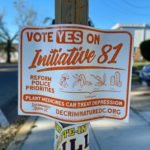
Next week, D.C. residents will (hopefully) head to the polls for another general election. Among the many offices they’ll be voting for—including the next mayor— will be a ballot initiative to legalize marijuana in D.C.
Initiative 71, which was drafted and submitted by local grassroots legalization organization, the D.C. Cannabis Campaign, had a long, rocky road to get on the November ballot. First they went through several drafts in order to get the language perfect. Then the Campaign caught flak from Attorney General Irv Nathan, who claimed it violated federal law. After making their case to the Board of Elections, approval for their ballot initiative didn’t come until the last minute, giving them only a few months to collect the requisite number of signatures to actually get it on the ballot.
But they did collect the requisite number of signatures, and then some.
Initiative 71 proposes allowing adults over the age of 21 to legally possess up to two ounces of marijuana for personal use, as well as give (but not sell) up to one ounce of pot to other adults. The initiative also allows for the home cultivation of up to six marijuana plants with three or fewer “being mature, flowering plants,” and the use and sale of drug paraphernalia “for the use, growing, or processing of marijuana or cannabis.”
D.C. already made significant changes to its marijuana laws earlier this summer, when a bill to decriminalize small amounts of pot became law, despite the wishes of some members of Congress whose districts aren’t anywhere near D.C. Under the current law, anyone caught with less than an ounce of pot is subject to a $25 fine, similar to a parking ticket. Smoking marijuana in public, however, can still get you arrested.
In addition to Initiative 71, Councilmember David Grosso (I-At Large) introduced a bill last fall to not only legalize marijuana in the District, but to introduce a taxation and regulation system, so that grow centers can legally sell pot that the city can tax, with the money used for things like drug education. A Council committee will hold a hearing on that bill today.
With the election less than a week away—and the latest polls showing that Initiative 71 is likely to pass, despite some recent opposition—DCist talked with Cannabis Campaign Chariman Adam Eidinger and Councilmember David Grosso to analyze all the scenarios that could play out after November 4, and the likelihood of each one happening.
The Initiative Doesn’t Pass
“I will move to Andy Harris’ district. I will leave D.C., and I’m going to spend the rest of my life trying to unseat that bastard.” That’s what Eidinger told DCist of his Initiative not passing, or Congress trying to block it if it does. Earlier this summer, Rep. Andy Harris (R-MD 1st District) was heavily criticized in D.C. for trying to block the marijuana decriminalization bill.
Although a loss at the polls is unlikely—a new City Paper/WAMU poll shows that 52 percent of likely voters back Initiative 71— it could set back marijuana legalization in D.C. for years.
But if it doesn’t pass, Grosso says he’ll go full in on his tax and regulate bill. “I’ve said from the beginning when I introduced my bill, which was in September of 2013, that this was the real answer to civil rights [issues] that we need to work out in the District of Columbia.” The crux of the marijuana decriminalization bill, as well as Grosso’s tax and regulate bill, is the deep-seated racial disparity in marijuana-related arrests in D.C. According to research, more than 90 percent of all marijuana-related arrests in D.C. affect black men, despite equal reported usage between whites and blacks.
“Until we have a framework for buying and selling marijuana in the District legally, we’re going to continue to have a disparity in police arrests and interactions with the police in our city,” Grosso says.
Likelihood: Not likely.
The Initiative Passes. Then What?
Once the initiative passes, it will undergo a 60-day Congressional review period before it becomes law. During this time, Congress can do nothing, or they can block it, but only with approval from the House, Senate, and President Obama.
There are several things that can happen in the 60 days after the Initiative passes, and it mostly revolves around what the Council decides they want to do and how much blowback this is going to have in Congress. If we get a repeat of the original medical marijuana bill —passed in 1998, but delayed from becoming law by Congress for more than a decade — then it could be a long while before we see legal marijuana in D.C.
Initiative 71 Passes, No Opposition From the Council or Congress
For Eidinger, the best cast scenarios is that Initiative 71 passes the vote, the Council decides to let it go through and become law as they work on a taxation and regulation system. It then goes through the 60-day Congressional review period without a peep from Congress. This, of course is very, very unlikely, considering the marijuana decriminalization bill was nearly blocked.
“The best thing the Council can do is transmit the initiative as is, the day after,” Eidinger says. “But I’m afraid they won’t do that.” With Grosso’s tax and regulate bill already on the table, the Council probably won’t let Initiative 71 go through without some sort of delay or emergency legislation.
Likelihood: Highly unlikely
Initiative 71 Passes, the Council Passes Emergency Legislation to Enact a Tax And Regulate Bill
“Either right before or right after the vote, we can pass an emergency bill,” Grosso recently told the National Journal. “Instead of it just immediately being effective, you would have a period of time where we could then put in the regulatory rules that we need in order to monitor the program.” That’s certainly an option, but one that’s unlikely to happen, Grosso tells DCist. Once Initiative 71 passes, “the question then becomes, do we as a city want to leave that initiative as it is, or do we need to do more? My opinion is that we need to do more,” he says.
“There’s a natural complementarity to the two measures,” Eidinger says. “The ballot initiative will provide relief for private residents who continue to face fines and arrests under the current decriminalization regime, while the District Council’s legislation pursues the more complex task of taxing and regulating private businesses.” Though the Cannabis Campaign supports a taxation and regulation bill, they don’t think their Initiative should be delayed until the Council figures it out.
Likelihood: Possible, but highly unlikely.
Initiative 71 Passes, But the Council Delays It In Order to Work Out a Proper Tax And Regulation System
Before marijuana decriminalization was passed, there was a hefty debate in the D.C. Council over a provision in the original bill that would’ve also decriminalized smoking in public. Ultimately, that provision was dropped from the bill, mostly because of opposition from Council Chairman Phil Mendelson, who quipped, “Why are we rushing to smoke?”
That same mentality will most likely permeate through the Council if Initiative 71 passes. Though all Councilmembers have said they either support the initiative, or the will of the voters, chances are they’re going to take their time to make sure they implement this law the right way, so as to reduce any noise from Congress.
“I do think we need to put a law in place like mine before this goes into full effect,” Grosso says. “We should consider delaying it, if we need to, to give us the time to put in a bill,” he adds. “It wouldn’t mean that we’re overriding it.”
Likelihood: Very likely.
Initiative 71 Passes, Council Delays To Implement Taxation And Regulation, Congress Puts it In Legislative Purgatory
When D.C. voters overwhelmingly voted to legalize medical marijuana in 1998, it took nearly 12 years before the city could actually implement the law. Thanks to Congress, the law was continually derailed thanks to the “Barr amendment”—a special rider attached to an omnibus spending bill—that forbid D.C. from implementing a medical marijuana program. It wasn’t until 2009, when both the House and Senate chose to remove the amendment, that the District could finally move forward with its medical marijuana program.
So the big question is, will history repeat itself?
“The soonest that Congress can act on anything is probably mid-December,” Grosso says. “Honestly, [I think] nothing’s going to go through the House, and the Senate, and get signed by the President to stop something like this.” Rep. Harris essentially tried to do this over the summer with the marijuana decriminalization bill, adding an amendment to the House Financial Services and General Government Appropriations Bill to defund the decriminalization bill. Ultimately, however, it was removed.
Grosso thinks that some members of Congress are likely to do this anyway, which could put Initiative 71 in a tough spot. “They’re going to do that whether or not we leave the initiative the way it is, delay it, or put our own bill in,” he says. No matter what they do, I think we can gain some confidence that they’re not going to do it from the fact that [marijuana decriminalization] has gone through.”
Eidinger agrees: “The Senate has our back, the President has our back.” But if they don’t, then Andy Harris better get used to seeing Eidinger in his neighborhood on a day-to-day basis.
Likelihood: Possible.