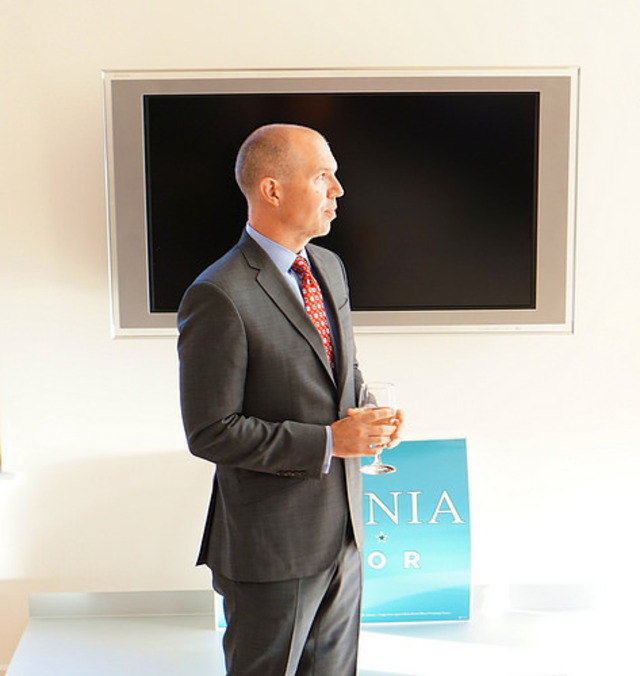
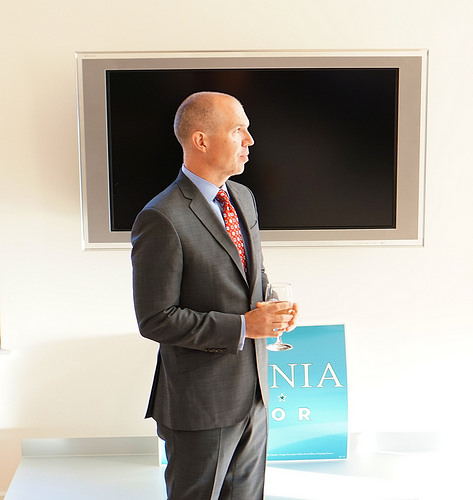
 Photo by Ted Eytan.
For the past 17 years, David Catania has served as an At-Large Councilmember, chairing both the Council’s health and education committees.
Known for his legislative accomplishments and his oft–written about temper, Catania may become the city’s first white, gay, non-Democrat mayor. Currently an Independent, Catania was first elected to the Council in 1997 as a Republican, leaving the party in 2004 after opposing President George W. Bush’s reelection.
One day before the November 4th general election, DCist brings to you the final chapter in our Get to Know a Candidate series: An interview with Catania conducted at his campaign headquarters in Dupont Circle last week.
Read our interviews with Councilmember Muriel Bowser, the Democratic nominee for mayor, and former Councilmember Carol Schwartz. This interview has been lightly edited and condensed for clarity.
My first question for you is about the mayor’s plan to close D.C. General and replace it with smaller community-based shelters. Your general reaction to the plan, whether or not you think it’s feasible, if it’s something you would continue with when elected.
Sarah, our homelessness crisis is a function of a failed housing policy. To be honest, we have the issue of the future and the now. In the future, the response has to be creating and executing a thoughtful, broad-based plan to house all the particular populations that we see laboring under this failed housing policy.
Obviously, you’re talking about the homeless, you’re talking about returning citizens and victims of domestic violence. You’re talking about individuals who require housing for drug adherence. There’s a whole host of folks for the long-term who we have to be mindful of as we construct a housing policy.
In the short run, there’s a great hue and cry to close D.C. General immediately. The solution that the mayor is proposing is creating six or eight freestanding buildings, scattered presumably throughout the city where a portion of the buildings would be set aside for services to be maintained and so on. I’ve yet to hear the case exactly as to how that is going to set up individuals to succeed any better than what we have at D.C. General. Let me stipulate: D.C. General is no place for individuals to live, and it’s no place to raise a family. And I’m not suggesting for a second that it’s a preferable strategy. I just haven’t heard the articulation as to why it makes sense to spread homeless families throughout the city and the services they need throughout the city.
My most recent visit to D.C. General — and I want to be very clear, I don’t find it presently acceptable on a lot of levels. Number one, the condition and the state of the facility is deplorable. Number two, the absence of services like washers and dryers so that individuals can have clean clothing is not only concerning, it’s perplexing and troubling and outrageous. And it’s also the notion that we spread people through six or seven or eight facilities that they’ll receive better wraparound services than they’re receiving right now, that’s not been made clear to me.
One of the biggest challenges and obstacles at the moment is that I don’t believe we’re setting up people to succeed and to transition into a better life, whether it be in one large facility, or eight smaller ones. If I might for a second: I’m troubled by the fact that the wraparound services, which are essential for people to get on their feet, are nowhere to be seen at D.C. General right now. And the idea that they will somehow magically appear if we spread people throughout multiple facilities across the city is concerning. For instance, the Department of Employment Services has no presence on the site of D.C. General. Ideally, in a perfect world, we would have a housing strategy where this wouldn’t be necessary, where people would have a place to live, where this institutions wouldn’t be necessary, big or small. But that’s not where we are. I just hesitate for a bit to say, ‘Well since this hasn’t worked, well this will work,’ without any plan as to how it will work.
I came to this issue through my chairmanship of the committee on education, where, many of your readers are well aware of the high rate of truancy that impacts our city. And truancy is a complicated issues; it’s complicated often by the age of the child. Older children, the 12 and above, 13 and above, their truancy is often a function of their personal decisions. But when you see younger kids not in school, this is a function of where are the adults.
During my nearly 150 school visits over the past 21 months, when you talk to school leaders about the students who are the most truant they are invariably homeless children, who remain enrolled in the schools and the communities from which they are displaced. It isn’t enough that we provide tokens for transportation. The total complexities facing these families where you have multiple children in multiple schools, where lives are so disrupted, and the way in which we engage these families in so uncoordinated, it doesn’t set these kids up to succeed at all.
So I guess the next question is, what do we do? Right? Well, we don’t descend into despair. We’re a rich city with a lot of resources. And what we need is a plan for the now and a plan for the future. And the plan for the now is to realize that December is not a one-off event. That December happens every year like clockwork and we know it. It’s to have a good understanding of the present inventory and the demand for housing, especially in hypothermia season and to be making plans in advance of the first day of hypothermia, where it once again appears we are not doing that.
So what does that mean? We know, we expect that there will be about 840 families seeking services this winter. We know that we only made allocations, we only have about 409 spaces for families, so there’s a huge divide there. We also know further that, relying on the executive’s commitment that they would have an issue resolved for this season, the Council did not appropriate funds for hotels. And that’s an expensive proposition; it’s about $15 million, at least that’s how much we spent last year. It’s as if we are, here we go again. We’re right back in the same soup. And what we need is a plan.
And the plan for the now is, We have the now. We have the D.C. General facility now. Let’s make sure that we’re putting that facility in the best condition possible for the residents who are there now. And it means actually trying to attach them to work and to housing and to education. It means bringing the various segments of our government which are necessary to succeed to that location, and let’s get on with it. It means having a plan now. We should have already done this, but it means now booking blocks of rooms in hotels to accommodate what we anticipate, as opposed to waiting for the first day. And again we haven’t done that.
Now going forward, what’s the plan? The strategy can’t be that we’re just going to live with the homeless forever and therefore we should have facilities all over the city in anticipation for it. No, the strategy should be, how are we going to create an abundance of affordable housing in the city, and how are we going to end homelessness as we know it.
And a couple of ideas. We have a public housing authority with about 8,000 units, right over 56, 57 projects across the city. I’m amazed at the disconnect between the vacant units that exist within our public housing authority and our Department of Human Services and our homelessness crisis. Why isn’t there greater connectivity? So depending on whose information you believe, there are anywhere up to 600 units that are used for administration of housing, that are offline because they are in various states of repair, or haven’t had the types of investments needed to house folks, etc. etc. I think job one is immediately, let’s have an honest assessment of the vacant public housing units we have, and what is it going to cost to get these units online, sooner rather than later.
One of the things I want to point out that the mayor’s plan to expand to eight facilities of between 30- and 50,000 square feet is going to be obviously much more expensive than the current price of housing people at D.C. General. If I’m not mistaken, it’s about a 25, 30 percent additional funds of what is needed. So we have to follow the money. I’ve seen enough invitations to mischief around town where these sweetheart deals are made, long-term leases above market-rate and without making sure that you can guarantee me that these individual smaller facilities will be any better than the larger facility. And we have no guarantee of that.
Going back to my previous point: Let’s look at how we look at our available public housing stock, and which units are at various levels of readiness, so we can put them and reintroduce them into service.
And I got to be honest with you, I want to be fair to the public housing authority, but there’s often a disconnect between what they say and what I see, and what residents in the community will tell me. Recently I toured Lincoln Heights, and the residents pointed out a couple dozen vacant, habitable units, and they explained how, in their view, the public housing authority will go through some motion to make it appear as if the building is actually being used, an apartment being used, as opposed to not, including turning on lights and so on to give the appearance of occupancy. I don’t want to engage in far-fetched speculation, but I need to know for myself.
That’s a lot of information. I just want to bring up New Communities: Would that be a a part of your housing plan moving forward?
So, New Communities is very ambitious and was, I thought at the time in 2006, the state of the city in 2006, there was a lot of merit to it. The city has changed incredible in the past eight years. We know that certain of the New Communities projects have been, some have been more successful than others. Northwest One has been more successful by a country mile than Lincoln Heights or Park Morton or Barry Farms.
The part of New Communities that bothers me is the legacy of broken promises. There were 1,500, nearly 1,600 units that were mothballed or demolished. And there was a one for one promise that folks would be able to return. And eight years later there are only 360, 370 units that have actually been either brought online or have been financed to be brought online.
What bothers me is the constant cynicism associated with telling people one thing and then doing another. I see this happening at Barry Farms [sic]. I see this notion of demolishing before you build, that doesn’t work for me, if we’re going to establish trust. The most important commodity in government, in communities is trust. I think the residents of Barry Farms are right to be distrustful about government. Similarly, I would look at, we’re proposing additional improvement to Greenleaf, for instance, with the stated promise of, once we do this people will be able to stay. We have a legacy of breaking that promise.
Under my administration, we will build before we demolish. As far the New Communities projects go, it’s time we revisit entirely these projects. Go back to Lincoln Heights, for example. They have 440, 450, something along those lines, separate units in garden-style apartments and multi-family apartments. To have 40-ish vacant — again I don’t know exactly, I know what the residents are telling me, what I see with my own eyes — to have six entire apartments, an entire building dedicated to maintenance staff, seems to me a waste. And to have 40 units out-of-commission waiting for New Communities one day, that the fire department now uses as a training facility, for crying out loud. Enough is enough. I think we need and the residents demand concrete plans, concrete actions.
This conversation is making me think about the City Paper’s endorsement [Thursday] morning: “We just find Catania’s fundamental critique of the District government today—that it settles for incrementalism, instead of aiming for excellence—to be persuasive. And we think his record on the Council shows his ability to keep doing that if he were mayor.”
Let’s say first 100 days, the people who live in D.C., what sort of new world are they living in after these 100 days? What are some of the biggest and first changes you plan to make?
As a mayor, as a leader, the first responsibility you have is to have a vision and the second is to be a convener. Among the biggest changes people will see in the first 100 days will be a set of expectations that will not suffer or tolerate incrementalism. I’m not running for mayor to do small things; I’m not running for mayor to make incremental change. I’m running for mayor to do big things and to have a government that reflects our city’s shared values. And for 17 years, I’ve had the privilege of representing every corner of the city, and I know the things that we all care about and we all believe in. We all believe in equality of opportunity, we all believe in fairness and we all believe in playing by the rules. And yet our government doesn’t govern through that lens. Our government acts as if these are not our values. Our government acts often to advance its own interests and not its citizens.
The biggest difference, Sarah, will be, people will see this government is going to be organized around delivering on behalf of residents and organized around a sense of urgency in the following areas.
I have no patience for the present, incremental approach to school improvement. We need clear and decisive statements on expectations. We will no longer accept 63 percent of our kids graduating on time; we will not accept the racial and gender divides in graduations and accomplishments; we will not accept this achievement gap that is the largest in the country. So, in 100 days, what might that look like? It will look like, from the top down, we will have one set of expectations, one expectation across our system and that will be of excellence. We are not gonna have two sets of expectations, or three sets. We have a sliding scale of expectations in this city. For poorer communities, we have long accepted failure and we have no risen up as a result.
So does that look like changing officials, changing teachers in schools. How does that excellence get achieved?
If we can just focus on education: For the last 21 months, if I could give a little history, it sets the stage for what the next incarnation of improvement would look like. Under our current trajectory of school reform, we celebrate one percent improvements in proficiency per year, and at this current trajectory it will take us 30 years to hit our stated goal of 75 percent proficiency in math and reading for our kids. I want to be very clear: This is not a criticism of anyone at all. This is just community expectations around our school.
So, what have we done in the last 21 months and what will we do in the first 100 days? Last 21 months, we ended social promotion in our schools. In DCPS, it was against the law to hold children back except in the third, the fifth or the eighth grade. There was just the collective system force kids along until they became freshman, where they would have to earn Algebra and English credits for the first time to become sophomores. So they consequences of the social promotion was that, by the time they got to ninth grade, especially within DCPS, our students really weren’t on ninth grade level. Couldn’t pass Math, Algebra and English, and a third would fail, every single year. That’s why our freshman classes are twice the size of our sophomore classes. The legacy of failure is sitting in the ninth grade. And that’s when kids start dropping out, start getting into trouble. So ending social promotion, rather than the actual law saying you had to be promoted, leaving that decision to principals and to teachers, and with the further requirement that we do an early intervention, an early assessment of the students, as early as the first quarter, which the law requires. To look at children who are at the risk of retention and come up with individualized plans and the resources to help them succeed.
The second thing we’ve done, which is very big — and, again, this will get to the first 100 days, because I think we’ve set the table for the first 100 days — the second issue that I tackled as chairman of the committee was the notion of at-risk funding. During my school tours I would see schools in one part of the city where a quarter of the families would have PhDs and a quarter of the families would be homeless. The District is a relic because we never, we haven’t during the school reform or school improvement period recognized that it takes more money to educate a poor child than a rich child. A child from an affluent background is better prepared to start, fewer emotional and social issues. Especially when you aggregate and concentrate poverty, those schools face different challenges. So authoring the fair funding bill, and having it implemented this year, I think is going to be one of the most important down payments on improving schools in east Washington going forward. Eighty million dollars this year, $2,200 for every child who’s homeless and in the foster care system, on public assistance, on food stamps, or one year older than their peers, and giving the leaders in those schools, the teachers with the principal the opportunity to craft what those interventions will be, narrow the achievement gap, I think is a down payment.
And finally, it’s special education. [Last] week, the Council passed three special ed bills that I worked on for over a year. It’s a culmination; I knew I wasn’t an expert on special ed, so I wanted to go to the people who were, and I asked Judith Sandalow from the Children’s Law Center to lead the effort. And we spent over a year, 500 plus people consulted, at the table — these were special ed advocates and parents and teachers and administrators and so on, and members of our own government — to craft what we think is a reform package that is ambitious and necessary.
So, what would the first 100 days look like? Now that we’ve set the table and seen what the challenges are, how do we execute? And it’s a lot about expectations. It’s a lot about how do we improve the systems within, in particularly DCPS where the mayor has the most authority.
It’s looking at how elementary schools in our feeder pattern system, the integration of elementary schools and middle schools into the high schools. I was shocked, candidly, about how little exist by way of communications between, even in the same feeder system.
One elementary school we’ll use the Ward 7 feeder system as an example, there’s very little communication between the elementary schools in that feeder system. As a result, you can’t necessarily take a child from the third grade in one school and have them in the third in another and believe that they’re the same place. So the next, the 100 days, we’ll be looking at how we improve systems. Horizontally to make sure there’s quality, a curriculum that is equally executed across the grades. Make sure that our elementary schools are integrated into our middle schools and our high schools, and making sure that program integration and curriculum integration.
Just to illustrate, I hear from parents all the time, ‘I’ve got a middle school that has an arts focus and a high school that has [International Baccalaureate] focus. Or I’ve got a middle school that has an IB focus. Why doesn’t the high school?’ We’ve got to listen to our customers. One of the best experiences I’ve had chairing the committee on education is going into our schools, and not just talking to parents and teachers and principals, but talking to the students. I made a focus of talking to the students in the highest grade levels in the schools. In elementary school, I’ll give you an example, I like to ask the fifth graders where they want to go to middle school, which is a very different question than, where are you going. So when you go in — I’ll use Simon Elementary, as an example, on Mississippi Avenue — and you ask the two fifth grade classes, you ask the fifth grade, ‘Where do you want to go?’ They never say Hart, which is across the street. They’ll say Hardy, and that tells you a lot about what your customers want and what they expect and what their parents think and what their peers think. And similarly, you go as I did months later to Hart and ask the eighth graders at Hart, ‘Where do you want to go to high school?’ Where they want to go and where they go is a function of lottery and luck. You ask the eighth graders at Hart, ‘Where do you want to go?’ and you will have a few, and it’s mostly boys because of sports, who say Ballou. And so you dig in deep and ask, ‘Well why is that?’ And again it’s from the exposure to the schools and the hands on hard work and heavy lifting of understanding that our schools in east Washington are not equal to our schools in west Washington.
I really want to say that again: Our schools in east Washington are not equal to our schools in west Washington. So you’re asking what the first 100 days would look like. That will end. The roadmap will be clear as to how that is. An illustration of how they’re not equal, we’ll use Hart Middle School, as an example. I believe Hart is only in its second year of having Algebra, by the way, which is a stable of our highest performing middle school, Deal. When you start looking at what languages are offered at Hart, versus what languages are offered at Deal. Often we talk east, west in terms of race, have, have-not, as if someone has been cheated and someone advantaged. I’m not coming from that perspective. I’m coming from the perspective, every child, in every neighborhood, without exception, has the right, the right to succeed. So what happens with the Hart middle schools, the parents who can flee and they go west. Hardy [in Ward 2], coincidentally, 43 percent of Hardy comes from Ward 7 and 8. When I was meeting with the principal, Trish Pride, I said, ‘We should just pack up the kids and the teachers and we should go east, because 43, 42 percent of the kids are coming from 7 and 9. Only 11 or 12 percent are coming from the feeder system. Let’s go east. At least we’ll get the kids closer to where they live.’
Why is that happening, why do we permit it? We permit is because this machine, this government of ours, has said it was OK and it’s not. What you’re getting is a different moral clarity. That’s the biggest difference that 100 days will start. Now, we’re not going to change the world in 100 days, but what we will do is we will say what is right and what is wrong. And when we see something that is wrong, we are going to have a plan to make it right.
HIV/AIDs. We’re still at an epidemic level in the city. We’re seeing improvement, but we’re still at an epidemic level.
In 2005, when I became chairman of the committee on health, it took us 12 to 18 months to pay bills for our non-profit providers who needed to pay their own staff, pay their own bills, keep the lights on. That’s the kind of partner we were, 12 to 18 months. We had millions and millions of dollars in unspent federal [AIDS Drug Assistance Program] funds to purchase life-saving medications for people with HIV, and we had a wait-list. It wasn’t technically called a wait-list, but we made it so impossible to enroll that it was in fact a wait-list. We had an immature infrastructure, meaning we didn’t have providers in east Washington, we didn’t have primary care providers who were instructed that this was a normal, chronic disease. We had only infectious disease doctors handling HIV. There was so much disfunction. But most importantly, we had a very limited public testing; we were testing maybe about 8,000 per year. We had a broken condom distribution program. But the real foundation of the failure was in our epidemiology, our data and research. And what I found in 2005 was a department relying on data years past its prime, not current, and that meant we couldn’t take our limited prevention dollars and know exactly who was being infected in realtime in order to have a real impact.
When I started, it was 3.2 percent rate if infections, front page stories on the Washington Post every time I woke up and a national disgrace that the richest city in the world, in the richest country in the world, compared to a third world country was an affront to who we are as people. So what did we do?
It was a rendezvous with accountability, is a nice way to put it, with the people who were receiving paychecks from the District government. What were sporadic HIV/AIDs administration hearings before I became chairman became an every Friday hearing. And we went from paying bills in 12 to 18 months to paying bills in 30 days. It wasn’t an accusatory relationship, it wasn’t easy for them. I wanted concretely to know what you were going to do about this and understand why it was so broken. And while I don’t remember exactly the number of steps, Sarah, one of the things in paying bills: We had 30 hands that would touch a bill between the time it entered the system and the time is was paid. Anyone on vacation along that time, it feel to the bottom. We had broken systems that couldn’t deliver. So we changed that. We hired George Washington University School of Public Health and created the best epidemiology report in the country, which is an annual report. We rebuilt our own data and research division within our HIV/AIDs administration, because we don’t want to rely on outside contractors forever. But by building that epidemiology infrastructure, we now know who is being infected and how. We now know how to target our limited prevention dollars. We increased public testing from 8,000 a year to 138,000. We increased condom distribution from 500,000 to five million including female condoms. We built the infrastructure for providers across the city. We trained primary care physicians in chronic care management of the condition. By the time my tenure ended after eight years, we cut the new infections in half and deaths by 68 percent.
I like to talk in numbers. I’m a nerd. But numbers are lives. Two-hundred-thirty-eight Washingtonians died of AIDs the first year I was chairman, and 72 the last year with no wait-list — no wait-list — for drugs. We can do a lot better.
So what’s the next incarnation? How do we continue this? We have to make sure we understand, and the epidemiology reports provide the roadmap for improvement, which communities are getting infected and what’s the best way to message, and how do we continue to build the infrastructure. We have to do a lot better with seniors and we have to do a lot better with young people. And building out our public health curriculum within our public schools, high schools in particular, is very important. Using social media is very important. Looking at the areas where growth continues, including in individuals where there’s substance abuse, and making sure people are accessing treatment is an important step in reducing exposure. But at this point we’re fighting a battle of complacency, especially with gay men. It is a battle that is never going to leave us.
Things to consider going forward, things we might use: Some of the more progressive cities in the country and jurisdictions around the world are exploring Pre-exposure Prophylaxis, PrEP, as a way to reduce the transmission. Getting individuals requires great adherence for the drugs, right? If you can make it available for those who are at high risk you can actually decrease your infection rate. But the science at the moment suggests the best way to reduce transmission of the disease and expansion of the disease is as follows: Continue massive public testing. If you do that and you capture individuals who are HIV positive and you get them on medication sooner, you lower their viral load, you reduce their ability to transmit to others. This is not a battle where we can just hoist the flag and say we’ve one. It’s going to require the experts, the evidence-based response and a constant reminder that it’s job one.
Vision Zero. According to Struck in D.C., which is run by an individual, not the city, we surpassed the number of cyclists and pedestrians who were hit last year already. The city doesn’t release real-time information about where pedestrians and cyclists are hit.
Has it been requested and specifically refused?
Yes. I’ve been told that because many of these have police or fire investigations that go along with it that the information can’t be released until the case is closed completely. But, how would your administration get us there, to Vision Zero, and how does that line up with our current transportation policy? Like the streetcar, for example, which for a moment there looked like it was going to push bikes off H Street completely [over safety concerns].
Vision Zero is an organizing philosophy out of Sweden. It’s organizing principles include ethics, the value of human life, and the appreciation of frailties and human mistakes. So organizing your transportation infrastructure around that ethic is important. The issue of engineering is an important component to Vision Zero; how do you engineer your streets from traffic patterns to speed? Enforcement is an incredibly important component of making our streets safer. I’ve spoken about the need to reengage our traffic enforcement division within the Metropolitan Police Department. That’s set both pedestrians and cyclists and cars on notice that we have laws and infractions will be enforced. And finally the notion of education — they’re kind of the four Es — one of the reasons that Vision Zero is so successful in Scandinavia and Sweden, in particular. I think they’ve had a 40 or 42 percent reduction in deaths as a result of its execution. Very successful. The organizing principles around these fours Es, and education, with respect to your issue of cycling safety, is especially critical. They’re just real simple public education campaigns. For instance, encouraging drivers to open their car doors with their right hand is enormously helpful in providing safer opportunity for cyclist. Because when you do that is actually forces you to turn, to look over your shoulder. It gets you into the practice, the idea that there could be someone coming.
So between ethics, engineering, enforcement and education, these are the cornerstones of Vision Zero, and I think we need a response to each one of those four areas. There’s no reason for our government to hide information about safety. When you’re organizing a government, it has to have each of those elements. If you try to cherry-pick, you’re not going to be successful. And I know, some of the big-city mayors, [Bill] de Blasio in New York has adopted some Vision Zero strategy as [has] the mayor of San Francisco. So we’ve got some go-behinds. But it’s really about — Again, the role of the mayor is to have the vision and then convene the parties and being in the process of execution. Those are the four fundamental elements of the values I see associated with Vision Zero. Then the task becomes, how do we take the resources we have and begin to execute?
One of the things I’ve always prided myself on is that I like to, I didn’t run for Council to do small things. I ran to do big things. That often means you take big bites. You have to improve systems and bring people along. So whether the work I did when I was chairman of the committee on health, not just what we did with HIV/AIDs, but cutting of rate of uninsured in half through targeted expansions of our health insurance system produced a 5.9 percent rate of uninsured before the Affordable Care Act, 3.2 percent for children before the Affordable Care Act. Saving a public hospital, Greater Southeast now United Medical Center, in the midst of a great recession, it does require bringing people together, having a vision and moving forward. And so I’m confident that I have the skill set to tackle these challenges.
…
Look, I’m a confessed nerd. I find this stuff fascinating. I love to know how things work. I like to understand from the people who are charged with assisting how it’s done. So whether it’s sitting down with school leaders, whether it’s sitting down with parents who have navigated the difficult special education system which has reduced them to tears. Understanding how it works and you basically say, ‘Look this is wrong and we’re gonna figure out a way to make it right.’ I get a knock or two because many consider me to be too passionate. I think it’s our responsibility, if we’re going to build a great community, we’re going to build a great community. We can’t accept substandard, we can’t accept mediocrity. That’s not who we are.
This one’s a little bit lighter, but the 11th Street Bridge Park…
I love the 11 Street Bridge. I love the 11th Street Bridge. So here’s what I want to do with the 11th Street Bridge. I am so excited about the prospect for this bridge and connecting. And I may get myself in huge trouble, but I have this vision for downtown Anacostia that it becomes a destination and that the bridge provides the path to the destination.
One of things that we very frequently talk about in terms of the value to human life and our while experience, our humanity is the role of the arts. I commend the Arts Commission and some very forward-thinking individuals currently in Anacostia about using those empty storefronts as places where public art is displayed, because I think there’s so much promise beating away with these opportunities. By virtue of making streets more interesting, not only do you increase foot traffic, you make the streets safer and more inviting. And it kind of has this, it metastasizes into great energy.
Having the 11th Street Bridge connect, and marketing and connecting historic Anacostia in a way that brings people from west to east, and very important, from east to west. I think it’s obviously a metaphor about bridging the city. But the $50 or so million that’s going to be necessary to bring this thing to fruition. I know we’ve committed about $15 million, the rest is promised by the private sector. I want people to know that as mayor I will work with the private sector to come up with those funds, but we will not let that be a barrier between what we want to accomplish. I love the plans, and I think, what’s the next step? What’s the next step?
It’s extremely exciting. The only concern is, once you build this incredible bridge park, all of the riverfront houses in Anacostia, the prices will skyrocket and people will be forced out.
If we do it wrong. How might we do it right? I’m a big believer in our HPAP program, our housing purchase assistance program. In its height, in 2008, we invested $27, $28 million in HPAP and we offered $70,000 per person, and so on. When the great recession hit, understandably, the program shrank, as did much of the government. We need to reevaluate what that baseline downpayment systems should be, and we need to reevaluate what the baseline HPAP funding should be. Then we should exercise some thinking about, do we want to create overlays, areas where we can have a greater emphasis on those funds. I think historic Anacostia is ripe for such an overlay. The 11th Street Bridge is one serious component facing the community not far from historic Anacostia. But you go right up Martin Luther King, and what will happen, once the east and west campus of St. Elizabeths really come to life, as transportation, we’re never going to build enough roads to build ourselves out of the congestion. It’s only going to make that area more attractive for people. We need to do a much better job of counseling people in terms of home ownership.
We’ll end the conversation where we started, around Barry Farm, which is located equidistant between historic Anacostia and St. Elizabeths. What we do there, and how we do it, will very much reflect who we are. If all of the sudden it becomes mixed-income, which is code for fewer poor people, that’s code. I’ve always kind of resented that notion. What if we took transportation opportunities to folks who are lower income and they were permitted to become through their own industry and effort middle income. That’s the way I prefer to see things.
Look, I came from pretty hardscrabble. As I mentioned, my mother raised me as a single person, having not graduated the tenth grade, when her mother died at six and her father at sixteen. To be candid, I watched the way my mother wrote, and I watched how her letters would be flipped, and I think there were perhaps some disabilities there, as well, which didn’t help her circumstances. Only through real hard work did she give me the opportunity for a great public education.
So it’s really bizarre when you consider what this country can produce — you can come from a background like I’ve had and be a candidate for mayor of our nation’s capital. I want for every person in our community, every parent, what my mother wanted for me, which is a chance. Now you have to do your part. You have to work hard, you have to play by the rules, but the system can’t be stacked against you. And that’s why I’m running.