 (Paramount)
It can be hokey, overbearing, sentimental and obvious, and it runs nearly three hours. But for all its flaws as heavy-handed science fiction, Christopher Nolan’s ambitious blockbuster Interstellar succeeds on a level that has been largely foreign to the celluloid-loving director: the emotional.
In an era of movies where feelings are over-telegraphed with bombastic scores (frequently by regular Nolan collaborator Hans Zimmer), this can be a terrible thing, but it’s what saves the movie — and the planet. There were touches of emotion in Inception, and blueprints of it in his Batman movies. His hero was an orphan, after all. Where sentimentality sunk Alfonso Cuarón’s Gravity, it grounds Interstellar, keeping the story human while it explores the farthest reaches of space.
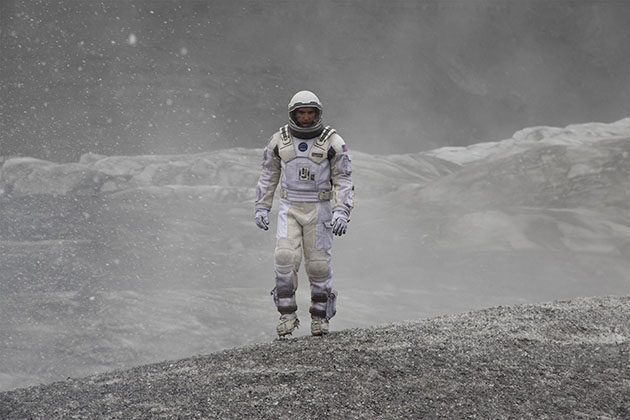
It helps that the film begins not only on Earth, but also of earth: dust. In this dystopic dustbowl America, it gathers on bookshelves that hold a space shuttle model and the works of Gabriel Garcia Márquez, explorers of the heavens and the mind. The planet is in a crisis mode in which heroes look not to the sky but to the ground. The space program has fallen into ruins, but farmers rule the hungry land. Cooper (Matthew McConaughey) was a NASA pilot who went back to work the corn fields, but he still dreams of space. His ten-year-old daughter, Murph (Mackenzie Foy), reads the dust patterns that fall in her father’s library as if they were tea leaves foretelling the future. But is there a fine line between science and the supernatural? Murph and her father interpret the density of dust patterns as a binary code that leads them to the coordinates of a secret NASA facility run by Cooper’s onetime mentor Professor Brand (Michael Caine) and his daughter Amelia (Anne Hathaway).
Brand (note the name) has sent a dozen astronauts to far off missions in search of habitable environments for future generations to populate after Earth becomes a wasteland. These missions involve deep sleep and time slippage that means an hour on a given planet equals seven years on Earth. None of these astronauts has come back from their missions, but three have sent back reports of varying promise. Brand recruits Cooper to pilot a mission to go after these leads.
The machinations and office politics of the film’s space program make me roll my eyes at times, with Hathaway’s Emily given some of the film’s most self-important lines noting that these missions were populated by “the finest in humanity.” (McConaughey has what may be the most ridiculous line in the movie, whose context I won’t spoil, but just remember, “Lazarus!”). But an hour into the film, both adventure and emotion kick in, and Zimmer’s score pulls back from bombastic orchestration to relatively trancelike electronics.
Moviegoers looking for another 2001 will be disappointed. Nobody makes a movie of this size without the lobbying influence of Big Love. But Nolan’s $200 million bauble creates something both awe inspiring in its technical achievement and intimate on the human scale. Which is what the movie is about, after all: can we explore the skies and still hold on to what’s good on earth? Interstellar is about space exploration, but more than that, it’s about something inherent to the art of cinema, and specifically to Nolan’s work: the exploration of time.
Release note: the movie opens in 70mm and 35mm formats today, and opens wide in digital formats on Friday.
—
Directed by Christopher Nolan
Written by Jonathan Nolan and Christopher Nolan
With Matthew McConaughey, Jessica Chastain, Michael Caine, Anne Hathaway
Rated PG-13 for some intense perilous action and brief strong language.
Running time 169 minutes
Opens today in 70mm at Lockheed Martin IMAX at the Air and Space Museum (though all showtimes are sold out) and in 35mm at Angelika Mosaic in Fairfax and ArcLight Bethesda; opens in digital formats everywhere else on Friday.