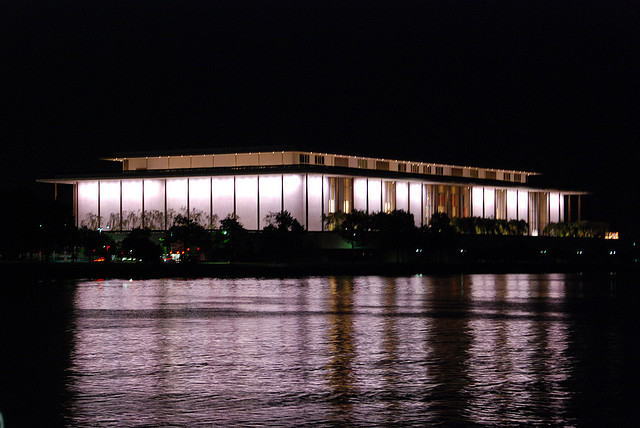
Welcome to a new column, one that amplifies an otherwise unheard music voice — classical music. No, no, don’t turn the dial! Don’t close the tab! Classical music is the bedrock on which modern music has been built. No Mozart, no Magnetic Fields; no Bartok, no Brubeck. We want to explore why that is. This column will highlight an upcoming concert at the Kennedy Center, The National Cathedral, and other classical venues, and give you some context for the performance. It will also feature what you should listen for if (when!) you decide to go and hear it.
By DCist contributor Caroline Baxter
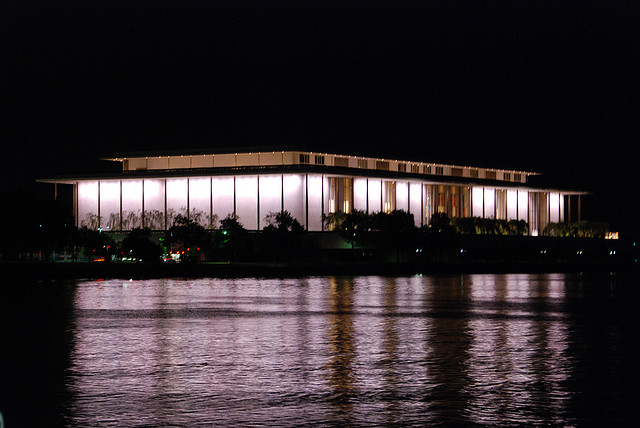 Photo by Kevin Harber
What: Igor Stravinsky, “The Rite of Spring”
Video of the ballet, with original choreography:
Where: The Kennedy Center, November 13th-15th. Tickets $10 and up.
Also, for those of you who are unclear on various musical terms, Naxos provides an excellent glossary.
Quick Facts
Stravinsky dates: 1882 – 1971
Composition date: 1913
Length: ~35 minutes
Stravinsky nationality: Russian
Other works: “The Firebird,” “Petrushka ”
You’ll like this if you like music that’s: rhythmic, moody, dramatic
It’s been 101 years since this piece was written. But it hasn’t lost its power to unsettle. It’s a jagged, ruthless piece of music that reveals more of itself with each listen. It is also the lynchpin of modern music as we know it.
Let’s contrast the opening few minutes of “The Rite of Spring” with two other works. In 1898, fifteen years before Stravinsky wrote this piece, Danish composer Carl Nielsen wrote the charming “String Quartet in E Flat Major.” Stylistically, it’s much closer to the Romantic period of Schubert and Brahms. It has a symmetrical, fairly restrictive rhythmic structure, and a short melody.
Fifteen years after “The Rite of Spring,” in 1928, George Gershwin wrote “An American in Paris.” Gershwin switches rhythms within the first 20 seconds and embraces dissonance. Arguably, the most memorable part of the piece isn’t a melody but the use of trumpets as car horns.
These pieces are thirty years apart, and smack in the middle is “The Rite of Spring.” Gershwin owes a great debt to Stravinsky for paving his way. So do many major film score composers—especially Bernard Herrmann—whose score for “Psycho” sounds strikingly similar to the music at 03:41.
“The Rite of Spring” premiered at the Champs Elysée Theatre in Paris in the spring of 1913. As is often the case with avant-garde art, its reception was fantastically poor. Decades later, the BBC interviewed two ballerinas who performed the night of the premiere. Lydia Sokolova, who danced the role of the girl scarified to the pagan gods, was aware that she was part of an entirely new creation. “It was a very, very difficult thing for people of those days… to suddenly have thrust upon them this gigantic work, a modern thing, that was 25 years in advance of what they had been used to.” Marie Rambert remembered the noise from the audience. “It was terribly difficult to hear the orchestra because of all that noise in the audience. …Najinsky [the choreographer] stood in the wings counting out ‘one two three, one two, one two three, one two.’”
It’s hard to look back on that audience in Paris and laugh at how uncultivated they were. This music is still difficult, but there are works that are written to be popular, and then there are works that are written to provoke. In a way, you’re not really supposed to like “The Rite of Spring,” but you are supposed to react to it—even if you don’t want to. As Harvard Professor Thomas Kelly put it, “the pagans on stage made pagans of the audience.”
What you’re hearing and what to listen for:
Stravinsky scored “Rite” for the biggest orchestra he ever used. There are 86 instruments, including 18 brass and 12 percussion instruments. Some of the percussion is very rarely seen in Western classical works, like the tam-tam, crotales (antique cymbals), and a guiro (an instrument from Latin America). This makes for a sharp, rhythmic sound—precisely the intent. By contrast, the Mendelssohn symphony we heard last time had 41 instruments, with seven brass and one percussion.
Part I: The Adoration of the Earth
The first phrase is discordant and atonal. The woodwinds writhe like snakes. It’s a sound that’s neither bad nor good. This is not a depiction of earth from the perspective of the casual day hiker; this is Earth from the perspective of someone for whom nature is provider and executioner. It’s factual, not normative. Around minute 07:13, the French horns sound a hunting call. The search for the sacrifice has begun.
Part II: The Sacrifice
A girl will be chosen from among her peers to dance herself to death in order to appease the gods of the earth. The solo violin plays briefly and sounds full of dread. After the strings meander for a while, eleven deeply startling strikes comes to the timpani: the girl to be sacrificed has been chosen. The other girls circle her to prevent her from leaving. She begins her dance, the ritual (the “Rite”) commences, and it—and the ballet—ends after she dies.