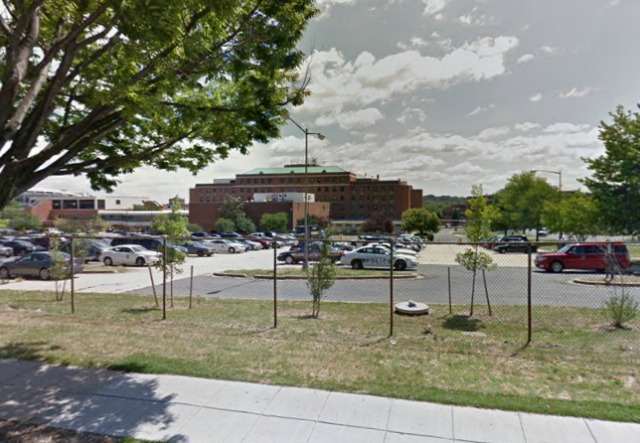
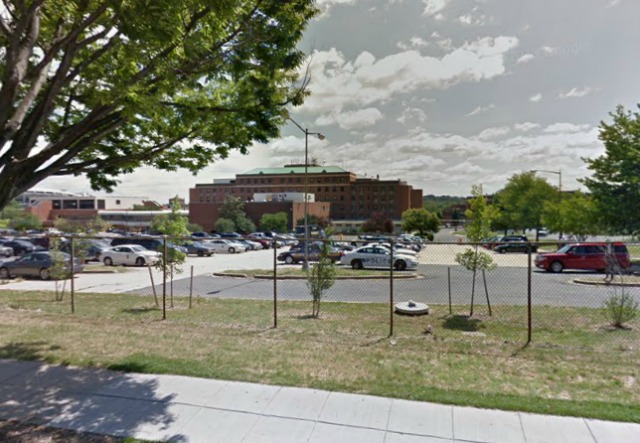
 The D.C. General Hospital building, which is now used as a homeless shelter. Photo via Google Street View.
At a reconvened roundtable on the city’s winter plan to shelter the homeless, officials were still unable to provide specifics on where 250 overflow units for families will be located.
While the city has 369 units for homeless families available, 840 are expected to seek shelter on hypothermia nights this winter season. There are already 120 families at the D.C. General shelter, which can house 248 families. “This leaves an elementary question,” Councilmember Jim Graham, chair of the Human Services committee, asked from the Community for Creative Non-Violence shelter Monday. “What are we going to do to meet the increased demand?”
Hypothermia season — when the city is legally obligated to shelter the homeless when the temperature falls below 32 degrees — began on November 1, with ten families seeking shelter during the first two days. The Gray administration, Graham said, made several requests for hearing delays during October in order to provide full and accurate information about the additional units being procured for families. He also claimed that Deputy Mayor for Health and Human Services B.B. Otero did not attend today’s roundtable at the request of Mayor Gray. Neither did City Administrator Allen Lew, who is chairman of the Interagency Council on Homelessness, which drafts the winter plan.
“We need to have hard facts about where we’re going to house the families,” he said.
Deborah Carroll, interim director of the Department of Human Services, said the agency is in the “very final stages of executing contracts” for 250 overflow units for homeless families. She declined to say whether the units will be in hotels or motels, as they were last year, but she did say they put out a request for dormitory style units. With the 369 units that are already in place for families, those additional units would bring the inventory up to 619.
She rejected that number as “shy” of what’s needed, as Graham put it, adding that all 840 families are not “coming through the door at the same time.”
“Once they’re in the door,” she said, “then we plan to get them out.”
One way the city has been doing this is through the rapid rehousing program. The mayor’s 500 Families, 100 Days program — which technically ended months ago — has housed 436 families, with 71 additional units inspected and ready to go at the moment. There are currently 36 families at hotels being housed with funds from the Temporary Assistance for Needy Families program.
DHS has budgeted $11 million for the 250 overflow units, with the money coming from unspent Child and Family Services Agency funds. The money from CFSA was earmarked as family prevention funds, money meant to keep children in homes and help them return. Graham questioned why DHS and the Gray administration didn’t request funds from the Council in the budget for hotel rooms.
“This is very curious to me,” Graham said of the funds. “This feels like a rabbit pulled from a hat.”
Carroll defended the city’s approach to housing homeless families this winter, saying it was not a “change in course, but a change in approach.”
“What’s different about our approach this year as opposed to previous years,” she said, “this time we’re going through procurement. We’ll have on-site services.”
Last year, families were housed in hotels as the city procured blocks of rooms everyday. “We’re not going to do that again,” Carroll said, adding that last year’s approach was “not the best efficient use of our dollars.” This year, the overflow units will be treated as if they are in a shelter.
Graham also used the opportunity to question DHS about the La Casa building in Columbia Heights. Under construction since October 2012, the building will be able to house 40 homeless men when it opens.
Completed in late September, Carroll said DHS is waiting for an elevator inspection from the Department of Consumer and Regulatory Affairs. (A DCRA spokesperson said, “DHS is not waiting on an elevator inspection from DCRA as a condition for opening the building. DCRA has been out to do inspections when requested.”) While not able to explain the delay, she said that men will be moved in as soon as they have clearance.
“I’m just not getting what I need,” Graham said of the lack of information that could be shared with the public ten days into hypothermia season.
“We’re using all the tools in the toolbox … to move families through the system,” Carroll said. “I see very concrete evidence that we’re in a very good position this year.”
“You know I want to believe,” Graham replied.