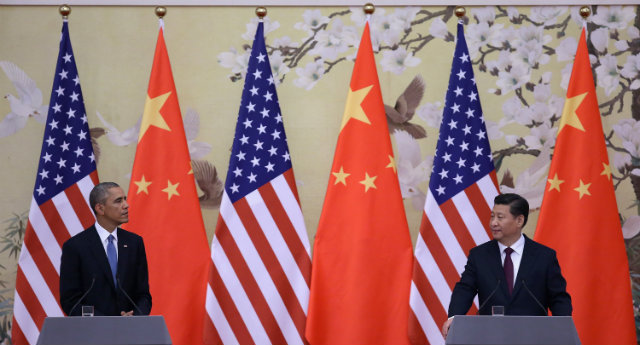
 Photo by Photo by Feng Li/Getty Images.
In a joint effort to help combat global climate change, President Barack Obama and President of the People’s Republic of China Xi Jinping struck an agreement today that will, among other things, help decrease the emission of greenhouse gases.
In a release from the White House, the U.S.-China climate change agreement will involve the two countries working together, with an action plan and goals that are part of a “longer range effort to transition to low-carbon economies.” Among the goals is for the U.S. to “achieve an economy-wide target of reducing its emissions by 26 to 28 percent below its 2005 level in 2025.” For China, one of their primary goals is to “achieve the peaking of CO2 emissions around 2030.”
In announcing this partnership, the White House says they hope it can “inject momentum” into making global climate change initiatives a priority and “inspire other countries to join in coming forward with ambitious actions as soon as possible, preferably by the first quarter of 2015.” Among the joint strategies announced today is a “renewed commitment to the U.S.-China Clean Energy Research Center,” establishing a project for major new carbon storage in China, start “phasing-down” the use of high global warming potential Hydrofluorocarbons (or HFCs), which cause greenhouse gas emissions, and more.
“A strong, cooperative relationship with China is at the heart of our pivot to Asia,” Obama said at the joint press conference announcing the partnership today in Beijing, China. “And if the United States is going to continue to lead the world in addressing global challenges, then we have to have the second-largest economy and the most populous nation on Earth as our partner. And the carbon reduction agreement that we just announced is a perfect example of why a strong U.S.-China relationship is so critical.”
While the President’s commitment to fighting climate change on a global level is important, some believe this should be an indicator of what should be done with environmental issues on the home front, such as the Keystone XL pipeline. In a statement, May Boeve, executive director of global climate campaign 350.org, said that “there’s no way approving the Keystone XL pipeline and additional fossil fuel development is compatible with this pathway.”
While she applauded the U.S.-China agreement on global climate change, she added that “President Obama needs to build on this announcement and continue to take on climate deniers in the oil industry and Congress to ensure a clean future.”