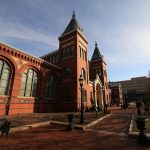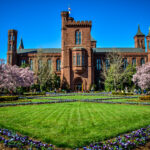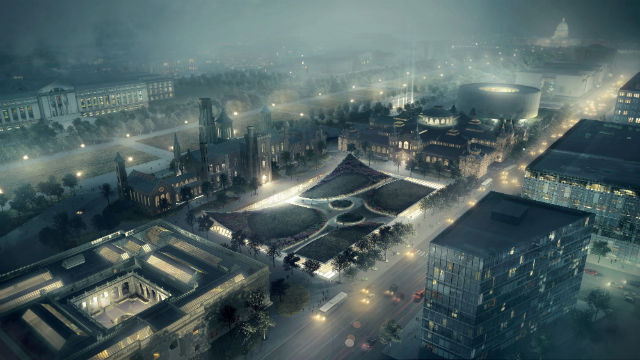
A master plan for the Smithsonian’s south National Mall campus includes revitalizing the Castle and creating new entrances that will connect the gardens with the museums.
The Smithsonian Institution Building, better known as the Castle, will begin in 2021 and will include restoration of the Great Hall and the addition of two underground levels. The $2 billion plan calls for a new entrance to the Freer Gallery of Art, and elevation of the Enid A. Haupt Garden’s corners to add access to the the Sackler Gallery and the National Museum of African Art.
“The Master Plan provides the first-ever integrative vision for the South Mall,” Wayne Clough, Secretary of the Smithsonian Institution, said in a release. “Bjarke Ingels Group has given us a plan that will offer open vistas, connected museums, galleries bathed in daylight, new performance venues, gardens that invite people into them, and it will visually attract visitors who will have an unparalleled experience.”
Yes, the group behind the National Building Museum’s maze designed the master plan for the South Mall. Here are some of the highlights from the plan:
Revitalization of the Castle, including replacement of its building systems and restoration and preservation of the Smithsonian’s oldest historic structure; seismic reinforcement is needed to bring the building to current codes and avoid damage in the future The Hirshhorn Museum will be made more open and accessible to the Mall, and the museum will expand underground to provide additional gallery and public programs space Replacement of the original roof of the quadrangle building under the Haupt Garden, which is nearing the end of its useful life; this roof is above the Ripley Center, Sackler Gallery and National Museum of African Art, and new light wells will allow daylight to light the underground complex for the first time Interior renovations and underground construction to support the Arts and Industries Building, once decisions are made regarding its long-term use Mechanical systems of buildings built in the 1970s and 1980s, including the Hirshhorn Museum (1974) and the quadrangle (1987), are reaching the end of their useful life and require replacement Above-ground and underground connections will be made between the buildings and the gardens running east-west along Independence Avenue