
Words, video and photo by DCist contributor Lang Kanai
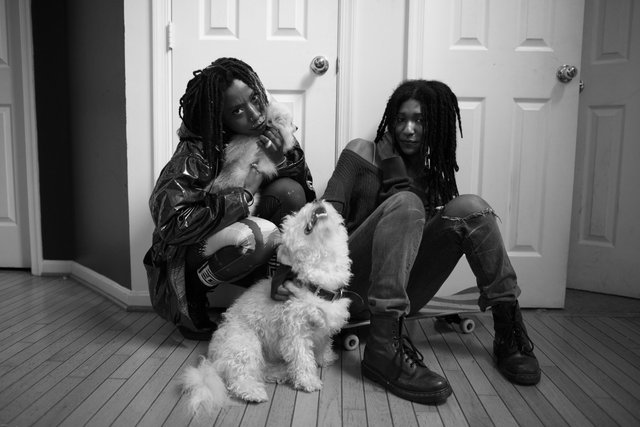
Going by the name Akoko, Sloane Amelia and Sugg Savage form a “philharmonic dyad” that’s as engaging as it is enigmatic. Cataraps, their first full-length LP released last fall, was one of the best albums of any genre to come out of D.C. in 2013. They just played at Atlanta’s world-beating A3C festival in October, headlined by international acts like 2Chainz, B.o.B. and Talib Kweli.
Yet you’d be hard pressed to find them on a bill in the District and even harder pressed to find anything about them online. The disparity between their prodigious talent and local attention is puzzling.
Sugg Savage’s appearance is startling and undeniably fierce. In addition to the many piercings that adorn her face, she wears white contact lenses that lend an otherworldly gaze to her already supernatural talent. It’s a potentially intimidating visage. But when she comes out of her apartment to greet me in a drizzly parking lot, she’s Felicia Soso. Without the lenses, her plaintive dark eyes look more puppy than panther. “I only wear them onstage. It makes me feel like Storm from X-Men.”
When Sloane Amelia, the other half of Akoko — Yoruba for “time” — first saw Felicia, it was in a high school music class. “She just walked in and had her nails all crazy, and I thought, ‘She looks like a good time,'” recalls Sloane, laughing a bit with her friend. Since that first music class at St. Mary’s Ryken in Leonardtown, Md., the two have grown into the best D.C. hip-hop act you’ve probably never heard of.
They were never going to announce themselves or beat their chests, embracing the stunt culture that dominates hip-hop. Natural iconoclasts, music has always been a refuge for both of them. “People would throw stuff at you,” recalls Sloane of her adolescence. “When I listened to rock music, I wasn’t black enough for black people, but obviously not white enough for white people. I would paint my nails black, and everyone would have a problem with it. People would throw stuff at me on the bus.”
Felicia nods in agreement: “I can remember just going into my room, turning the lights off and listening to my music,” she says, echoing her friend. “Like, ‘Yeah, this is so much better than whatever’s going on in school.’” The recollection evokes lyrics from their song, “Deadly Venom”:
Push play, relax/
As if they said no words to me/
Hip-hop was never dead to me/
Punk rock, hip-hop and Keds to me/
Something like wine and bread for me/
Blood and body, Boogie said he’d come for me/
Lock that door threw away the key
The teenage house of mirrors wasn’t the only building block to their identities. It was also poverty, having parents who emigrated to the U.S. from the Caribbean, being black and female. For Sloane, it was also undergoing a history of sexual abuse: “People get uncomfortable when I talk about it,” begins Sloane, “but I talk about it because I don’t want anyone else to have to go through what I did.”
“We’re real hurt about a lot of stuff. People are uncomfortable hearing us talk about it, but how uncomfortable do you think we are living it, ya know?” She pauses. “Being black and a woman,” Sloane continues, “it’s just hard.”
They’ve never bothered with the pretense of giving a damn about what the scene has to say about them. They don’t always have to burn, though, in rebuking a culture they criticize as steeped in patriarchy and misogyny: “And my ovaries done told me I’m the motherfuckin’ man,” Sloane tosses playfully on the album’s opening track.
The two thread anger and playfulness into the tapestry of Cataraps. They also weave beauty, gratitude and an authentic attempt to embrace, in Sloane’s words, “the full color spectrum of life” into their music. They achieve it with dizzying verbal skill. They pull rabbits out of nearly every line, stretching words out, sawing words up, only to put it all together again before the phrase falls apart.
The women of Akoko are motivated and energized by reaching other girls and women who are searching for their own voices. “There are a lot of women out there who are afraid to have personality,” Sloane said. “I know growing up as a little girl in school, it was hard trying to worry about that. If I had heard of other women who were being themselves, it would have been easier to just be myself. I want to have that effect on women, on little girls.”
Akoko plays Tropicalia (2001 14th Street NW) Saturday at 8 p.m. Free for people over 21, $5 for people younger than that.