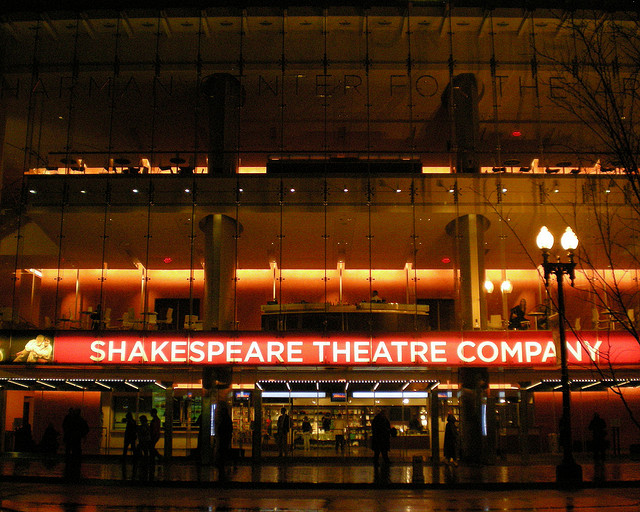
 Photo Via Kevin Harber/Flickr
By DCist contributor Anya van Wagtendonk
You may not expect it from a theater company named for the father of the western canon, but the Shakespeare Theatre Company wants to expand your understanding of the classics —and they don’t think it should just be old white guys, either.
Thirty years ago, when he’d just taken over the helm of the then new Shakespeare Theatre at the Folger Shakespeare Library, Michael Kahn staged Romeo and Juliet, to great acclaim. In his first few years, he also directed plays by Machiavelli, the Spanish Golden Age playwright Lope de Vega, and the Jacobean playwriting trio of Dekker, Rowley and Ford.
The reception to those was a bit more mixed.
“The audience was for the most part befuddled,” says Drew Lichtenberg, literary associate at the Shakespeare Theatre Company (STC), now its own entity with two stages in downtown D.C.
Kahn realized his audience, committed to classical theater though they might have been, was generally underexposed to a number of works that he considered canonical. This posed a practical problem for the artistic director of a classical theater company: How do you convince a discerning patron that this centuries-old play they’ve never heard of is worth their time?
Six years later, in 1993, the year after STC’s move into the Lansburgh Theatre, he launched the ReDiscovery Series, a run of free readings of deserving, but generally neglected, classical plays.
It was “a way of first exposing the audience to these titles,” says Lichtenberg, “and then, secondarily, seeing how these rare plays would play in front of an audience.”
The program launched with plays by Richard Brinsley Sheridan and Friedrich Schiller, among others. Since then, more than 70 neglected works have been given new life on the Lansburgh stage, and many, including that very first Schiller play, have gone on to become full, mainstage productions at STC.
Some of these plays can rightfully be called rediscovered. Written by playwrights comfortably inhabiting the halls of dramatic history, lesser-known works by Euripides, Ben Jonson, Henrik Ibsen, Oscar Wilde, and Tennessee Williams have received readings through this program.
But Kahn’s other challenge that first season was ideological, not practical. The question was not how to get an audience through the door for a classical play, but what constitutes a so-called classic in the first place.
In 1997, after years of mainstage seasons made up primarily of Shakespeare and his contemporaries —with some Brecht and Shaw for good measure —Kahn directed Eugene O’Neill’s Mourning Becomes Electra, STC’s first modern American play.
“It was kind of a landmark production in a lot of ways,” says Lichtenberg, “Because it was Michael saying, this play is a classic and deserves to stand alongside Shakespeare.”
The ReDiscovery Series is, inherently, similarly bold. By identifying the works being read as “overlooked classics” from the outset, the artistic team at STC aims not merely to represent the canon but to reimagine it entirely.
It’s a project that Lichtenberg notices reverberating across the classical theater world. Plays that started as ReDiscovery readings and were adapted for the STC mainstage —including three French plays David Ives, the contemporary playwright behind Venus in Furs, was commissioned by STC to translate and adapt —have gone on to further production at theater companies around the country.
Lichtenberg wears a number of literary hats around STC, acting as literary manager and production dramaturg for every show that goes up. A Yale-trained dramaturg with a background in both classical and contemporary theater, for the past four years he has worked alongside Kahn to choose the titles for each ReDiscovery Series. He says it is an opportunity to essentially develop new plays, even if the words were written decades or centuries ago.
“By doing these plays that are rare or not staged, or ones that were staged 100 years ago and then forgotten, you are basically doing new plays,” he says. “It’s that tension between the old and the new that is part of what the theater is all about.”
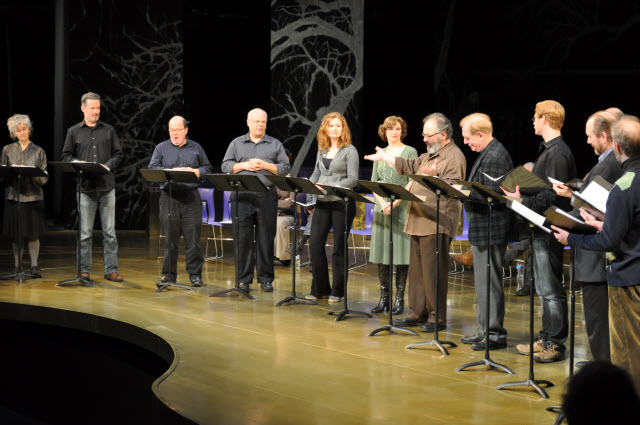 The Shakespeare Theatre Company’s ReDiscovery reading of The Government Inspector by Nikolai Gogol, adapted by Jeffrey Hatcher. Photo courtesy of STC.
That tension can raise new ideas entirely, as it did this season, when Lichtenberg and his team began to prepare for next autumn’s Women’s Voices Festival, a months-long, D.C.-wide commitment to stage world premiere works by female dramatists. During their research for this project, they pored over stacks of woman-authored plays from all different eras, sparking a conversation about the placement of women within the canon.
“We were interested in learning more about why, historically, women have been underrepresented as playwrights, what kinds of plays did they tend to write,” Lichtenberg says. Once they’d settled on a piece for the festival, it seemed a waste to let this line of inquiry, along with some great plays, fall by the wayside.
And so they found themselves with a thematic structure for their annual reading series: plays written by American women in the early 20th century. ReDiscovery kicked off in September with Chains of Dew (1922) by Susan Glaspell. Still to come are Rachel Crothers’ Susan and God (1939), Dawn Powell’s Big Night (1930), Lillian Hellman’s The Autumn Garden (1951), and Alice Childress’s Wedding Band (1962).
The reading of Chains of Dew was one of the first times that play has been revisited since its opening production 90 years ago; it was not even published until 2010. In bringing her words back to the stage, Lichtenberg says, “it felt in some ways like we were restarting this conversation that had lapsed decades ago.”
Engaging with and expanding that conversation is the driving force behind the ReDiscovery Series, but this mission is not without its perils. There are reasons why some older works don’t get staged, often having to do with how they represent certain cultures or answer political or societal questions. This isn’t, of course, unique to theater; think of debates over racial language in Tom Sawyer, or the changing understanding of Wagner’s music.
But in some ways, the “classic” label gives an audience permission to enjoy a work’s redeeming features while contextualizing its problematic aspects as at least era-typical and perhaps even era-representative. It is understood that The Merchant of Venice is anti-Semitic, says Lichtenberg, but we read it in critical context, and nobody protests when it is staged anew.
But to make the argument that other works deserve to be dusted off and given the same treatment, as STC does each ReDiscovery Series, means sometimes exposing audiences to a work’s troubling themes for the first time.
In the case of this year’s women-authored plays, even those that were seen as progressive or even outright feminist in their time “make arguments that we would think of as profoundly unfeminist,” Lichtenberg says. He wonders, though: Even if the arguments made or conclusions reached in some ReDiscovery plays startle modern ears, at one time didn’t these plays speak to the world the writers lived in? Who is to say which work of art deserves the benefit of historical context, and which are unforgivably anachronistic?
It’s an ongoing dialogue, says Lichtenberg, but one that the Shakespeare Theatre Company is committed to promoting. The company hopes that this year’s series, with its stronger thematic structure, will particularly and pointedly point to the need for diversity within the canon. But they also recognize that theirs is not a simple project.
“One of the things that doing this series has taught me, and I think our audiences have recognized, is that progress really is hard, and progress really is arduous,” says Lichtenberg, pointing to the call for female self-abnegation that caps off one of this season’s early readings. “It’s not until you get to Hellmann or Childress in some ways that you start to get a sense of things changing for the better.”
The next reading in the ReDiscovery series takes place at 7:30 p.m. on Monday, November 17, at the Lansburgh Theatre, 450 F St. NW. Free; reservations required. (202) 547-1122. See below for a full schedule, or visit shakespearetheatre.org.
Susan and God (1939)
Monday, November 17, 2014, 7:30 p.m.
By Rachel Crothers
Directed by Shirley Serotsky
Big Night (1930)
Monday, January 12, 2015, 7:30 p.m.
By Dawn Powell
Directed by Lise Bruneau
The Autumn Garden (1951)
Monday, April 27, 2015, 7:30 p.m.
By Lillian Hellman
Directed by Eleanor Holdridge
Wedding Band (1962)
Monday, June 15, 2015, 7:30 p.m.
By Alice Childress
Directed by Jennifer Nelson