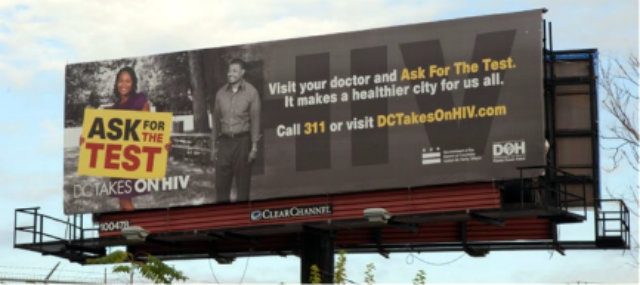
 Via Department of Health.
Still, there’s concern over the lingering presence of the devastating virus in D.C.—and what local officials can be doing to help reduce the number of cases. But a report released today by the Department of Health suggests that their HIV/AIDS prevention campaigns are not only effective in reaching D.C. residents, but could be contributing to the city’s reduction in HIV rates.
“We know that D.C. Takes on HIV and its companion campaigns work,” Dr. Joxel Garcia, Director of D.C.’s Department of Health, said in a statement. “Reaching residents in their homes or on the way to school or work is one of the best ways to connect residents to the array of HIV-prevention resources we offer. Providing those resources is the first step to combatting HIV. Connecting residents across the city to these resources is equally important.”
According to the polling, which was conducted by Braun Research, Incorporated between January 3 and February 9 of 2014, 71 percent of respondents said they’re aware of the city’s free condom services because of outreach campaigns. Those campaigns are comprised of three high-profile marketing efforts, “D.C. Takes on HIV,” “Ask for the Test,” and “Rubber Revolution,” which showed varying degrees of success according to the report.
While 44 percent of respondents recalled the “D.C. Takes on HIV” social marketing campaign and 39 percent of respondents recalled the “Ask for the Test” campaign, only 14 percent recalled the District’s condom use and education campaign, “Rubber Revolution.”
To put things in a bigger perspective, the report found that 74 percent of all survey respondents said that “the campaigns made them think about the risks of HIV,” while 55 percent said that they “made them think about getting tested for HIV.”
In 2012, the number of newly diagnosed HIV cases decreased to 680 cases, a 42 percent decrease from 1,180 in 2008. While that number was certainly a good sign that the HIV/AIDS epidemic in D.C. is declining, a D.C. Appleseed report concluded that officials could be doing more to reduce the number of new cases, such as educating public school students about the virus more effectively, improving the relationships with medical service providers, and implementing federal health care reform measures for HIV/AIDS-diagnosed residents.
“Our social marketing efforts bridge the awareness gap between D.C.’s world-class HIV/AIDS services and residents in every ward,” Michael Kharfen, Senior Deputy Director of the HIV/AIDS, STD, Hepatitis and TB Administration (HAHSTA), stated in a release. “We’re thrilled to be able to quantify the success of the D.C. Takes on HIV campaign. With what we’ve learned from this study, we can continue to make improvements to our outreach efforts and increase resident access to sexual health services.”
You can read the full report below:
DC Takes on HIV Public Awareness Resident Engagement and a Call to Action