Rachel Kurzius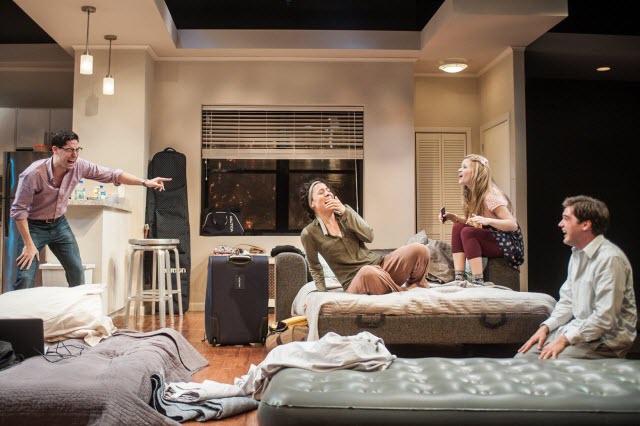
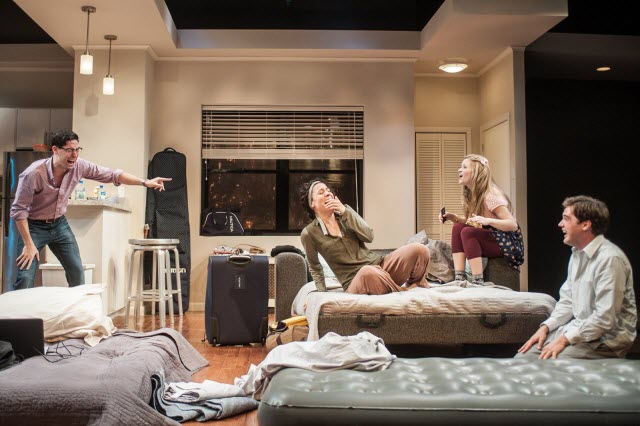 Alex Mandell (Liam), Irene Sofia Lucio (Daphna), Maggie Erwin (Melody), and Joe Paulik (Jonah). Photo: Teddy Wolff.
By DCist contributor Rachel Kurzius
Having a cousin can feel like being stuck with the result of a matchmaking service for family gatherings and holidays. Sometimes the matchmaker gets it right, and people end up with partners-in-crime for stealing sips of wine or making jokes at the odd uncle’s expense. In Bad Jews, currently playing at Studio Theatre, the Shadchan instead found two people who bring out the most venomous sides of the other.
After their poppy’s funeral, cousins Jonah (Joe Paulik) and Daphna (Irene Sofia Lucio) spend the night in an Upper West Side apartment Jonah’s parents bought for him and his brother Liam (Alex Mandell). Liam missed the service, either because of an iPhone mishap while skiing, if he is to be believed, or sheer carelessness, if you take Daphna’s reasoning.
Before Liam arrives with his girlfriend Melody (Maggie Erwin), Daphna tells Jonah that she wants their poppy’s chai, a necklace with the Hebrew symbol for “life.” Their grandfather kept the necklace through the Holocaust by keeping it under his tongue for years, and wanted his grandkids to work out between themselves who got which possession. Poppy either didn’t know his grandchildren very well, or he wanted a verbal bloodbath to ensue.
When Bad Jews begins, Daphna plays the part of good cousin, good granddaughter, good Jew for Jonah and the audience. She is sure of her righteousness in carrying on religious traditions, including its more modern components, like joining the Israeli army. In a brave performance, Lucio isn’t afraid to irritate the audience. She makes Daphna feel so real that I was getting flashbacks to Jewish summer camp, where Daphnas abounded.
Liam arrives and his takedown of Daphna soon follows. At first, his vicious characterization of his cousin feels welcome, almost satisfying. His monologue grows madcap as Liam continues to whip himself into a frenzy. This has the effect of making the audience (or at least this audience member) feel complicit in and guilty about some of his more violent statements.
Liam is more interested in the romantic traditions of the necklace, which he wants for himself. Poppy put it around their grandmother’s neck when he proposed, too poor to buy a ring but willing to give her anything precious he had to show his love. Liam plans to tell the story of the chai to Melody before asking her to marry him. This is doubly bad for Daphna, who can’t imagine an heirloom she sees as irrevocably Jewish around the neck of someone she describes as “live water-birthed in a Talbots.” Melody, who personifies the now-popular term “basic,” has some of the funniest scenes in the play, including a musical number that you really just have to see for yourself.
Jonah wants to stay out of it. This is a pattern for Jonah, who spends much of the play cowering in a corner. When sought out by his brother or cousin as the staging re-centers itself, he finds a new corner in smart directing from Serge Seiden. If he is supposed to act as an audience stand-in, playwright Joshua Harmon does not have a very high regard for his audience. Instead, viewer sympathies jump around among the other three characters, depending on who needs a beatdown by monologue.
And for those thinking these harangues will leave you feeling depressed, remember this: Bad Jews is a comedy. It is at turns goofy, clever, cutting, gross, slapstick. In one scene, the three cousins double over laughing about a scatological memory of their family at a Benihana, showing us that shared history binds them together no matter their disagreements.
Daphna and Liam’s argument over the chai reminded me of the Old Testament story about wise King Solomon.* Two women come to him claiming that they are the mother of the same boy. Solomon decides he will solve this dispute by splitting the baby — literally cutting him in half. One woman protests. She would rather the boy survive with another woman than keep one dead half of him. This, Solomon proclaims, is the real mother. By these standards, neither Daphna nor Liam should be the heirloom’s steward.
The entirety of the play happens in real time during that night. Set designer Luciana Steconni makes the Upper West Side apartment look realistic, and she increases the staging opportunities. For instance, a glass window offers a glimpse of characters’ facial expressions when they have their backs to the audience.
Bad Jews is one of the three most produced plays in America this year, because playwright Harmon hits on questions that go beyond Judaism or even religion. Which parts of our identity do we pass on to the next generation? What are our obligations to our traditions and to our families?
One of the central Jewish texts is called the Talmud, which presents a series of back-and-forths about the meaning of the Old Testament. It shows how central the idea of argument is to the Jewish faith. Using that ideal, maybe the characters of Bad Jews are really all good Jews after all.
Bad Jews plays through December 21. Tickets, $44-88, are available here.
*Corrected.