By Sarah Anne Hughes and Matt Cohen
Marion Barry — the four-term mayor and Ward 8 Councilmember of the District of Columbia — died shortly after midnight Sunday at United Medical Center. He was 78.
The “mayor-for-life,” as he became known, was admitted to the Southeast hospital at about 12:30 a.m. this morning and died at 1:46 a.m., according to the Post. At this time, no cause of death was given, but Barry, who had been suffering from numerous health problems for years, was released from a brief visit to Howard University Hospital earlier this week.
In a statement, D.C. Del. Eleanor Holmes Norton expressed her sadness on the loss of Barry and how big of a loss this is for the District of Columbia. “From my earliest encounter with Marion Barry, when he was the first chair of the Student Nonviolent Coordinating Committee until I came back home and found him mayor of my home town,” Norton said, “I have seen Marion take hold and write his signature boldly on his own life and times and on the life of the nation’s capital. Many took his struggle to personify in some way their own, endearing him and making him a larger-than-life figure as he became a creator of post-home-rule D.C.”
Mayor Vince Gray echoed the sentiment of Del. Norton, writing in a statement that “Marion was not just a colleague but also was a friend with whom I shared many fond moments about governing the city. He loved the District of Columbia and so many Washingtonians loved him.”
>>Read also: D.C. Reacts To The Death Of Marion Barry
On his path from a childhood in segregated Mississippi to becoming the mayor of Chocolate City, Barry first became involved in the civil rights movement at what was then LeMoyne College in Memphis, Tenn. While pursuing higher education, Barry was elected chairman of the Student Nonviolent Coordinating Committee, which brought him to D.C. in 1965.
With his second wife, Mary Treadwell, he founded Pride Inc., which provided jobs to low-income youths. He left the organization to run for D.C. Board of Education, to which he was elected as an at-large member in 1971.
When D.C. was granted home rule in 1974, able to elect its own mayor and Councilmembers, Barry became an at-large member of the city’s first Council. During that term, he was shot in the chest by Hanafi Muslims during a two-day siege on the Wilson Building in 1977.
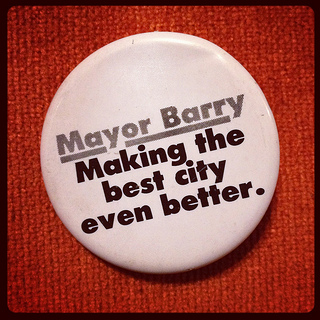 A Barry campaign pin from the 1980s. Photo by allison_dc.
Barry was first elected to D.C.’s highest office in 1978 then again in 1982 and 1986. “I said, ‘We need to ‘Take a Stand’ for new leadership and show that we are not going to take the same old, same old of do-nothing Washington politics,” he wrote of his first campaign in a 2014 autobiography. “You had to do something to make changes; you couldn’t sit around expecting the best to happen. Nothing would change that way.”
While his first term saw some of his most well-known accomplishments, including the summer jobs program, by his third the city was overrun by crack and Barry himself was struggling with addiction.
His downfall began on January 18, 1990, when federal agents arrested Barry during a sting operation at the Vista Hotel. With his on-and-off-again girlfriend, Rasheeda Moore, Barry was captured on a surveillance camera smoking crack cocaine.
Barry served six months in a federal prison, during which time his third wife, Effi Barry, left the family home with their son Christopher. He returned to D.C. and mounted a political comeback that ended with his election to the Ward 8 Council seat.
Two years later, Barry was elected to his fourth term as D.C. mayor. With an enormous deficit, Congress gave control of D.C.’s finances and spending to a control board and left Barry with little power. He returned to political life in 2002, when he was again elected Ward 8 Councilmember, a position he held until his death.
With his health declining, Barry sought to define his legacy in Mayor for Life: The Incredible Story of Marion Barry, Jr., an autobiography released earlier this year.
“You can’t lead where you won’t go, and you can’t teach what you don’t know. That’s a Barryism,” he wrote. “I have been an inspiration to a number of people, but also some people have been afraid to take the same steps that I took. This may be the final chapter of the book, but not the final chapter of my life or yours. For some, it can be the beginning of moving beyond just being here, but also having the vision, courage and tenacity to lead. The struggle continues.”