 Photo by Sarah Anne Hughes.
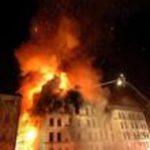
In 2008, a five-alarm fire destroyed the Deauville apartment building in Mount Pleasant, leaving nearly 200 people without a home.
The 85 unit-building has been plagued by issues, from mold to broken heating, with more than 7,000 code violations issued in the years before the blaze.
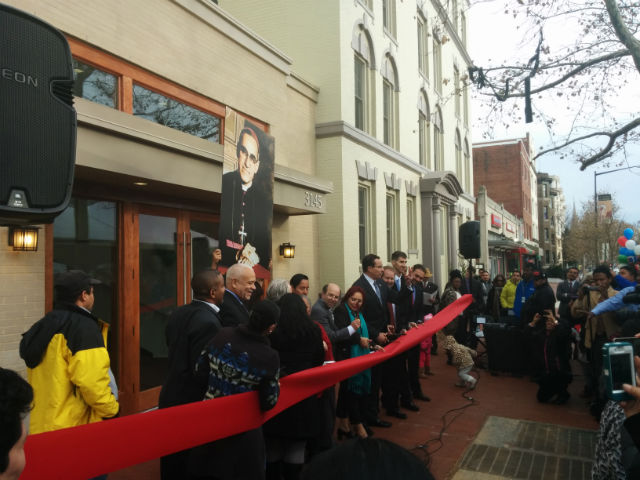
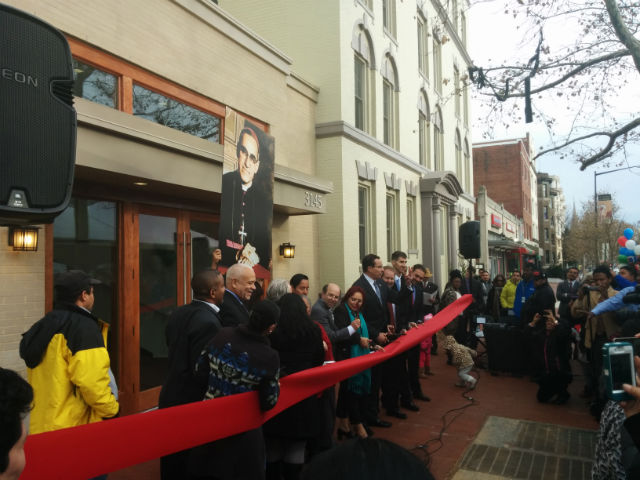
Those issues are nowhere to be seen outside or inside the building at 3145 Mount Pleasant Street NW. Tenants who will return to the building, and the advocates, city leaders and non-profit partners who helped them get there, today gathered at what’s now known as the Monsenor Romero apartments to celebrate its opening.
“Today we have a new beginning,” said Rob Richardson, development manager of the The National Housing Trust-Enterprise Preservation Corporation, which partnered with 3145 Mount Pleasant Street Tenant’s Association to redevelop the building.
Financing for the $19 million building came from the D.C. Department of Housing and Community Development ($4.137 million for an acquisition loan), Capital One Bank ($9.7 million for a construction loan) and through Low Income Housing Tax Credits sold to investors.
“Without the loan,” Richardson said of DHCD’s contribution, “it could not have happened to bring back the residents who used to live here.”
With construction completed 16 months after groundbreaking, 38 of the families who were displaced will move back into what’s now a 61-unit affordable building.
“We’re here today for the phoenix that has risen quite literally from the ashes,” Mayor Vincent Gray said at the ribbon cutting. “This is the completion of a ten-year journey. It shouldn’t take that long to be able to reserve and restore and bring people back, but it did. In one context, I’m glad it did take ten years because it might have been never.”
Among the credit spread around for bringing the building back online, much of it went to Yasmin Romero-Latin of the 3145 Mount Pleasant Street Tenant’s Association — which banded together to to keep the building affordable.
Scott Kline of the NHT-Enterprise Preservation Corporation said he was unsure about the project’s success until meeting Romero-Latin. “This project can’t fail. This project won’t fail with a leader like this,” he said.
Councilmember Jim Graham, who represents Ward 1, also credited Romero-Latin. “I love you for your determination,” he told her, “and for your success in that determination.”
Graham called out the “pig” who formerly owned the building — “that’s what he was” — he called the thousands of violations “tragic.”
“And then the fire.”
Graham said it was a “miracle” that no one — not a tenant or firefighter — was killed during the fire. “It was God’s hand that saved every person in this building,” he said.
He also noted the long process of reconstruction, adding, “If we wanted this to be a mixed income building, we could have done it within 18 months.”
“But there was a commitment that came from the tenants, came from the resident’s council that said, ‘We want to bring all of the tenants back. We want this to be an all-affordable building,'” he said. “You stayed true to that commitment throughout.”
“It’s a miracle that everybody survived,” Graham said. “It’s a miracle that everybody’s coming back.”
The building is now named about Oscar Romero, the late Catholic Archbishop who was a crusader for social justice. “A building of miracles named after a man who will soon become a saint,” Graham said.
“Señor Romero is my inspiration. He helped us a lot from there,” Romero-Latin said, pointing to the sky, “so we could come back home.”