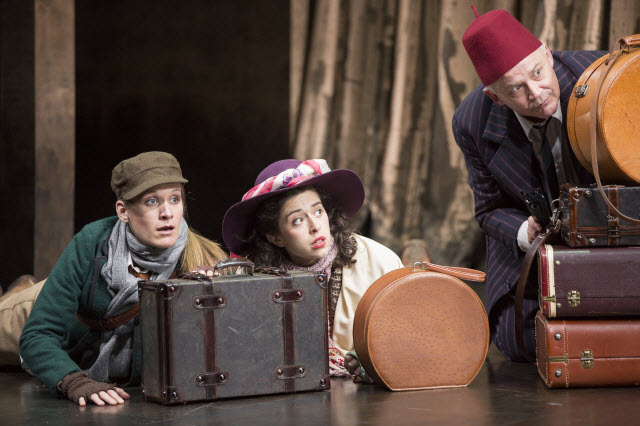
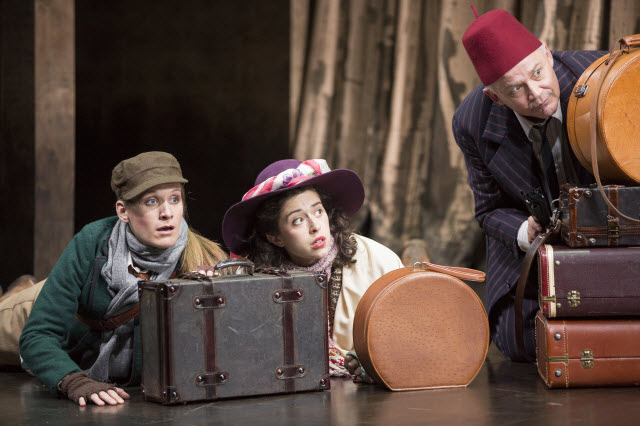
 Zoë Waites as Rosalind, Adina Verson as Celia and Andrew Weems as Touchstone in the Shakespeare Theatre Company’s As You Like It. Photo: Scott Suchman.
By DCist Contributor Jonelle Walker
For a play that delights in themes of rejuvenation, Shakespeare Theatre Company’s production of As You Like It does very little to bring new life to Shakespeare’s classic comedy.
In his dramaturgical preface, literary associate Drew Lichtenberg refers to the play’s “sublime” leading lady, Rosalind, one of Shakespeare’s “most astonishing creations.” His language inadvertently evokes the artistic lens for director Michael Attenborough’s interpretation: placing the exquisite play behind a pane of museum glass, not to be actively engaged with, but rather admired like a statue from antiquity. The audience, for example, is first introduced to Rosalind by a beautiful stage picture; she is revealed by the opening of double doors, with her back turned, and remains lighted for a few moments with swelling cinematic music wafting through the house. This must be our heroine, we assume, but is she so simply for the beautiful shape she makes against the backdrop?
The second of the Bard’s high comedies, As You Like It exhibits a number of the tropes one expects from the genre. A high-minded and quick-witted beauty, Rosalind (Zoë Waites), is the daughter of Duke Senior who has been wrongfully exiled by his brutish older brother, Duke Frederick (both played by Timothy D. Stickney). She remains at court through the kindness of her cousin and companion, Celia (Adina Verson), where she meets our dashing young lover, Orlando (Andrew Veenstra). Through a series of banishments and political entanglements, Rosalind ends up in boy’s clothes accompanied by the fool, Touchstone (Andrew Weems), and all other plot-relevant parties in the pastoral forest of Arden. And, yes, it all ends neatly with a handful of simultaneous weddings and a jaunty country dance.
This production marks decorated stage director Michael Attenborough’s D.C. debut and—despite the evening’s largely dull demeanor— his extensive history with classical theatre is obvious in the ensemble’s performances.
Zoë Waites and Andrew Veenstra are simply adorable as the piece’s leading lovers, Rosalind and Orlando. Though Waites has a mature elegance about her, Veenstra’s youthful earnestness does not throw their chemistry out of balance. Rather, the contrast between the two pairs so nicely that their love at first sight is believable. Their first moment of extended close contact was so well-rendered and deliciously full of tension that, for a moment, it felt as if they were the only two people in the theater.
There were a few truly exceptional performances in the supporting cast, as well. As brothers Duke Senior and Duke Frederick, Timothy D. Stickney turns in a powerful study in contrast. Attenborough, bolstering the play’s themes of transformation and rejuvenation, makes a point of highlighting Stickney’s performance by showing the audience his costume changes, center stage under a spotlight. Derek Smith also shines at Jaques, making full use of the “All the world’s a stage …” speech in what was one of the night’s most engaging moments.
Attenborough’s obvious wealth of talent and strong ensemble seems mislaid here, however, as odd directorial and design choices left the production lacking in excitement. Though both designed by Jonathan Fensom, the costumes and set did not seem to be in conversation with one another.
The costumes for the bulk of the performance have a taste of the mystical pastoral seen in Tim Burton’s film Big Fish with a variety of colors and mid-century costume pieces, but the set takes on a minimalist aesthetic that does not carry its share of the storytelling. A series of rising and falling curtains with splashes of green paint are meant to evoke the lush forest of Arden. Bare wood paneling serves as representative for the indulgent court scenes. Though it seems the set choices were made to convey a simple, stripped-down aesthetic, ultimately the scenic design leaves the audience disappointed by what could have been.
Wistful thoughts of what could have been also haunted this particular performance’s wrestling scene between Orlando and Charles, Duke Frederick’s wrestler. The wrestling scene, while fun, appeared to be run at half-speed. Many of the hits did not connect and a number of naps could be seen, even from the center of the audience. This left the scene feeling more erotic than was probably intended.
Most odd of Attenborough’s directorial choices were those regarding Hymen, goddess of marriage, performed ably by Te’La Curtis Lee. Hymen appears throughout as a non-speaking servant to Rosalind, but is apparently in a human form that appears unremarkable to all of her companions. When it comes time for the requisite marriages, Hymen presents the brides with a song but there is no transformation to indicate that we should regard her now as a deity. In fact, it would be impossible to note her mythic identity unless one were to look in the program. Unfortunately, because Lee happens to be a woman of color, this nearly drops Hymen into the trope of mystical characters of color—and that of a servant, no less— only existing to bestow wisdom on their white counterparts. Though this appears to be completely unintentional, it is still jarring.
By play’s end, there was one glimpse of blistering life at the heart of this production, despite its drab choices. After the marriages and the jaunty country dance, the house lights were brought up to half, and Zoë Waites stepped to the lip of the stage to deliver Rosalind’s rousing final speech. She makes direct eye contact with members of the audience and speaks to the house with absolutely no pretense. Though impressive throughout, this is the first time that Waites is allowed to let her effortless charisma come through and she creates an intimate connection with her audience. Attenborough introduces Rosalind in that early cinematic silhouette, but the audience never really meets Shakespeare’s sublime creation until her final farewell.
To that effect, Attenborough’s As You Like It serves as a great showcase for acting and scene direction, but misses the folksy magic, cheek, and comedic verve that was intended.
As You Like It runs until December 14 at The Shakespeare Theatre Company. Tickets and info here.