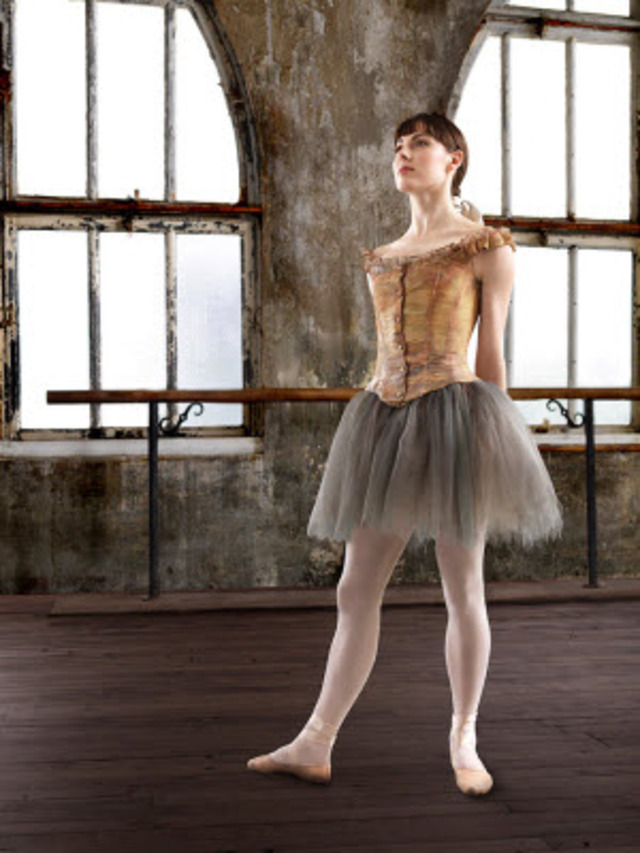
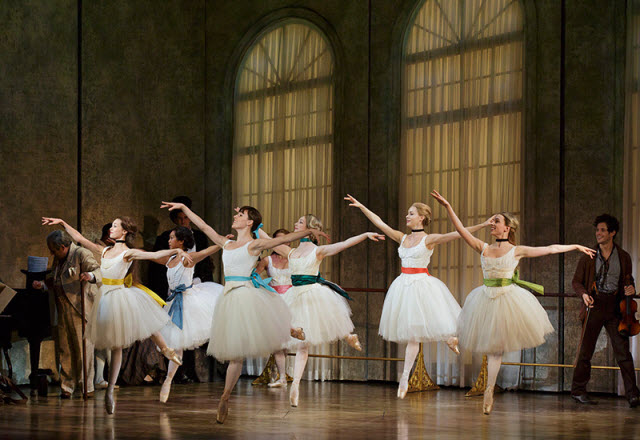
 Tiler Peck and Company. Photo: Paul Kolonik
Little Dancer, the brand new musical wrapping up its debut at the Kennedy Center this weekend, is a whirlwind of fluid dance and motion, to the point where categorizing the performance as a “musical” is a bit disingenuous. The true heart of the show lies in its lively and breathtaking dance, not its music. And yes, sure, that emphasis on dance is right there in the title, but the performance’s vivid celebration of movement is still surprising given its source of inspiration: a static (but beautiful) sculpture sealed forever behind security glass.
The life of the model for Degas’ famous Little Dancer Aged 14, Marie van Goethem, has been mostly lost to history, though the musical adaptation (if you can adapt a sculpture) faithfully relates what little has been discovered about her life — her family, her participation in the Paris Opera Ballet, her serving as a model for Degas (Boyd Gaines). Little Dancer is also concerned with the factual history of the sculpture itself, from its genesis (Degas’ fading eyesight pushes him away from painting) to its current state (its impossible to read anything about the show without being forcefully reminded that you can mosey over to the National Gallery of Art to see one of its reproductions for yourself.)
With the bare minimum of available facts accounted for, everything else is open for interpretation. As the show points out, some critics were scandalized by the sculpture’s debut, and found it base and ugly, while current criticism of the work takes a notably rosier point of view. The creative forces that drive Little Dancer—Lynn Ahrens’ book and lyrics, Stephen Flaherty’s music— go a long way in selling that cheery interpretation. Their understanding of the sculpture and the life of van Goethem is a relentlessly optimistic and beautiful one, despite any tragedies that might lurk beneath the surface.
To explore as much of Marie’s (known) life as possible, the petite ballerina is brought to life twice. Tiler Peck plays the young, scrappy thief, and Rebecca Luker serves as the older, wiser, sadder woman who yearns only to see the statue that took on such an outsize role in her life. In the musical’s framing story, the elder Marie seeks out the sculpture after Degas’ death, and must prove to Mary Cassatt (Janet Dickinson) that she was the model by telling her (and thus the audience) her life story. She haunts the stage for much of the show, often seeming to appear from thin air (more on that later), as she narrates and sings her way through her hard-knock life: stealing on the street, working at the ballet, working as a laundry girl, and eventually modeling for Degas, all to support her manipulative mother (Karen Ziemba, vivid, brass, and weirdly likable for playing a child-endangering alcoholic) and her unrelentingly cheerful and starry-eyed younger sister (Sophia Anne Caruso).
 Tiler Peck as Marie van Goethem and-slash-or a work of impressionist art. Photo: Matthew Karas
There’s another reason to cast two Maries that is impossible not to speculate on. Luker, relying on her Broadway pedigree, does the heavy lifting whenever the character is called to sing out her joys or sorrows and is awarded the entirety of that character’s solo songs. Tiler, meanwhile, acts proficiently and is called to sing in a duets or ensemble, but her real power lies in her background as a principal dancer in the New York City Ballet. Tiler has the impressive ability to bring an audience to thunderous applause while emoting solely in dance, and director and choreographer Susan Stroman has wisely given her ample opportunity to do so throughout the show.
And the musical is indeed a spectacle. The flurry of dancing and singing all unfolds seamlessly across Beowulf Boritt’s masterpiece of an impressionist-inspired stage (in a touch that is perhaps a bit too on-the-nose, the stage is literally framed like a museum painting). The set captures the essence of impressionism in form (minimalist brushstrokes, to the point that the “canvas” shows through around the edges) and function, as walls glide about the stage and props rise through the floor; a new scene with a completely different mood, space, and feel can appear seconds after the previous scene has closed.
This fluid setup allows for Stroman to achieve a few cunningly impressive magic tricks. Characters often seem to blink in and out of existence, vanishing in an instant into a crowd of extras or appearing from behind a sliding wall. And most scenes are staged so quickly, via the actors carrying their props on stage with them, that a new scene will often materialize before the applause has died down for the preceding segment.
Still, there’s a sense that the sleight of hand goes deeper than clever staging. The impressive set, the precise and graceful ballet, and uplifting music are all visually and aurally stunning, but carry the uneasy sense of being a purposeful distraction from the story. Pay no attention to that tragedy behind the curtain, in other words. Still, that’s not because the play shies away from presenting the more morose aspects of Marie’s known life—these are used, usually to great effect, to tug at audience sympathies.
And this is not a dark musical by any stretch (leave that to the heartbreaking Side Show which was also recently on display at the Kennedy Center). Little Dancer easily aims to be the new favorite of many theater goers, ballet-loving girls of a certain age especially. But the sad or troubling aspects that do make it on stage aren’t so much dealt with as swept under the rug with a song and a smile.
Take the girls’ alcoholic mother, who jokingly (or at least, she claims to be joking) says the only reason she had daughters was to earn money from them. She leeches from her daughters, drives the family to ruin, and dashes any of Marie’s plans to save for herself or her sister. When Marie reaches new levels of success, we’re treated to an emotional scene where both the younger and elder Marie look wistfully back through time, saying how proud they are to have their mother in the audience. It’s a poignant moment, but nothing has really happened to explain where either version of Marie found such forgiveness.
These quibbles aside, the play is enough of a technical and visual marvel to make its emotional string pulling seem inconsequential by comparison. The show no doubt aims to be as widely reproduced and as universally admired as the sculpture it is based on, and it likely has the pedigree to pull off that trick. Just don’t think too hard about what’s going on beneath the surface.
Little Dancer runs through November 30 at the Kennedy Center. Tickets sill available for Friday and Saturday performances.