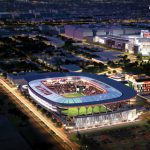
 (Populous/DC United)
Update: The D.C. United stadium bill, with the amendments highlighted below, has passed first vote by the D.C. Council. The second and final vote will be on December 16th. Still, expect a lot of back-and-forth about funding and budget between the Gray administration and Chairman Mendelson.
Original post:
Today, the D.C. Council will vote on legislation that would bring a new soccer stadium for D.C. United to Buzzard Point in Southwest D.C. If you haven’t been following along with changes to the bill in recent months, well, it’s gotten a bit complicated.
The Original Bill
The original bill proposed a pretty straightforward deal, wherein D.C. would trade the Franklin D. Reeves Center at 14th and U streets NW to Akridge development company, which owns most of the land where the stadium would be built. But in the last month, things have gotten a bit more tricky.
The original bill also called for D.C. to pay $150 million toward land acquisition and infrastructure for the stadium, while D.C. United would pay $150 million to build the stadium itself. The deal would last for 30 years, with a couple of five-year extensions available and the team paying a whooping $1 in rent. After that time, the city would be the sole owner of the stadium.
In terms of deadlines, the city agreed to have all the land purchased by March 31, 2015 (in addition to the parcel owned by Akridge, the city needed some buy parcels of land from Pepco, Super Salvage, and investor Mark Ein), all the existing structures demolished by March 1, 2016, and infrastructure work done by December 31, 2016. In turn, the team would need to have design drawings for the stadium done by March 1, 2016, a contract for a construction company signed by July 1, 2016, and the stadium (mostly) completed by March 1, 2018.
The consequences for missing these deadlines could lead to fees waived by the team, as well as the opportunity for either the city or the team to pull out of the deal, if either misses specific deadlines.
What’s Changed?
The day after the November general election, an analysis commissioned by the D.C. Council was released, and found that, not only would the stadium be the most expensive in Major League Soccer history, but that the city is getting the short end of the stick in the land-swap portion of the deal.
The negotiated price for the Reeves center is $55.585 million, but the analysis found that the market price is valued at $66.8 million, meaning that the city could theoretically get more for it if they put it on the market. Additionally, the analysis found that the city would be overpaying for the parcels of land owned by Pepco, Super Salvage, and Mark Ein by about $19.4 million.
Mayor-elect Muriel Bowser then removed the Reeves Center land-swap deal from the bill, instead authorizing the city to use eminent domain to acquire the land from Akridge, or borrow $62 million in capital funds to purchase it. But Mayor Vince Gray has “refused to submit a supplemental budget request to the Council” to borrow the capital funds, WAMU reports. Council Chairman Phil Mendelson criticized Gray’s refusal, and said that the city will seek supplemental budget to cover the $62 million, though Gray still did not support that decision.
Although the Reeves Center land-swap deal is out of the bill, the city is still swapping some land in order to obtain parcels needed. The latest edition of the bill, which will have its first vote today, still calls for the District to swap the Farm at Walker-Jones, situated at First and K streets NW, to Pepco for the parcel of land the company owns needed to build the stadium. Pepco plans to turn the farm into a substation, Housing Complex reports.
Meanwhile, a community benefits package — which includes a Circulator route that goes to Buzzard Point, a requirement that 51 percent of the jobs related to the stadium going to D.C. residents, and more—was included in the most recent version of the bill.
The city’s $150 million cap is still in place, but the tax break D.C. United would get in the bill could cost the city closer to $200 million.
What Happens Next?
The Council will take the first vote today, and while some are still skeptical about aspects of the bill in its current form, it’s looking like the bill will be approved.
Meanwhile, Mayor Vince Gray has issued a statement urging the D.C. Council to pass the bill. “While the plan has changed from the version introduced earlier this year, the opportunity to move forward quickly with this stadium is something that the entire District wants,” he said in a statement.
But there’s definitely some trouble ahead for the land-swap portion. If the city exercises eminent domain over Akridge, chances are the company will try to do something about it and the city will still have to pay a lot in legal funds; but if the city borrows the $62 million in capital funds, that’s putting D.C. very close to the debt cap. Mendelson and the Gray administration will likely clash over funding for the stadium.