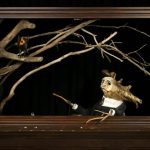
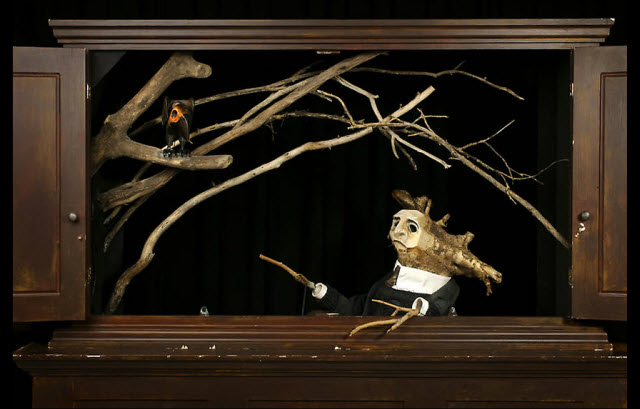
 The “Edward Grue” vignette in Famous Puppet Death Scenes. Photo: Jason Stang
By DCist contributor Anya van Wagtendonk
Peter Balkwill believes he can cure you of your fear of death. How? With puppets, of course.
For the past eight years, the Old Trout Puppet Workshop, of which Balkwill is a co-founder and co-artistic director, has enacted 22 distinct puppet deaths across the world in their aptly-titled Famous Puppet Death Scenes. Beginning December 9 and running through January 4, puppets will succumb to murder, misfortune, and suicide at the Woolly Mammoth Theatre Company. But despite the morose nature of the show, Balkwill says he doesn’t want to bum you out.
“It’s a very uplifting show,” Balkwill promises, “And I think for a very brief time, if you’re sitting there and you’re present in the theater, you will find yourself actually not afraid of the idea of death.”
If you thought puppets were for kids—not a tool for navigating heady ideas or quelling existential anxiety—well, that’s partly the point. The Old Trouts came together in Alberta, Canada, in the late ‘90s as a group of camp counselors who never wanted summer to end.
“We wanted to band together in a way that would allow us to fight off the evils of adulthood and shirk responsibilities and hovel ourselves off into a little laboratory where we could just play and create,” says Balkwill.
The result of this desire is the Workshop, a sort of creative umbrella, embodying music, sculpture, painting, dance, and storytelling. And “when you add up all those different disciplines, the thing at the end of the equation sign is puppetry,” says Balkwill.
Puppetry gave them the opportunity to play with these different forms of artistic expression, even though it’s a form largely associated with children’s entertainment (in large part due to the success of the Muppets, he says). But the group also believes that puppets are much more sophisticated, allowing audiences to access strange, uncomfortable, and even fearsome ideas.
 A dead puppet. Photo: Jason Stang
Puppets “sit in representation of things, they never are the actual thing,” he says. “So we’re able to follow them down the rabbit hole of some fairly deep and moody themes, and witness and examine these ideas in a way that is more accessible than when it’s a human that’s trying to tell us to think about these things.”
Early on, the Old Trouts realized that no less a “moody theme” than Death could be made joyful when presented in puppet form. Working on an adaptation of Pinocchio, they decided to keep in a detail stricken from the Disney version: in the original story by Carlo Collodi, Pinocchio kills the cricket in the second scene. Balkwill says the troupe worried about how children would respond to the murder of dear old Jiminy Cricket.
With pure joy and delight, it turned out. So the next step seemed obvious: an entire show of nothing but puppet death scenes.
Famous Puppet Death Scenes began as a series of unrelated vignettes in 2006, but solidified into a more cohesive story when it first premiered. Balkwill says it changes a bit every time it is remounted, which is fairly frequently. This latest run, premiering at Woolly, will continue on to Canada and France, but the show has been staged across the U.S., Canada, and Europe throughout the years.
Despite cultural differences among audiences, the Old Trouts think the very nature of puppetry is what helps their themes resonate no matter who is watching.
“We try to not write with text. We try to write on the visual plane,” explains Balkwill, who says music plays a central role as well. “And so when you’re writing without words, you have a tendency to work from a more universal place, a more instinctual, human place. A body place. Because it’s funny, but our sense of body language is much more universal than our vocal language.”
As a result, he says, audiences young and old, who may not speak the same language or draw from the same cultural experiences, can access moments and ideas together.
Balkwill remembers the first time he ever picked up a puppet. He was 13, and it was a monk named Algernon; a neighbor’s toy left untouched in the basement. He picked it up, and found— instinctively —that he could bring it to life.
“There is some sense of truth to the idea that the puppet calls the puppeteer,” he now says. “They have this ability to recognize an individual who has the instincts to bring them to life and then call them forward.”
After all, you’ve got to bring a puppet to life, before you can kill it in spectacular fashion—as the artists of the Old Trout Puppet Workshop will do, 22 times a night, for the next month.
Famous Puppet Deaths opens December 9th and runs until January 4, 2015 at the Woolly Mammoth Theatre (641 D Street NW). Tickets and info here.