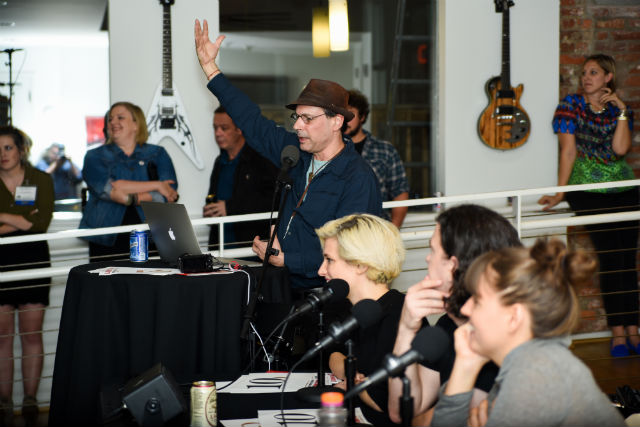
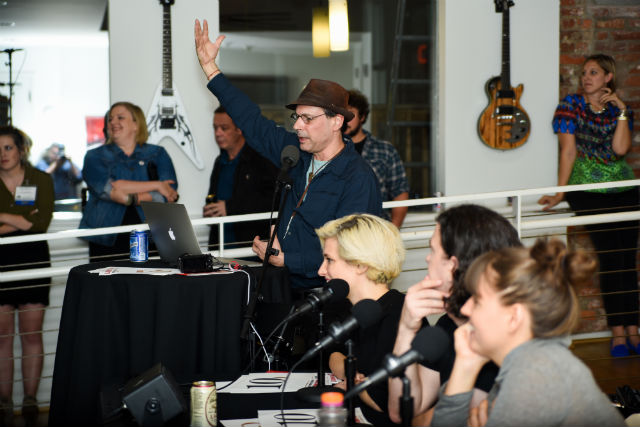
 From the Future of Music Coalition Music Policy Summit earlier this year. Photo by Rob Cannon.
By Chris Naoum, co-founder of Listen Local First D.C.
As January approaches, Mayor-elect Muriel Bowser and her staff have been reaching out to local experts across the community to establish transition teams to advise her new administration.
Listen Local First has spent the last two months working with the current Deputy Mayor for Planning and Economic Development’s office and the D.C. Economic Partnership to help establish a unified voice for our creative community. On November 21, the Local Music Task Force, a new coalition inspired by a LLF co-moderated panel at the Future of Music Policy Summit held its first meeting. Made up of a diverse mix of musicians, record labels, managers, music bloggers, community organizers, and local promoters, the task force addresses the needs and interests specific to the local musicians and the unique challenges they face as artists living and working in the nation’s capital.
During the Music Policy Summit, the panel found six key areas where positive public sector engagement with the music communities can drive increased economic growth. The framework, along with the Local Music Task Force and other initiatives like Fair Trade Music D.C., will establish a set of best practices for Bowser’s administration and other local elected officials to foster engagement with our music community and establish a dialogue. Areas like arts funding, ways to grow cultural creative communities, public performance and busking, permits and licensing, permits and licensing issues, ideas for business-development education and best practices, and coalition building.
FUNDING THE ARTS
Increased funding for the arts is a top priority across the arts sectors; however, there are specific funding practices that have a more pronounced impact on musicians.
1. Larger percentage of Small Arts Grants for individual musicians and bands
2. Create funding opportunities for the small disruptive music startups, tech companies and projects that incorporate music to give back to the community
3. Establish fluid timing and rolling grant opportunities for grants
4. Give grants for printing, merchandise, production, travel and touring for musicians
5. Fund unique creative projects that incorporate the largest number of stakeholders
6. Create more funding opportunities that support general operating budgets for community arts organizations
LIVING AND GROWTH – GROWING A CULTURAL CREATIVE COMMUNITY
If we think of musicians as businesses, the following suggestions can be addressed under general economic and business development initiatives.
1. Affordable housing opportunities for musicians
2. Incentivize musicians and creative music projects to incorporate public school music education within their creative community development plans
3. Affordable space for musicians to practice. Cultural DC’s Spacefinder program is a good start but a more proactive plan for identifying and incentivizing space for this type of use is still necessary.
4. Build stronger relationships with community radio stations, artists and artist groups that are organizing on behalf of the music community
5. Increase the living wage in the district.
PUBLIC PERFORMANCE & BUSKING:
Public performance and busking are time-honored trades that need to be protected. They provide invaluable opportunities for artists to market themselves to new audiences on their own terms. Our city’s most talented musicians will not want to perform in public if they are restrained from marketing themselves, selling their music, accepting donations and are likely to get hassled by WMATA station managers and general law enforcement.
1. Remove any outdated local regulations prohibiting busking in public places
2. If the government wants to designate certain areas where public performance is allowed, they should do that.
3. Create what many cities across the country have– a very simple application and permit processes to allow musicians to perform in public locations over a designated period of time.
4. Work with local music organizations to establish a best practices guide for public performance
5. Work with WMATA to allow for performance in metro stations
6. The current Metro Performs Series should be redeveloped to include best practices for public performance.
PERMITS & LICENSING
The special event permitting process to host cultural community events is currently overly complicated and could be streamlined.
1. Reduce and consolidate paperwork for special events licensees hosting cultural events focused on music arts and community building. Differentiate the process for large commercial events and ones with the most inclusive community impact.
2. Establish a position in the Mayor’s office to help streamline the paperwork requirement and vestigial components of the cultural events permitting and licensing process.
3. Re-visit the Temporary Urbanism Initiative
BUSINESS DEVELOPMENT EDUCATION & BEST PRACTICES
Any tools we can provide to musicians to better educate themselves to navigate the complex landscape of the music industry is important for the development of their small businesses.
1. Create a centralized database and resource center for professional training and development programs targeted to the music community
2. Build partnerships and allocate resources to already existing institutions and organizations already providing educational services and materials for working musicians.
3. Adopt the “best practices guides” of current organizations attempting to create frameworks for best practices in music business development, live music performance, busking and public performance etc.
COALITION BUILDING
In order to prevent wasted government resources, we believe that coalition building is essential to the development of a robust arts community. Working with local arts organizations and leveraging all of their unique resources will require a little extra time and research but will yield greater benefits down the road.
1. Use local radio stations, music blogs and promoters as a tool to work with local artists
2. Incentives and promote unique partnerships. Partnerships that work across all wards, genres and seek to work on larger community issues like education, health and housing will have the largest economic impact.
3. Work with the arts and humanities communities to establish a set of ideal metrics that are publicly available and should help determine grant funding, loan and other government support priorities
If there is one more thing that we can add to this framework as a general principle, it is the D.C. government should be a champion of support for initiatives that pay musicians fair wages. There are too many incidents where musicians are asked to perform in return for exposure. If we truly embrace the premise that musicians are small businesses, then proper compensation is of the utmost importance. The Transition Team will host a public engagement forum on the Arts & Creative Economy this Wednesday, December 10th.