Welcome to a new column, one that amplifies an otherwise unheard music voice — classical music. No, no, don’t turn the dial! Don’t close the tab! Classical music is the bedrock on which modern music has been built. No Mozart, no Magnetic Fields; no Bartok, no Brubeck. We want to explore why that is. This column will highlight an upcoming concert and give you some context for the performance. It will also feature what you should listen for if (when!) you decide to go and hear it.
By DCist contributor Caroline Baxter
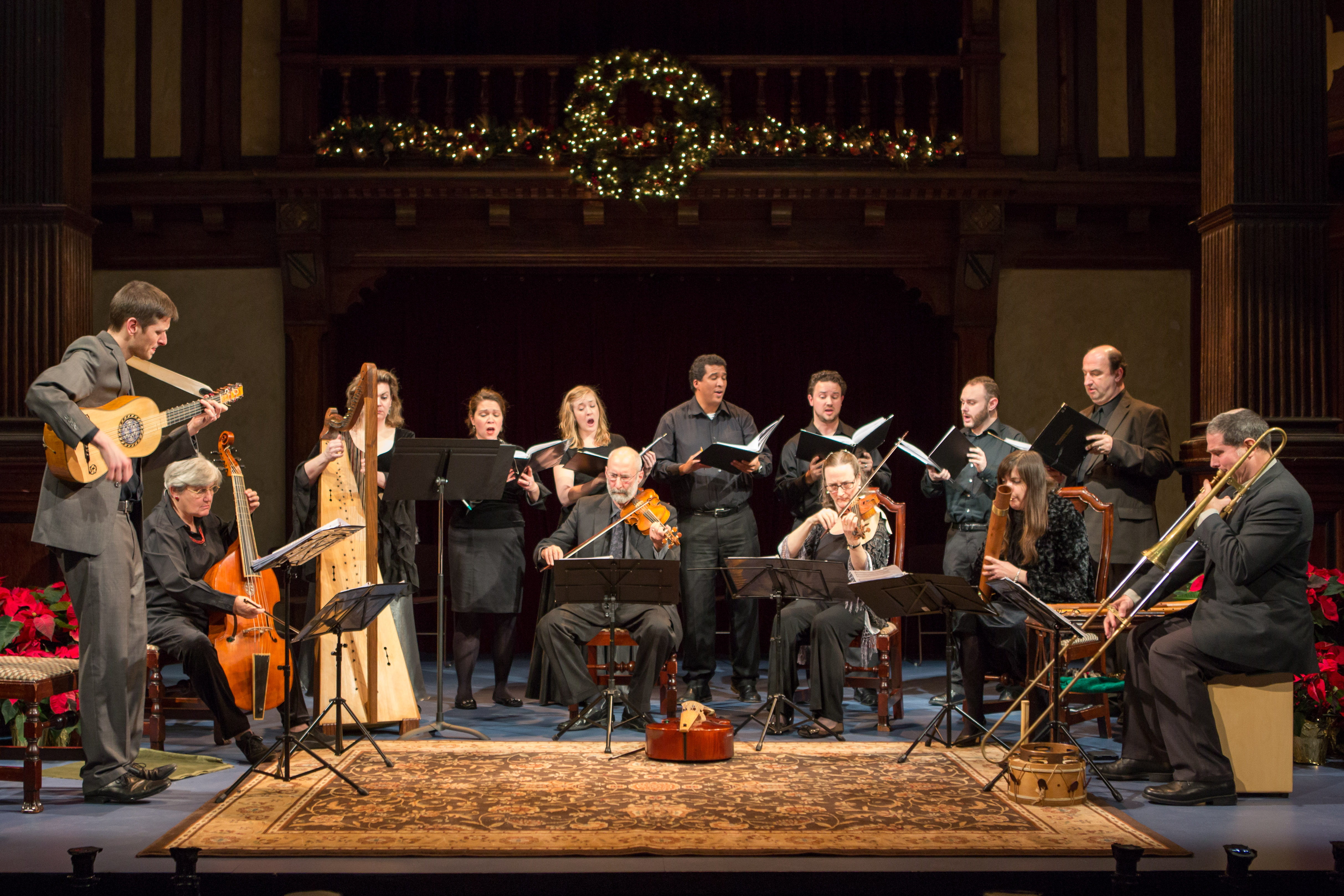 Photo by Teresa Wood
What: “A Renaissance Christmas: Music of Flanders and Italy circa 1500”
Where: The Folger Shakespeare Library, December 16 to 23. Tickets $50.
Also, for those of you who are unclear on various musical terms, Naxos provides an excellent glossary.
Composers represented:
Antoine Busnois: Netherlandish (i.e. from the Low Countries), 1430-1492
Antoine Brumel: French, 1460-1512
Jacob Obrecht: Dutch, 1457-1505
Heinrich Isaac: Netherlandish, 1450-1517
Johannes Ockeghem: Flemish, 1425-1497
Johannes Ghiselin: Flemish, 14–? – 1511
Josquin des Prez: Franco-Flemish, 1450-1521
Johannes Martini: Franco-Flemish, 1440-1497
Loyset Compère: Franco-Flemish, 1445-1518
Bartolomeo Tromboncino: Italian, 1470-1535
Marchetto (Marco) Cara: Italian, 1470-1525
Innocentius Dammonis: Italian, 1500s
The Renaissance spanned three centuries, from the 14th to the 17th, and represented the “rebirth” of (largely European) society. The Renaissance gave us modern diplomacy, the linear style of prose and realism in art and solidified the foundations of our understanding of the workings of the cosmos. The Folger Consort’s Renaissance Christmas concert showcases some of the most beautiful music from the middle of that period. The twelve composers represented in the program all offer lyrical, intricate and stimulating music, and this column couldn’t possibly do justice to each. Rather, it will place the lot into historical context and then drill down into one of the pieces performed.
The music you will hear at this concert was all written in the late 15th and early 16th centuries, a time when, to put it artlessly, everything was happening everywhere. The Wars of the Roses, whose outcome guaranteed the reigns of Henry VIII and Elizabeth I, were fought and won during the latter half of the 15th century. In 1497, the beginning of the Age of Discovery, Portuguese explorer Vasco da Gama circumnavigated Africa.
Some of the world’s greatest achievements in art and science took place during the first half of the 16th century. Da Vinci painted the “Mona Lisa” in 1503 and Michelangelo sculpted “David” the following year. Niccolò Machiavelli wrote the modern diplomat’s handbook, The Prince in 1513. The Age of Discovery continued, as, in 1519, Ferdinand Magellan began his circumnavigation of the earth. And in 1543, eight years after the death of Tromboncino, the eldest composer in our line-up, Nicolaus Copernicus published his theory that the earth revolves around the sun.
To give some context to this context? At the beginning of the Renaissance, the Black Death was just around the corner. By the end of the Renaissance, the Massachusetts Bay Colony was just around the corner.
A lot happened.
There is one piece that the Folger Consort will perform that is worth the entire price of admission. That piece is Josquin des Prez’s choral motet, “Ave Maria,” written around 1485.
Ave Maria, gratia plena/(Hail Mary, full of grace)
Dominus tecum, virgo serena/(The Lord be with you, serene Virgin.)Ave cujus conceptio/(Hail to you whose conception)
Solemni plena gaudio/(With solemn rejoicing)
Caelestia, terrestria/(Fills heaven and earth)
Nova replet laetitia./(With new joy.)Ave cujus nativitas/(Hail to you whose birth)
Nostra fuit solemnitas/(Was to be our solemnity)
Ut Lucifer lux oriens/(As the rising morning star)
Verum solem praeveniens./(Anticipates the true sun.)Ave pia humilitas/(Hail pious humility)
Sine viro foecunditas/(Fruitful without man)
Cujus annuntiatio/(Whose annunciation)
Nostra fuit salvation./(Was to be our salvation.)Ave vera virginitas/(Hail true virginity)
Immaculata castitas/(Immaculate chastity)
Cujus purificatio/(Whose purification)
Nostra fuit purgatio./(Was to be our purgation.)Ave praeclara omnibus/(Hail shining example)
Angelicis virtutibus/(Of all angelic virtues)
Cujus fuit assumptio/(Whose assumption)
Nostra glorificatio./(Was to be our glorification.)O Mater Dei/(O Mother of God)
Memento mei. Amen./(Remember me. Amen)
Des Prez uses tone painting throughout to great effect. In the first phrase, the four voices cascade downwards — first soprano, followed by alto, tenor, and bass — simulating the cacophony of a group of people incanting the same prayer in their own time. This gives the impression of a global communion of the faithful. Then the singers — the voices in heaven and earth — stumble over each other as they rejoice at the Virgin’s conception, and the tenor line is written like a laugh on the word “laetitia.” It humanizes the divine.
The piece shifts twice from multiplicity of voices to singularity of voices. The first occurs when the prayer recounts the birth of Jesus. The piece assumes a hushed tone, like that of a group of people who, having been talking individually, murmur together after being surprised all at once. The second time the voices come together is at the very end, for the final supplication to the Virgin: “O, mother of God, remember me.” The crescendo on the words “Dei” and “Mei” is almost crushingly plaintive, made more so by the use of an open fifth chord for the “Amen.” Without internal notes to apply a major (positive) or minor (negative) filter, the listener is left with no guarantee that Mary will answer the plea. We have said our piece; the rest is entirely up to her. It’s a beautiful, utterly human moment: the unity of hope with fear.
That unity exists at the heart of the Renaissance, and also at the heart of the Christmas story. With great revelation comes great risk. As the Renaissance issued forth the “rebirth” of society, so too does the birth of Jesus in the Christian gospel. What will be the result of this new rebirth? What will happen next? Listening to early music by des Prez and his contemporaries might not give us the answer, but it does remind us that we all stumbling towards it together. And that is a very comforting message these days.