Photos by Justin T. Gellerson.
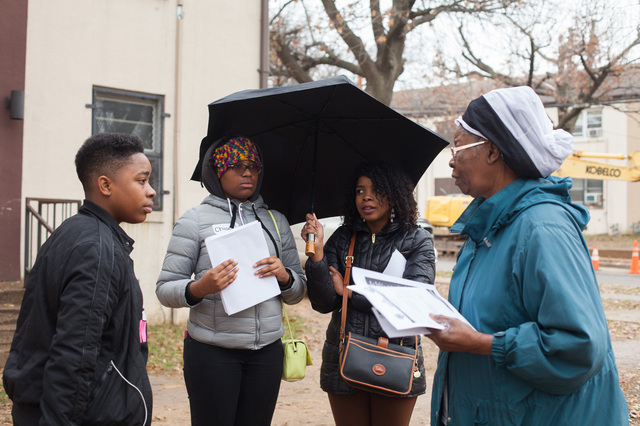
It’s a chilly Friday afternoon, and Chisom Achuko, a senior at E.L. Haynes Public Charter School, is going door-to-door in Barry Farm. She’s not alone. About a dozen or so of her classmates are visiting each house in the Ward 8 neighborhood, accompanied by chaperones, teachers, and members of ONE D.C., a neighborhood activist organization.
Their task? Handing out information about ONE D.C.’s mission, letting neighbors know about the changes happening in their area, and telling them how they can be involved. “People have a lot of concerns,” says Dominic Moulden, a resource organizer for ONE D.C. Moulden, who has been involved with the organization for nearly a decade, is referring to the on-going discussions to redevelop the public housing complex into a mixed-income community with more than 1,500 units.
Here, with Moulden and other ONE D.C. representatives, some of the senior class of E.L. Haynes—the ten-year-old Petworth school’s first—are learning first hand the effects of gentrification and displacement in D.C. It’s part of a year-long sociology seminar class they’re taking that examines the current state of race and race relations across the country.
The class was designed and is being taught by Barrie Moorman, a history teacher at E.L. Haynes. The curriculum, she tells DCist, “focuses on exploring how race and ideas about race are socially constructed, and how racism plays out in our interactions with each other and in institutions.” The goal of the class, Moorman says, is to prepare the students, once they graduate, to “effectively navigate those institutions by understanding how they’ve been constructed and to really challenge them.”
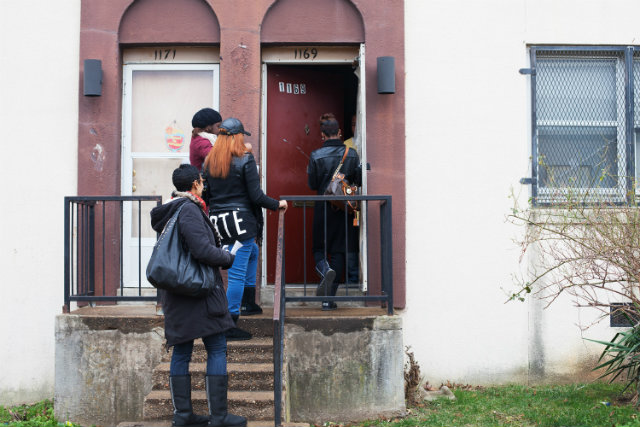 Photo by Justin T. Gellerson.
For the past several weeks, the students have spent classroom time learning about the history of housing policy in the U.S. and its effect on opportunity and access for different racial groups. To wrap up the unit, the students spent last Friday traveling around the city to see the effects of gentrification in D.C. While a handful of them spent time canvassing in Barry Farm, others were traveling to gentrified neighborhoods like Columbia Heights, Mount Pleasant, Shaw and the U Street Corridor.
“We really wanted the students to have a space to be thinking about the society they’ll be entering into as young adults,” Moorman says, “as well as giving them tools and experiences to be activists.”
That’s how the class was introduced to Moulden and ONE D.C. Since 1997, ONE D.C. has been working with longtime residents in transitioning neighborhoods to “exercise political strength to create and preserve racial and economic equity” in the city. Though the organization (originally called Manna CDC) started as a way to help protect residents of the Shaw neighborhood as it began experiencing change, it’s since expanded, operating as a voice and force for residents whose communities are threatened by gentrification.
Specifically, Moulden’s been working in the Barry Farm neighborhood since about 2007. The community currently offers hundreds of single-family homes low-income residents can afford, but the D.C. government is seeking to redevelop Barry Farm into a mixed-use, mixed-income neighborhood through the New Communities Initiative.
While “mayor-for-life” Marion Barry represented Barry Farm until his recent death, the neighborhood is not actually named after him. The history of the neighborhood dates back to after the Civil War, when it became a notable settlement for freed slaves. It’s not hard to find signs of the neighborhood’s Civil War history today. Streets like “Sumner Road SE” and “Howard Road SE” were named after Union generals and radical Republicans who helped end slavery in America.
In 1943, the National Capital Housing Authority built a housing project with 432 units in the neighborhood. While NCHA was abolished in 1987, those units remain today and are owned by the D.C. Housing Authority. Barry Farm is also home to a community basketball league, now known as The Goodman League, which is a part of summer life in the neighborhood, with hundreds of residents coming out to cheer and socialize during games.
But Barry Farm is also plagued by poverty, which is part of the reason why the city says it needs redevelopment. “Some people say it’s an eyesore, it needs to go. But there’s a lot of history behind Barry Farms [sic],” Schyla Pondexter-Moore, an organizer at Empower D.C., told Truthout last January. According to Census data compiled by D.C. Kids Count, 53 percent of the children in Barry Farm, and the neighboring communities of Sheridan and Buena Vista, live in poverty. But in an ever-changing city, the options for affordable housing are becoming increasingly hard to find.
Now, Moulden says, his job is more important than ever. Teaming up with Empower D.C., a community organizing group, Moulden and ONE D.C. have been doing whatever they can—rallying residents, showing up to zoning commission hearings, talking to local lawmakers—to ensure that people won’t get pushed out of their homes, as they have been in other parts of the city.
With Moulden, as well as staff and AmeriCorps volunteers from the Latin American Youth Center, the seniors of E.L. Haynes experienced community activism first-hand and connected the experience to things they’ve seen in their own neighborhoods.
Destinee Davis, a Haynes senior, says that, while her family hasn’t directly been affected by gentrification, she’s certainly seen it in her neighborhood, Trinidad. “Some of my friends have been forced to move,” she says. “A lot of white people are moving in.”
But while these students have learned about, and experienced, the negative effects of gentrification, they’ve also learned about the positive ones and how it can benefit communities. They know that it’s a complicated, nuanced issue, and that it can be as beneficial to communities as it can be destructive
“There’s different perspectives,” says Kai Lin Shi, another senior, when asked if gentrification is a good or bad thing.
Yeny Mendoza, one of Shi’s classmates, agrees: “We get to see the real effect of what we’ve learned in class. … It’s good for [planners, developers] to be building new things, but they need to work with the community.
“The community needs to accept it first.”
Walking door-to-door, there’s a shadow looming over Barry Farm: A new recreation center currently next to The Goodman League basketball court that is scheduled to open this weekend. While some residents are excited about what the recreation center will bring to the neighborhood, others are skeptical, Moulden notes. “That rec center will have the biggest pool in D.C.,” he says, “which is raising a lot of concerns.”
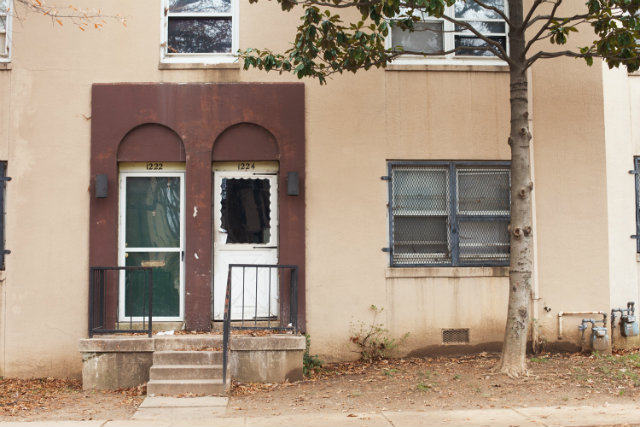 Photo by Justin T. Gellerson.
The next Monday morning, the students came to class and spent a good portion of the day reflecting about what they learned from traveling around the city. “A couple of students talked about the experience of working with Dominic,” Moorman says. His passion, dedication, and commitment, she says, really struck a chord with some students. “He really looks out for the city, particularly for the interest of longterm residents of color. He gave them a stronger idea that people can actually do this with their lives,” she says. “A number of [the students] have asked how they can continue to be involved.”
But the class doesn’t end there. The seniors are still several months from graduation, and there’s plenty more to analyze in the conversation about race and equality in America. Learning about and exploring how gentrification has affected—and is continuing to affect—their neighborhoods is just one part of the student’s year-long seminar. And the goal isn’t just to provide something that looks good on a college resume.
“It’s thinking about how our own racial identities impact our experiences,” Moorman says. “One of the things this class is doing is really providing the language for students to describe, but also engage, with lots of different audiences about the changes they’re seeing. How they can lend their voices to make sure our city is one that is equitable and accessible for everyone.”
The nationwide demonstrations sparked by outrage over the deaths of Trayvon Martin, Michael Brown, Eric Garner and other black men have been a huge topic of conversation for Moorman’s class. It’s been a “very powerful and overwhelming year” to introduce an immersive class like this, Moorman says, and it’s a unique opportunity to get the students thinking about race relations in America as they transition into young adult life.
“I think, to some degree, the end of the course is going to be shaped by what’s going on right now and how to make a difference,” Moorman says. “I feel like right now, in our country and in our city, we’re seeing people standing up saying, ‘This isn’t OK.’ So I feel like this class has definitely been a stage for students to connect with what’s happening around them.”