 Via http://blacklistandyharris.tumblr.com/.
Andy Harris, the Maryland Representative who is spearheading the Republican movement to block marijuana legalization in D.C., does not have many fans in the District at the moment.
His language, added as a rider to a Congressional spending bill, may block D.C. from implementing a marijuana legalization initiative approved by 65 percent of local voters. His response to the outcry from D.C. residents — if you don’t like it, move to a state — added insult to injury.
When Harris introduced an amendment to block implementation of D.C.’s marijuana decriminalization law, Mayor Vince Gray called for D.C. residents to boycott the Eastern Shore, which Harris represents. His latest actions against D.C. led to the creation of the Blacklist Andy Harris movement:
My fellow Washingtonians, Rep. Andy Harris doesn’t give a damn about District residents or our rights, so let’s blacklist him! We can generate and distribute signs/stickers/posters with his face, words like “Persona non Grata” (or something similar), and ask local businesses to display them. We could also put up signs with similar messages all around the District.
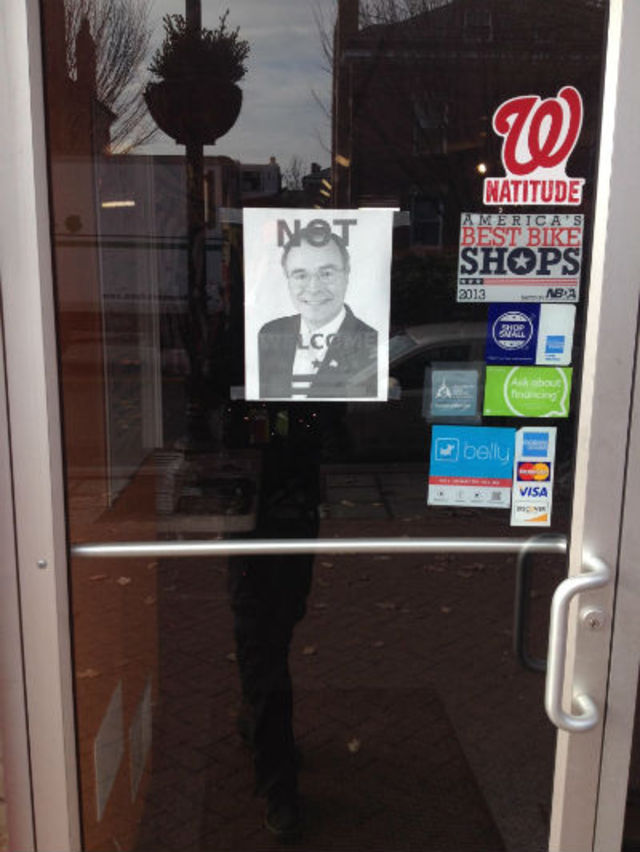
At least one business, Capitol Hill Bikes along Barracks Row, put up a sign displaying Harris’s face with the message “Not welcome.”
While it’s doubtful that Harris would be found shopping at a bike shop in D.C., it’s reasonable to assume that at least his staff eats at establishments near the Capitol and House office building.
So can D.C. businesses really refuse service to Harris and his staff?
A spokesperson for the Department of Consumer and Regulatory Affairs, which regulates businesses in D.C., said this question doesn’t come under their jurisdiction. A spokesperson for the D.C. Office of Human Rights provided this answer:
In the District, businesses may not refuse service to people based on any of the 18 traits protected from discrimination in public accommodations. One of the traits protected from discrimination is political affiliation. Typically that trait has been interpreted as membership in or support for a political party, though it might also include a connection to particular political issues. As always, if individuals believe that they are being discriminated against based on any of the traits protected in the DC Human Rights Act, we encourage them to file a complaint with our office and we will consider all the facts in our investigation.
Harris has framed the issue as a political one, writing in a Washington Post op-ed, “We believe that Congress must defend the federal government and the U.S. Constitution by preventing marijuana legalization from moving forward in the District.” But advocates for D.C. autonomy and statehood see the meddling as an issue of basic democracy.