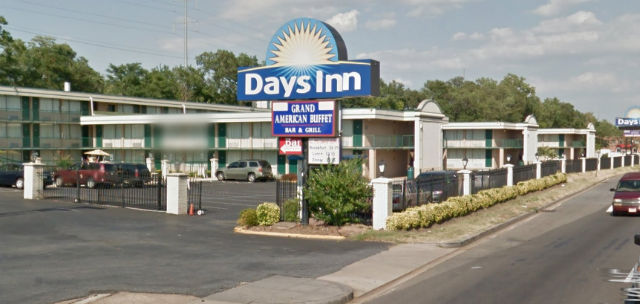
 Via Google Maps.
D.C. is now housing homeless families in a Northeast D.C. motel as exits from shelter slowed in November.
At the final Interagency Council on Homelessness meeting of the year, an official from the Department of Human Services said 477 families had been placed in some sort of shelter between the beginning of hypothermia season, November 1, and December 13.
All 248 units at D.C. General, the city’s largest family homeless shelter, are full, as are the city’s other 170 permanent units for families. That means that 59 placements have been made at the Days Inn on New York Avenue as of December 13. The ICH’s Winter Plan predicted that 840 families would seek shelter between November 1 and the end of March.
Through two agreements, D.C. has secured 260 overflow units at motels, including 170 at the Days Inn. The other agreement, at a hotel that has not been publicly named, allows for an additional 50 units on top the 90 secured.
About 64 families were exiting shelter per month during the summer, but that number slowed around 50 between November 1 and December 12.
Deborah Carroll, the interim director of DHS, said her department is working to find out how DHS can improve and “build upon what we accomplished over the summer.”
She blamed the “slippage” partially on the additional capacity at the shelters and the added “drain on resources” that brings.
The two overflow motels will be operated by the Community Partnership for the Prevention of Homelessness, which runs D.C. General, like a shelter, with breakfast and dinner provided.
Carroll said they are “augmenting security” at the Days Inn in addition to existing security. The Metropolitan Police Department will also provide additional patrols, according to Carroll.
Michelle Williams of DHS declined to provide additional details on the security changes to DCist, directing questions to a spokesperson. A request for comment was not immediately returned.
D.C. has relied heavily on rapid rehousing, which provides a housing subsidy for up to a year, to house homeless families. Carroll said some families face issues with a lack of or bad credit, as well as a lack of work and rental histories.
She said improvements have been made with getting families to attend housing fairs. Families are no longer required to have their assessments finished before attending these fairs, she said. The Office of Human Rights also now provides training to staff and clients on
housing discrimination, she said, “so they know it when they see it.”
“The stock is there,” she said of rapid rehousing units. “Now it’s about identifying families and getting them matched up.”