For many fans of D.C. United, the “light at the end of the tunnel” became a mirage a long time ago.
And who could blame them? They’ve stuck with the club for nearly a decade as United searched for a soccer-specific home of their own, and have watched as nearly every other club in Major League Soccer got one. Through a pair of stalled stadium deals and a host of owners, United’s fan base has remained loyal — albeit a bit jaded — patiently waiting for a stadium deal fall into place.
That finally happened on Wednesday morning.
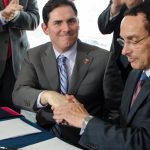
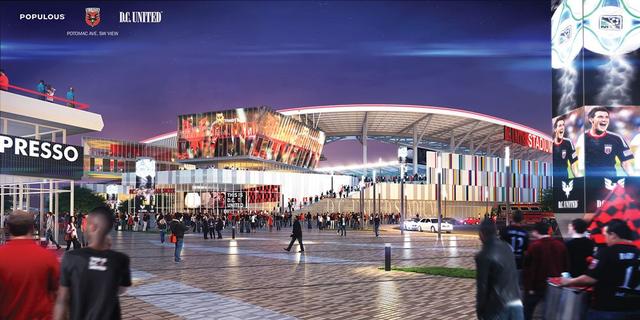
In a packed Council chamber, where most in attendance seemed to be sporting the red and black colors of the team they’d come to support, the mirage became very real. The D.C. Council passed the District of Columbia Soccer Stadium Development Act of 2014 — and did so unanimously — paving the way for construction of a 20,000-seat, soccer-specific stadium on Buzzard Point in Southwest D.C.
“I would say that we’re thrilled with the outcome here today, deeply humbled and appreciative of the city Council, Mayor-elect, current Mayor Gray, Allen Lew in the City Administrator’s office,” D.C. United Managing Partner Jason Levien, who played point on the stadium push, said. “This was a collective team effort between the club, city and fans who led this charge. … The club has been at this for more than a decade and today is a terrific moment for soccer in the United States.”
The approval comes after nearly two years of negotiations between the parties involved, and while the main principles of the deal have remained the same — the city pays for the infrastructure associated with the stadium while United pays for the building itself — the details had become the subject of much debate over the past few months.
At the center of the discussion were a series of land swaps, the largest of which would’ve seen the city trade away the Reeves Center — a government complex in the city’s bustling U Street corridor — for much of the land needed to build the stadium. Several Councilmembers and a handful of citizens raised concerns about the swap, suggesting that the city might be getting the short end of the stick, fears that were confirmed when an independent study ordered by the Council reported that there was a major discrepancy in the assessed value of the sites. Even Levien felt the doubt creeping in.
“There were many [moments of doubt,]” he said with a chuckle. “We’ve been at this for 29 months. I felt a real confidence when we first took over the club. You could sense that the city and current Mayor were committed to this. There have been a lot of hills and valleys, though, in the last 29 months, and there were moments where we weren’t as optimistic as we’d like to be, but you stick with it. It’s a testament to the work that we did that we got a unanimous vote on this.”
Convinced that the deal would not pass in its current form, Mayor-Elect and Ward 4 Councilmember Muriel Bowser led a charge to re-shape the deal, eliminating the largest of the land swaps entirely while keeping the smaller ones. Instead of dealing the Reeves Center to Akridge — the private developer that owns a good deal of the land at Buzzard Point the city needed to acquire — the city would now borrow some $62 million (eventually bumped up to $106 million) and spend $37 million in existing funds to help finance their $139 million contribution to the deal.
A $7 million sales tax abatement was also removed, while $43 million in sales tax abatements remained; though D.C.’s contribution is “capped” at $150 million, the cap only applies to land and infrastructure costs. The tax breaks bring D.C.’s potential contribution closer to $200 million.
A community benefits package — adding a Circulator route to include the stadium site and funding programs to help link residents of Buzzard Point with stadium-related jobs — found its way into the deal, helping to calm some who feared the effect the stadium would have on locals.
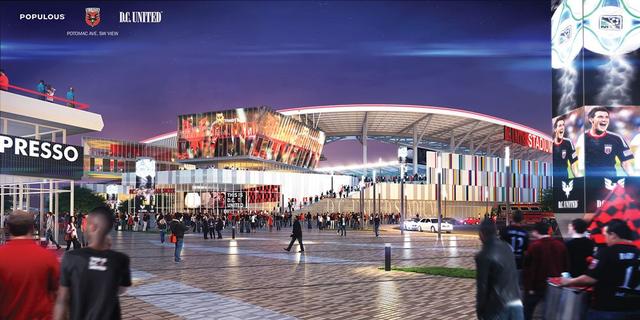 (Populous/DC United)
The revised deal passed the Council’s initial vote on December 2 unanimously. Mayor Vincent Gray initially balked at the idea of re-shaping the deal, expressing concerns that submitting a supplemental budget would open the city up to “add-ons” and other unrelated expenses and declaring it “illegal.” Within a week, Gray and Council Chair Phil Mendelson worked those kinks out, setting the stage for Wednesday’s passage.
The only dissenting voice this morning came from Councilmember David Catania, who raised concerns about the actual cost of the package, suggesting that over the next 30 years the deal would end up costing the city upwards of $400 million. He also suggested that funding the soccer stadium would siphon funds away from other planned projects — two new middle schools, for one — and that the city would have to find that money elsewhere in the coming years. After expressing those concerns, Catania voted to pass the legislation.
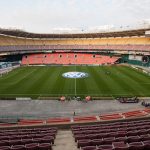
United, of course, currently play their home games at RFK Stadium, a 53-year-old venue high on charm but short on amenities. The oversized venue and the terms of the lease the team signed to play there make turning a profit impossible for the club. The same independent report which cast into doubt the land swaps also shed some light on the team’s financial peril: United lose an estimated $7 to $10 million a year.
“You’d see all of these other stadiums pop up,” Olsen said, “and there was a little jealousy. But it was more excitement that the league was growing. You knew that eventually, when we got our stadium, it would be one of the best places to play in this country.”
Though the deal has been passed, there’s still one sticking point: Akridge is far from happy to have had the rug pulled out from under them and has little incentive to cut the city a deal on that plot of land. The city has authorized the use of eminent domain if necessary. Outgoing City Administrator Allen Lew suggested last week that he’s confident D.C. can stay under their $150 million “cap” even if Akridge puts up a fight.
And there’s certainly collateral damage, as there is in any major city project: the community farm at First and K streets NW — known as the Farm at Walker-Jones — will be turned over to Pepco in one of the smaller land swaps which remained in place. The site will most likely be developed into a substation in the next year or two, casting doubt on the future of the farm itself.
But there was little room for skepticism in Council chamber on Wednesday morning. The mood was celebratory, in no part due to the bevy of United fans who attended the hearing, bringing much of the same energy and enthusiasm to the proceeding that they’ve brought to United games in the home they’ll soon be leaving. If all goes to plan, United will look to break ground on the stadium in “late 2015,” according to Levien, and will take the field in their new home sometime in 2017.