The number of people riding bikes in D.C. continues to rise, which brings with it an increased number of injuries.
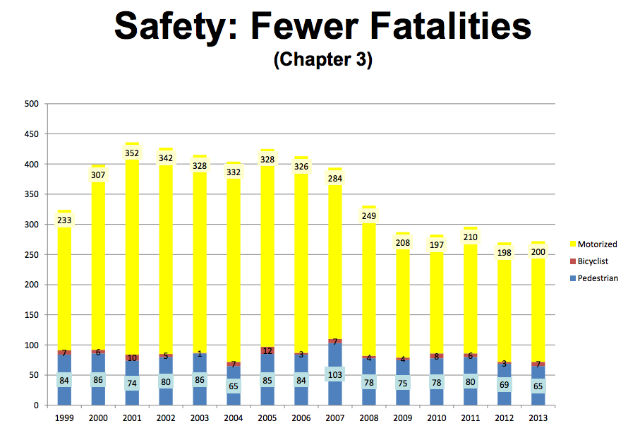
And while fewer motorists and vehicle passengers are dying now thanks to “improved occupant
protection and vehicle design,” “comparable progress for people outside motor vehicles” has not been made in the region, according to a report [PDF] from the Metropolitan Washington Council of Governments’ transportation planning board.
“As the population of carless immigrants and poor people grows in suburban areas that were designed for driving, pedestrian and bicyclist safety will remain a challenge,” the report, presented this week, states. “Bicycling mode share has increased sharply in the last four years, most notably in the District of Columbia, and that increase has been associated with increased numbers of injuries.”
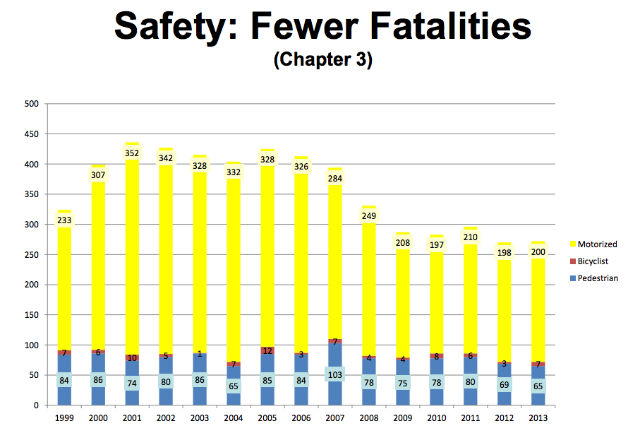 From a report presented by Jim Sebastian of DDOT.
In D.C., 14 pedestrians and cyclists were killed in 2013, while 1,283 were injured in 2012. “Pedestrian fatalities have fallen slightly, but have increased as a percentage of the total” in the region, the report states. “Bicyclist injuries have increased – both in absolute numbers and as a percentage of total.”
While facilities for cyclists and pedestrians are improving in D.C. and parts of the region, the ethnicity of pedestrian who is being hospitalized most often hasn’t changed. From this year’s report:
There are large differences in the rates of hospitalization for pedestrian injury by ethnicity. The rate of hospitalization per 100,000 population for pedestrian injuries for Hispanics is nearly three times as high as that for Whites, and twice that for African-Americans.
Geographically, the highest rates of hospitalization are found in the area east of the Anacostia river in the District of Columbia, most of Prince George’s County inside the beltway, the Columbia Pike corridor in Arlington, the area between Fairfax City and Falls Church in Fairfax County, and Dumfries in Prince William County.
As was pointed out on Twitter, that same language, which cites a 2005 study, was also in a 2006 MWCOG report. So was the below paragraph:
Data from the Washington region indicate that drivers are about as likely as pedestrians to be at fault in a crash. Drivers were cited for a violation in about half the crashes. Males aged 25 to 34 are most likely to hit pedestrians, while pedestrians who are hit are most likely to be males aged 25 to 44. Pedestrian crashes are most likely to occur at the
evening rush hour, 5-7 p.m., with 6-9 a.m. the second most likely. Alcohol is a serious
problem for both pedestrians and motorists, affecting approximately one third of crashes.
The report does not specify why exactly pedestrian hospitalization is worse east of the Anacostia River. To my knowledge, such a report specifically about that does not exist. The MWCOG report generally states:
The region’s most dangerous areas for walking have high-speed roads and poor pedestrian facilities, together with people who lack automobiles. Lower vehicle speeds in the urban core are a likely cause of the lower fatality rates there.
… while a 2014 report from Smart Growth America states:
The majority of pedestrian deaths occur on roadways that are dangerous by design —engineered and operated for speeding traffic with little to no provision for the safety of people walking, biking or using public transit. One of the biggest culprits is the arterial. Rockville Pike or Route 1 are examples of arterial roads that have both local businesses and destinations that attract pedestrians, while also trying to move regional traffic through at high speeds. This type of design is especially dangerous for pedestrians: in Maryland, Virginia, and D.C., a majority of pedestrian deaths occurred on high speed arterials.
We’ve reached out to the D.C. Department of Transportation for more insight.