 Photo by Jim Havard.
Another year down and here we are, still without voting rights, even though more people live in D.C. than in Wyoming and Vermont. And this year we really felt the full weight of what that means, with Congress nearly blocking marijuana decriminalization and (thus far) completely blocking marijuana legalization, which about 70 percent of District voters voted in favor of.
But beyond the turmoils of marijuana policy, it was, without question, a turbulent year in the District. We lost our mayor-for-life, Marion Barry. Eight-year-old Relisha Rudd, who disappeared last March, is still missing, leaving a trail of unanswered questions and serious concerns about the state of our homeless shelters. The H Street NE-Benning Road Streetcar, which was supposed to begin service by the end of the year, is likely not going to happen. We had such a terrible turnout for the last primary election that it was moved back to September. And on and on it goes. It was, without a doubt, a rough year.
But it wasn’t all bad! We’ve got a new soccer stadium coming that most people are happy with, the Fort Reno concert series was saved, and the D.C. Ferguson movement demonstrated what a disruptive—but peaceful—protest looks like. And then there’s the absolute WTF moments, like when Forbes named us the “Coolest City In America.” Yeah, remember that?
With 2014 coming to a close, your DCist editors look back at a year’s worth of good, bad, and weird local news.
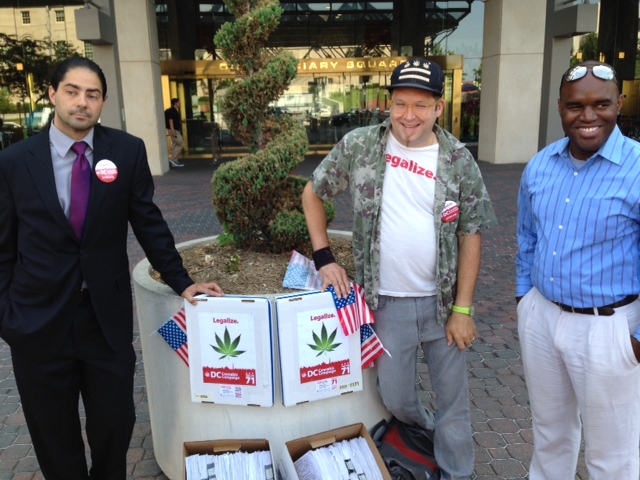 L to R: D.C. Cannabis Campaign’s Nikolas Schiller, Adam Eidinger, and Dr. Malik Burnett outside the D.C. Board of Elections. Photo by Matt Cohen.
Marijuana
2014 was both the best and worst (more on that later) year for marijuana policy in D.C. Last March, the D.C. Council passed—albeit with some significant changes—a bill to decriminalize the possession of small amounts of marijuana. The bill, which became law over the summer, says that anyone caught with less than two ounces of pot will be punished by no more than a $25 fine. Add that to the November general election where nearly 70 percent of District residents voted on a ballot initiative to actually legalize small amounts of pot for personal use, and it was a very good year for pot and social justice advocates. — Matt Cohen
Smooth November Election
The April primary election was something of a disaster. Not only did it have one of the lowest voter turnout rates in a long time, but problems with the D.C. Board of Elections’ voting machines on the night of the primary caused issues for voters. All things considered, November’s general election went pretty smooth. Election results came in at a relatively early hour and there were no significant problems to report, other than, you know, that whole flag thing (more on that later, as well). — Matt Cohen
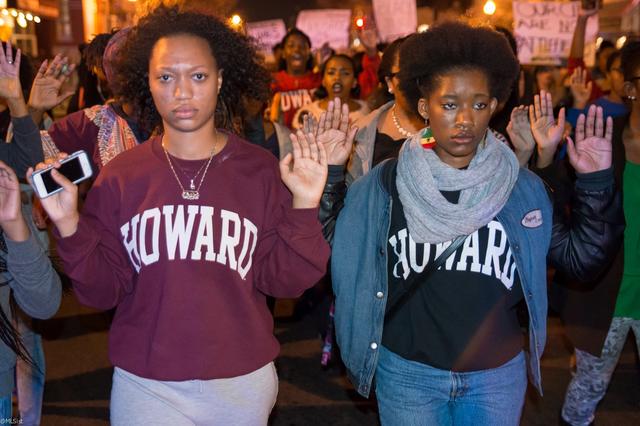 Photo by Pablo Maurer.
The Peaceful, But Significant D.C. Ferguson Demonstrations
The decision from a pair of grand juries to not indict two white cops in the deaths of two unarmed black men, Michael Brown and Eric Garner, sparked nationwide protests and demonstrations as the state of institutional racism in the country reached a boiling point. While some parts of the country broke out in violence and vandalism, the movement that evolved in D.C.—D.C. Ferguson—has regularly proved what peaceful civil disobedience looks like. With regular demonstrations and marches that have made splashes within the city without ever turning violent—the Metropolitan Police Department made no arrests in relation to the demonstrations, and protesters were allowed to march in the streets—the D.C. Ferguson movement set a precedence the rest of the country should follow. And don’t expect it to die down anytime soon, the well-organized movement already has events and demonstrations planned well into the new year. — Matt Cohen
D.C. United Soccer Stadium Deal
While this project could easily make our “worst” list next year, we’re opting to be hopeful. After over a year of debate, the Council passed a bill that will pave the way for a D.C. United stadium to be built at Buzzard Point in Southwest. The final agreement includes a community benefits package, with promises from officials that no affordable housing will be lost because of the stadium. Not included in the final bill was a land swap agreement with developer Akridge for the Reeves Center at 14th and U streets NW, long a sticking point for some Councilmembers. The deal is good news for soccer fans in D.C. and, we hope, will be good news for the people of D.C. —Sarah Anne Hughes
The Year Fort Reno Almost Wasn’t
After some discussion between the organizers of the annual summer concert series and the National Park Service soured, it was looking like this would be the first year since 1968 Fort Reno concerts wouldn’t happened. Luckily, it all worked out and, save for two rained out shows, it did happen. It also had some of the biggest crowds I’ve seen in years. Here’s hoping the 2015 season happens without a hitch. — Matt Cohen
Relisha Rudd
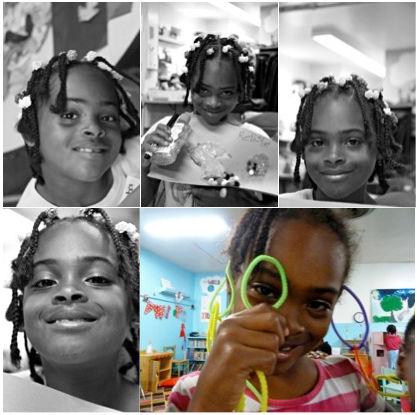 Missing Relisha Rudd. Via MPD.
On March 20, the Metropolitan Police Department issued a missing person bulletin for an eight-year-old child last seen in the 1900 block of Massachusetts Avenue SE. The address jumped out immediately: It’s the address for D.C. General, where hundreds of the city’s homeless families live. What followed after is a nightmare. The missing child, Relisha Rudd, had actually been missing for three weeks, last seen in the custody of shelter janitor Kahlil Tatum at a Northeast D.C. motel. The day after Rudd’s disappearance was made public, Tatum was charged with murdering his wife. Ten days later, Tatum’s body was found at a D.C. park. Relisha is still missing and feared dead, although D.C. police and community members are not giving up hope.
Relisha’s disappearance set off an investigation of D.C. agencies who had contact with the girl’s family and put a renewed focus on the city’s family homelessness crisis. While the city eventually concluded it could not have prevented her disappearance, agencies like the Department of Human Services did institute recommended changes. The child has become a symbol of the city’s failures, with promises to protect the “other Relishas.” —Sarah Anne Hughes
Mayor Gray’s Legal Troubles Continue
Just one year after taking office, the Washington Post reported that Mayor Vince Gray’s 2010 campaign was under federal scrutiny. By March 2014, Gray was being accused in open court of having knowledge of a $660,000 “shadow campaign” conducted on his behalf. The accusation came from businessman Jeffrey Thompson, who pleaded guilty to to orchestrating the illegal fundraising for Gray and other D.C. candidates. Gray, as he had before and continues to do, denied wrongdoing, but the damage was done. With one month before a Democratic primary, the threat of an indictment was hanging over Gray and he lost to Councilmember Muriel Bowser. Nine months later, the U.S. Attorney’s Office has yet to indict Gray, although the Post reported in November that an indictment is coming. Regardless of the outcome, the scandal has further damaged D.C.’s reputation, providing ammunition for autonomy and statehood opponents. —Sarah Anne Hughes
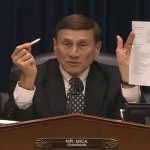
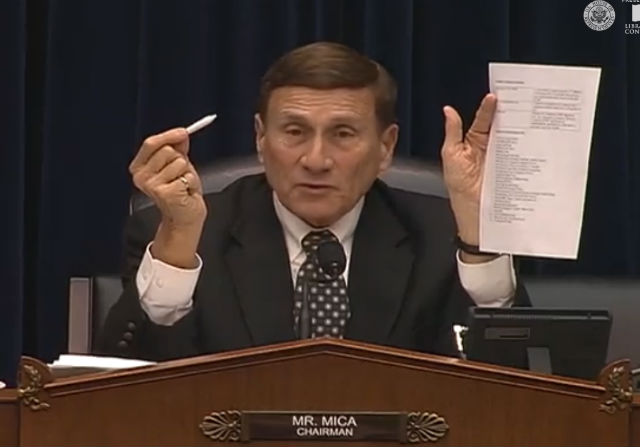 Rep. Mica with a fake joint. Via CSPAN.
Marijuana
Just as it was a good year for marijuana policy in the District was it also a terrible one. Sure, the marijuana decriminalization law was eventually passed, but not without some serious trouble from our best bud, Rep. Andy Harris. So it’s not entirely surprising that Harris and the GOP would introduce an amendment in an omnibus spending bill to prevent D.C. from legalizing marijuana. But what is surprising is how the House democrats seemed to just let it happen without much of a fight. Another year, another cold reminder of our lack of voting rights. Sigh. — Matt Cohen
Terrible Primary Election
The November general election looked so good mostly because of how terribly the primary went. With the lowest voter turnout rate in years, the primary was so dismal that it caused the D.C. Council to vote to move it back to September. Yeesh. — Matt Cohen
The Streetcar Gets Off Track
In 2013, the streetcar was placed under the “best” category on this list. After years (and years and years) of promises, streetcars finally arrived on H Street and Benning Road NE to begin testing, with the start of passenger service promised for 2014. That will probably not happen, another deadline missed with public support continuing to erode. The issues that faced the 2.4-mile line led the Council to cut funding for future streetcar lines, with the system’s future up in the air. —Sarah Anne Hughes
The Death of Marion Barry
You can say a lot of things about mayor-for-life Marion Barry, but you can’t say he didn’t matter to this city. For better or for worse, Marion Barry lived, breathed, and was D.C. His passing in November left a big hole in the heart of the city and as many vie for his Ward 8 Council seat, one thing is for sure: D.C. will never have a politician like him. — Matt Cohen
The Rabbi Voyeurism Scandal
Barry Freundel, the Georgetown rabbi accused of voyeurism, ripped a big scar in D.C.’s Jewish community. As investigators are still working to uncover just how deep his voyeurism—he allegedly set up hidden cameras in a spiritual bathing area called a “mikveh,” the unsettling nature of the crime makes us question how safe we are in our places of worship, which, arguably, should one of the most comforting places in our lives — Matt Cohen
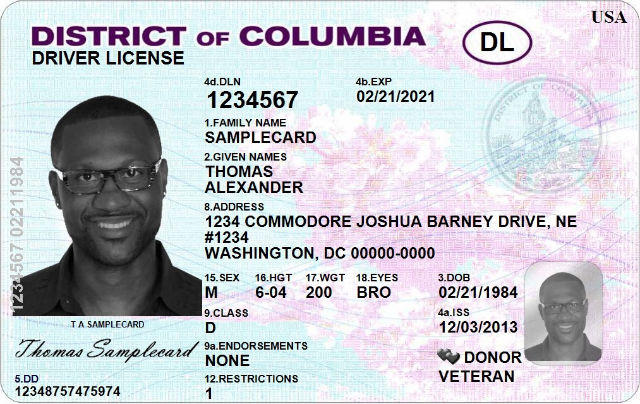 Courtesy D.C. Department of Motor Vehicles.
New Hampshire Rejects D.C. License
The people of D.C. do not have full representation in Congress, but they are, believe it or not, citizens of the United States of America. One liquor store clerk in New Hampshire was apparently not aware of that when he rejected journalist Travis Mitchell’s D.C. license. The New Hampshire Liquor Commission eventually clarified that D.C. residents live in the U.S. and can buy alcohol, but the insult still stings.
This was not the only time a D.C. resident’s license was questioned as actual identification this year. A Transportation Security Administration agent in Phoenix was unsure whether she could accept a D.C. license as ID, an event that was repeated later this year in Orlando. Statehood now. —Sarah Anne Hughes
The Olympics in D.C.
Hosting the Olympics in Washington, D.C. is not that weird of an idea. It is, after all, the capital of the United States. What is weird is the way Washington 2024 — the group of business, sports and community leaders dedicated to bringing the summer Olympics to the D.C. area — has gone about making the bid. Between the lack of community meetings, hand sign and #ThisTown video featuring Newt Gingrich, the group is not doing much to secure the goodwill of residents who may have to put up with the games. —Sarah Anne Hughes
D.C.: Coolest City in America
Forbes named D.C. the coolest city in America this year. Wait, what? — Matt Cohen